libertarians on abortion

Mollie Hemingway does an excellent job defending unborn babies. Note that the creepy and weird Ronald Bailey is the same one that wrote an article suggesting only to mock creationists. Yeah, a real gem for libertarians:


Video streaming by Ustream

Posted in Abortion, videos | Leave a comment

bruce ware gets something right

From Their God is Too Small, by Bruce Ware:

We read, “Then the LORD said, ‘Because the outcry against Sodom and Gomorrah is great and their sin is very grave, I will go down to see whether they have done altogether according to the outcry that has come to Me. And if not, I will know” (vv. 20-21, emphasis added). Open theists insist that language about God learning from what happens ought to be taken “literally” or in a “straightforward” manner. Well, consider what we would end up with from this passage if we follow this openness approach. First, we would have to deny that God is omnipresent (i.e. , everywhere present), because God says that he has to “go down to see” if what he has heard is true. This indicates, on a “straightforward” reading, that until God gets to Sodom, he cannot know whether the reports he has heard are correct. Second, we would have to deny that God knows everything about the past, for he has to confirm whether the Sodomites have done these horrible things. Evidently, then, God does not know whether what he has heard about their past actions is true, so he doesn’t know the past perfectly. Third, we would have to deny that God knows everything about the present. Because he has to go down to see, God doesn’t know right now whether the reports are true. [Ware’s italics changed to bold for formatting reasons]

Ware’s logic is sound. A straightforward reading of Genesis 18 means all those three things. Ware admits as much.

Open Theism

Posted in Bible, Calvinism, God, Omnipresence, Omniscience, Open Theism, Theology | Leave a comment

anthropomorphisms

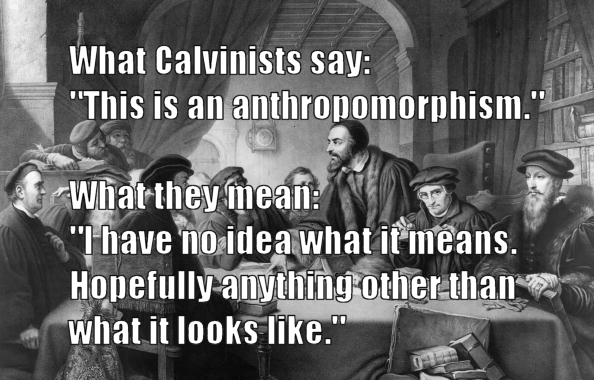
When Calvinists call verses anthropomorphic, it is always good to point out that they cannot even define anthropomorphism intelligibly. From Beyond the Bounds: Open Theism and the Undermining of Biblical Christianity:

Bruce Ware offers a working definition of anthropomorphism: “A given ascription to God may rightly be understood as anthropomorphic when Scripture clearly presents God as transcending the very human or finite features it elsewhere attributes to him.”

This is not a definition in any sense of the word, not even a “working definition”. This actually just describes Calvinists methodology of when to call verses anthropomorphic. This does not tell the reader what an anthropomorphism actually does or how it is used. It fails to describe anything. A proper definition describes what the idiom accomplishes. Take for example a hyperbole:

Hyperbole is the use of exaggeration as a rhetorical device or figure of speech. It may be used to evoke strong feelings or to create a strong impression, but is not meant to be taken literally.

When a hyperbole is used it is an exaggeration used to evoke strong feelings. If I said “I am so hungry that I could eat a horse”, what I am communicating is that I am hungrier than usual. There is no equivalent definition for anthropomorphism. When an anthropomorphism is used, what is it and what does it do? From the same book, a second attempt to define anthropomorphism:

Therefor, I propose the following definition of anthropomorphism, a definition that emerges from the soil of Scriptures: Because God formed Adam from the “dust of the earth” and breathed into his nostrils the breath of life, making him in his own image and likeness, God makes himself known to his creatures in their likeness, as if he wears both their form and qualities, when in fact they wear his likeness.

So what the author is saying is that an anthropomorphism is a verse that means the opposite of what it says. When the Bible says God repented of making man, it means God never repents but man repents of other things sometimes. When God repents of making Saul the king, it means God never repents but man repents of other things sometimes. This is not a intelligible definition. It does not explain what the reader is to understand from the text or how the reader is to gain any semblance of reality from the idiom. When God is said to repent, the Calvinist responds by saying God never repents. Anthropomorphisms then, are just “meaningless statements” that communicate nothing to the reader.

If the Open Theists were to make up a word “petramorphism” and then just claim each verse that the Calvinists use for “immutability” was merely a “petramorphism”, no one would take the claim seriously. But Calvinists make up a concept foreign to human language, impose it on any verse that contradicts their image of God, and they are allowed to get away with it.

If a verse is idiomatic, it has meaning.

Gen 6:6 And it repented the LORD that he had made man on the earth, and it grieved him at his heart.

What is the author communicating to the reader?
What should the reader understand from this?
What is the context of the verse and does the idiom make sense in context?
Are there any other contextual statements that reinforce idiomatic interpretation?

Do not let Calvinists get away with calling verses anthropomorphisms.

god is open

Posted in Bible, Calvinism, Figures of Speech, God, Immutablility, Open Theism, Theology | 4 Comments

repent is a figure of speech

Throughout the Old Testament the Bible uses the word “repent”. God is said to repent. People are said to repent. The Hebrew word used is nacham. This word literally translates to “sighs heavily”.

In the English language, we also have idioms for repentance: “My boss did a 180 this morning about his position on smoke breaks”. “180” refers to the degrees it takes to turn around. Turning around might be physical, but it can be idiomatically applied to mental activities. No English speaker would assume that the boss in the example would physically turn around.

In the Hebrew language this image of someone “sighing heavily” figuratively meant repentance. When someone makes a deep mistake and wishes to change their actions, they might deeply sigh. This deep sigh was a sigh of exasperation, indicating a change of heart and change of actions. As a result, the Bible uses the word to idiomatically symbolize repentance.

See also, Calvinist Lies.

Posted in Bible, Figures of Speech, God | Leave a comment

the gospel of babies

As Christians, it is our duty to proclaim to the world the gospel of babies. Babies are a blessing. God loves babies, and God holds particular love for the innocent.

We see God’s love throughout the Bible. In Exodus, God gives the death penalty to negligent homicide of the unborn baby.

Exo 21:22 “If men fight, and hurt a woman with child, so that she gives birth prematurely, yet no harm follows, he shall surely be punished accordingly as the woman’s husband imposes on him; and he shall pay as the judges determine.
Exo 21:23 But if any harm follows, then you shall give life for life,

Some people claim that this does not refer to the unborn baby, but the text is very clear. A woman has a premature birth and the text links this to the harm that may follow. The birth causes the assailant to pay restitution. But Exodus adds, if any harm follows (as opposed to “no harm” against the unborn baby), then it is a “life for a life”. Killing unborn babies, even accidentally, was a capital crime.

Elsewhere, when God sees Israel sacrificing their own children to a false God, He laments that their actions are so evil that He never even imagined they would do such a thing:

Jer 19:5 (they have also built the high places of Baal, to burn their sons with fire for burnt offerings to Baal, which I did not command or speak, nor did it come into My mind),

All major versions of the Bible were translated by Calvinists, and their dedication to Calvinism masks the true force of this verse with jumbled language. But God is proclaiming the deepest sorrow, hurt, and rage. He next proclaims that because of this (and other sins) He would slaughter them all:

Jer 19:6 therefore behold, the days are coming,” says the LORD, “that this place shall no more be called Tophet or the Valley of the Son of Hinnom, but the Valley of Slaughter.

Elsewhere in the Bible we see God working with babies in the womb. God is said to have formed David in the womb. Jeremiah was called by God when yet unborn. John the Baptist is said to have leapt in the womb. Unborn babies are personified because they are valuable people. God loves babies.

However, modern Americans tend to hate babies. One or two children are seen as ideal. More than that, people receive glares, ridicule, and negative comments. “Wow, I am glad I am not the mother.” “You do know how babies are made, right?” “You must be Catholic.”

The perception of babies is a perception of “users” or “leaches”. Each additional baby is seen as an extra polluter or an extra consumer. Government programs are instituted to control population. Various classes of people are encouraged not to have children.

So how, as Christians, do we fight this assault on babies?

The first thing Christians must do is fight the stigmatization of children. At all points, encourage people to have children. Explain to people that “waiting to have children” is a terrible strategy that sometimes results in childlessness. If someone has more than three children, offer congratulations and encouraging words. Ask and encourage them to have more. Always point out that no one regrets having a child. In old age, no parent looks back as says “I wish little Susie was never born”.

Even unwed mothers never regret having their child. If an unwed mother is talking to you about the struggles of being unmarried with children, ask if they would undo their decision. They will think of their child, and say they cannot imagine life without their baby. They lose their regrets. When they think of their baby and weigh it against what they gave up, they choose the baby.

Our gospel should be forceful, direct, and strong:

Babies are amazing. They are little people. They are little “you”s that wander around, learning and living. They have their own little thoughts and dreams and desires. You get to watch them experience the world anew. They are creative and innocent. You get to talk to them and teach them. They are precious.

Single mothers. When you find out someone is a single mother, our first response should be happy approval. In this country it is legally permissible to kill your children. A mother with a child chose life. Our eyes should beam because there is another soul alive on Earth, another human being with their own thoughts, dreams, wishes, and desires. This is a beautiful thing. The events leading up to the baby are in the past. They have resulted in this innocent child. Even if we hold scorn for premarital sex, our love of the child should trump our negativity.

Our first questions to unwed mothers should always be about the child. Instead of “how old were you when you got pregnant” ask “how old is your child?”. Focus on the child. What is the baby’s age, gender, name? Women beam with pride when talking about their offspring. We need mothers to feel good about their children.

If critics talk about population, cost, time, or anything else negative about child rearing, they should be pointed to Economist Bryan Caplan’s book: Selfish Reasons to Have More Kids

Never before in all of history have kids been as affordable, valuable, and safe. Children are not as expensive or time consuming as people think they are or make them into. Parents have much less long term effect on their children than they would like to think, so even “bad parenting” is not a concern. Environmental concerns and population concerns are definitely unfounded and easy to refute.

There is no better time in all of history to have children.

Posted in Abortion, Standard of Living | 2 Comments

our amazing standard of living

Three very well written articles on the amazing standard of living we now share:

Don Boudreaux explains that people from the past watching multimillionaires would most likely see as amazing the very things that all Americans have access to:

Do a mental experiment. Imagine resurrecting an ancestor from the year 1700 and showing him a typical day in the life of Bill Gates. The opulence would obviously astonish your ancestor, but a good guess is that the features of Gates’s life that would make the deepest impression are the fact that he and his family never worry about starving to death; that they bathe daily; that they have several changes of clean clothes; that they have clean and healthy teeth; that diseases such as smallpox, polio, diphtheria, tuberculosis, tetanus, and pertusis present no substantial risks; that Melinda Gates’s chances of dying during childbirth are about one-sixtieth what they would have been in 1700; that each child born to the Gateses is about 40 times more likely than a pre-industrial child to survive infancy; that the Gateses have a household refrigerator and freezer (not to mention microwave ovens, dishwashers, and televisions); that the Gateses’s work week is only five days and that the family takes several weeks of vacation each year; that the Gates children will receive well over a decade of formal schooling; that the Gateses routinely travel through the air to distant lands in a matter of hours; that they effortlessly converse with people miles or oceans away; that they can, whenever and wherever they please, listen to a Mozart string quartet, a Verdi opera, or Frank Sinatra singing of romance.

In short, what would likely most impress a visitor from the past about Bill Gates’s life are precisely those modern advantages that are not unique to Bill Gates – advantages now enjoyed by nearly all Americans.

David Boaz shows three snap shots in time of what life was like in the past. Here is one:

The squalor and meanness of [lowland Scottish] life around 1600 [or 1700] can hardly be conceived by a person of the twentieth century. A cluster of hovels housed the tenants and their helpers….A home was likely to be little more than a shanty, constructed of stones, banked with turf, without mortar, and with straw, heather, or moss stuffed in the holes to keep out the blasts….The fire, usually in the middle of the house floor, often filled the whole hut with malodorous clouds, since the smoke-clotted roof gradually stopped the vent-hole. Cattle were tethered at night at one end of the room, while the family lay at the other end on heather piled upon the floor….Vermin abounded…skin diseases…Infectious diseases were propagated readily.

Don Boudreaux explains the increase in the standard of living within his own lifetime:

– In 1965, Howard Hughes could afford to pay someone to unlock his car doors for him.. today, keyless entry and, on many models, automatic opening and closing doors and trunk lids are the norm for automobiles driven by middle-class Americans.

– In 1965, Howard Hughes could afford to talk on the phone for hours to someone hundreds or thousands of miles away… Today, even the poorest American pays no long-distance charges even when making a transcontinental telephone call.

– In 1965, Howard Hughes could afford to equip his house with a large screen, a state-of-the-art projector… Today, nearly every ordinary American can buy a large-screen hi-def television…

– In 1965, Howard Hughes could easily afford to equip each member of his family with an automobile of his or her own… today it’s not unusual for a middle-class American household to have one car each for every person in that household who is at least 17 years old.

… unlike even Howard Hughes in 1965, ordinary Americans in 2014 can correct their vision by wearing soft contact lenses.

Life is amazing. Here is my own account of the massive standard of living improvement in my own life in the last decade.

Posted in History, Standard of Living | Leave a comment

william lane craig debates ehrman

William Lane Craig is said by atheists to be someone atheists should never debate. Atheists self-admittedly get trounced by William Lane Craig. Here is Common Sense Atheist on the matter:

Let me repeat. Craig has done 20+ years of Ph.D+ level research in the two fields he debates, has published hundreds of academic books and papers on both subjects, and has been debating since high school.

So yeah, that’s right. You are not qualified to debate William Lane Craig. Richard Carrier? Austin Dacey? Quentin Smith? Bart Ehrman? You are not qualified to debate William Lane Craig. Louise Antony? Christopher Hitchens? Eddie Tabash? You are not qualified to debate William Lane Craig. Frank Zindler? Gerd Ludermann? Hector Avalos? You are not qualified to debate William Lane Craig… Mark Smith? John Loftus? You are not qualified to debate William Lane Craig.
“Okay, well, is anyone qualified to debate William Lane Craig?”
Nobody comes to mind…

Elsewhere common sense atheist points out that William Lane Craig has won almost all his debates against atheists and then lists them.

Although Christians may not agree with everything William Lane Craig believes, we should take note of his demeanor, his argumentation style, and his systematic way of thinking. Here is William Lane Craig debating famed atheist Bart Ehrman.

Posted in Bible, Bible Critics, Church History, Ehrman, Textual Criticism, videos | Leave a comment

God kills for a bad sermon

One clear Sunday morning my family and I arrived to church to find that our pastor, Pastor John, was away. He was absent due to a recent death of his dear friend. This friend happened to be another pastor, and his funeral was out of town. Needless to say, our youth leader opted to fill in for John while he was away mourning the loss of his dear friend.

Our youth pastor was not a very good public speaker, nor did he speak about anything important. He rambled on for what seemed like hours, drudging through a PowerPoint of cheesy graphics and not-so orthodox clip art to say practically nothing. But at one point our youth pastor decided, in what seemed like a move to advertise the importance of his own sermon, tell the congregation how dearly God wanted him to speak that day.

Being a Calvinist, our youth pastor believed that every action has a purpose. God meticulously controls every detail in order to carry out his will on Earth. With such beliefs, our youth pastor confidently proclaimed that God killed Pastor John’s friend for the precise purpose of letting him preach that day.

My brother and I looked at each other in shocked horror. The youth pastor’s look of utter self-approval left no doubt in my mind that not only he was serious but he believed this was a righteous and holy act from God.

Posted in Calvinism, God, Theology, Vanity | Leave a comment

arminianism and open theism

Arminianism is most commonly thought of as the belief that although God knows the future, God also allows free will in future actions. In this belief, adherents are able to maintain both the Classical attributes of God (such as Omniscience) while also maintaining the Classical attributes of man (Free Will). See the Church Fathers on Free Will.

Open Theism is the belief that God is free to choose not the know the future. In order to introduce Open Theism to people, I often ask: “Can God do anything?” and then follow it up with “Can God choose not to know something?”. When it is put in the manner, people are forced to weigh their conflicting beliefs about God. Is God free to learn new thoughts, create new things, locate Himself where He wants? If not, is God all powerful? Open Theism is about if God is free.

Critics and some Open Theists describe Open Theism as the belief that the future is not set. To me, that is a strange way of defining the issue. After all, isn’t the primary purpose of the Bible to tell us about God? Isn’t the core issue about who God is? I am not an Open Theist due to philosophical reasons or because I am particularly attached to philosophical notions about the future. I am an Open Theist because I believe the Bible is the source of our knowledge about God and the Bible does not present God in the Classical image.

The difference then, between Arminianism and Open Theism primarily comes down to how attached each are to the Classical attributes of God. Arminianism wants to maintain the attribute of Omniscience while trying to maintain the truth of select Old Testament stories about God (in relation to His emotions and appeals to man for repentance). They spiritualize texts that describe God’s surprise about the future, God’s reliance on others (such as when God asked angels for advice in 1 Kings 22), and God’s repentance. They hold as literal God’s emotional outbursts, God’s unending appeal to His people to repent, and God’s blamelessness for evil.

Open Theism, on the other hand, discards the traditional understanding of Omniscience (some Open Theists try to redefine Omniscience in order to maintain use of the word). The philosophical contingent of Open Theists maintain God is more righteous and better understood as Open. The fundamentalist contingent of Open Theism holds that all Old Testament stories about God are true, regardless of the implications. Myself, and select other Open Theists, take it a step farther and claim that if God wants to not know current events, that is His prerogative. For example, if God does not want up-to-the-minute updates on the wickedness of Sodom, He does not have to have it. If God then wants to go see if Sodom is as evil as He hears, He can go do that. There is no alternative figurative meaning to Genesis 18, in which this exact event is described.

Although there is a large contingent of Open Theists that do not take the Bible literally (they do not maintain that the face value communication of the writers to the reader always reflects reality), the more that someone accepts the Bible as literal, the more they have to affirm Open Theism. The case of Sodom being exhibit one.

The difference between Open Theism and Arminianism fundamentalism is how willing one is to spiritualize the text in order to maintain a Classical understanding of Omniscience. The difference between Open Theism and Arminianism spiritualists is how one values God’s interactions with humanity.

Posted in Bible, Figures of Speech, God, Omniscience, Open Theism, Theology | 3 Comments

understanding isaiah 41

In Isaiah 41, there is a section in which God challenges false gods to predict the future:

Isa 41:21 “Present your case,” says the LORD. “Bring forth your strong reasons,” says the King of Jacob.
Isa 41:22 “Let them bring forth and show us what will happen; Let them show the former things, what they were, That we may consider them, And know the latter end of them; Or declare to us things to come.
Isa 41:23 Show the things that are to come hereafter, That we may know that you are gods; Yes, do good or do evil, That we may be dismayed and see it together.
Isa 41:24 Indeed you are nothing, And your work is nothing; He who chooses you is an abomination.

Augustinian Christians point to this as some sort of proof that knowing the future is part of what makes God divine. It is easy to see where they get that conclusion. Verses 21-24 seem to be saying just that. But it is always a mistake to pull verses out of their context.

The previous 20 verses are making a concerted point:

Isa 41:2 “Who raised up one from the east? Who in righteousness called him to His feet? Who gave the nations before him, And made him rule over kings? Who gave them as the dust to his sword, As driven stubble to his bow?
Isa 41:3 Who pursued them, and passed safely By the way that he had not gone with his feet?
Isa 41:4 Who has performed and done it, Calling the generations from the beginning? ‘I, the LORD, am the first; And with the last I am He.’ ”
Isa 41:5 The coastlands saw it and feared, The ends of the earth were afraid; They drew near and came.
Isa 41:6 Everyone helped his neighbor, And said to his brother, “Be of good courage!”
Isa 41:7 So the craftsman encouraged the goldsmith; He who smooths with the hammer inspired him who strikes the anvil, Saying, “It is ready for the soldering”; Then he fastened it with pegs, That it might not totter.

Verses 2-7 inform the reader that God used His power to raise up an powerful army. The text is very clear. The army was powerful and God was responsible. God asks rhetorically: “Who raised one up?” “Who called?” “Who gave the nations?” “Who made him king?” “Who gave them to his sword?” “Who pursued them?” “Who has performed and done it?” The text is all about God’s power. God used His power to affect His plans, to bring them to past.

Isa 41:8 “But you, Israel, are My servant, Jacob whom I have chosen, The descendants of Abraham My friend.
Isa 41:9 You whom I have taken from the ends of the earth, And called from its farthest regions, And said to you, ‘You are My servant, I have chosen you and have not cast you away:
Isa 41:10 Fear not, for I am with you; Be not dismayed, for I am your God. I will strengthen you, Yes, I will help you, I will uphold you with My righteous right hand.’
Isa 41:11 “Behold, all those who were incensed against you Shall be ashamed and disgraced; They shall be as nothing, And those who strive with you shall perish.
Isa 41:12 You shall seek them and not find them— Those who contended with you. Those who war against you Shall be as nothing, As a nonexistent thing.
Isa 41:13 For I, the LORD your God, will hold your right hand, Saying to you, ‘Fear not, I will help you.’
Isa 41:14 “Fear not, you worm Jacob, You men of Israel! I will help you,” says the LORD And your Redeemer, the Holy One of Israel.
Isa 41:15 “Behold, I will make you into a new threshing sledge with sharp teeth; You shall thresh the mountains and beat them small, And make the hills like chaff.
Isa 41:16 You shall winnow them, the wind shall carry them away, And the whirlwind shall scatter them; You shall rejoice in the LORD, And glory in the Holy One of Israel.

Verses 8-16 speak that God will be with Israel. The text again is very explicit that God will save based on His power. “I have chosen.” “I will help you.” “I will make.” “I am your God.” “I will strengthen you.” “ I will help you.” “I will uphold you.” The entire text is about God being powerful and helping accomplish His plans in Israel. This block of text shows a shift in God talking about what He did do (v1-7 to what He will do). The idea is God established His power in v1-7 and now He is making promises for the future which can be trusted basted on that establishment.

Isa 41:17 “The poor and needy seek water, but there is none, Their tongues fail for thirst. I, the LORD, will hear them; I, the God of Israel, will not forsake them.
Isa 41:18 I will open rivers in desolate heights, And fountains in the midst of the valleys; I will make the wilderness a pool of water, And the dry land springs of water.
Isa 41:19 I will plant in the wilderness the cedar and the acacia tree, The myrtle and the oil tree; I will set in the desert the cypress tree and the pine And the box tree together,
Isa 41:20 That they may see and know, And consider and understand together, That the hand of the LORD has done this, And the Holy One of Israel has created it.

The next block of text again focuses on God’s power. God, in this text, points out explicitly that He is predicting, that He will accomplish, and then people can see the results and know God was the cause. As I have written before, prophecy is about power. God being able to affect His plans, shows us not God’s knowledge, but His power. That is what God says in Isaiah 41:20.

It is in this context that the text goes on to compare God to powerless idols:

Isa 41:21 “Present your case,” says the LORD. “Bring forth your strong reasons,” says the King of Jacob.
Isa 41:22 “Let them bring forth and show us what will happen; Let them show the former things, what they were, That we may consider them, And know the latter end of them; Or declare to us things to come.
Isa 41:23 Show the things that are to come hereafter, That we may know that you are gods; Yes, do good or do evil, That we may be dismayed and see it together.
Isa 41:24 Indeed you are nothing, And your work is nothing; He who chooses you is an abomination.

Notice God’s claim that their “work is nothing”. What God is saying is that idols are powerless. God is not comparing knowledge, but power. Although idols have no knowledge that is besides God’s point. Because prophecy is about power, God sees any failed prophecy as a sign of powerlessness. That is His primary claim against the idols, it is not that they are not omniscient.

This exact theme of power and prophecy is repeated time and time again in Isaiah 40-48.

Isa 46:10 Declaring the end from the beginning, And from ancient times things that are not yet done, Saying, ‘My counsel shall stand, And I will do all My pleasure,’

Isa 48:3 “I have declared the former things from the beginning; They went forth from My mouth, and I caused them to hear it. Suddenly I did them, and they came to pass.

God intimately connects His ability to accomplish things with His declared plans. That is what God wants Israel to believe. Prophecy is about power.

Posted in Bible, Calvinism, Dispensationalism, God, Omnipotence, Omniscience, Prophecy, Theology | 7 Comments