soviet grocery store

It is very important to understand the abject poverty that socialism wreaked on its population. Without price incentives, no one produced and no one could buy anything. Lines and shortages were everyday life. Here is video from a Soviet grocery store in 1986:

click here

One movie that everyone should watch is the subtitled foreign film Goodbye Lenin!. It details life from communism to the post communism world embedded in a captivating drama.

Posted in Economics, Standard of Living, videos | Leave a comment

the case against education

Bryan Caplan makes the case against education. He has a forthcoming book on the subject.

Posted in Economics, videos | Leave a comment

Jesus and election

RT-election-experience

1Pe 1:1 Peter, an apostle of Jesus Christ, To those who are elect exiles of the Dispersion in Pontus, Galatia, Cappadocia, Asia, and Bithynia,
1Pe 1:2 according to the foreknowledge of God the Father, in the sanctification of the Spirit, for obedience to Jesus Christ and for sprinkling with his blood: May grace and peace be multiplied to you.

In 1 Peter 2, Peter writes that people were “chosen” or “elect” according to the foreknowledge of God the Father. In the Augustinian mindset, this is some sort of predetermination of people, almost like a guest-list of people that will be saved. But this is not at all how Jesus uses the word “elect”, so we should take caution before believing Peter thought of election in this sense.

Two times in Matthew, Jesus states “For many are called, but few are chosen.” Context is key to understanding this phrase. In both contexts, Jesus illustrates with a parable. In no context does the events indicate the Augustinian interpretation of election.

In Matthew 22 is found the parable of the wedding feast. It is a very interesting story:

Mat 22:2 “The kingdom of heaven may be compared to a king who gave a wedding feast for his son,
Mat 22:3 and sent his servants to call those who were invited to the wedding feast, but they would not come.
Mat 22:4 Again he sent other servants, saying, ‘Tell those who are invited, “See, I have prepared my dinner, my oxen and my fat calves have been slaughtered, and everything is ready. Come to the wedding feast.”‘
Mat 22:5 But they paid no attention and went off, one to his farm, another to his business,
Mat 22:6 while the rest seized his servants, treated them shamefully, and killed them.
Mat 22:7 The king was angry, and he sent his troops and destroyed those murderers and burned their city.

A rich man is hosting a wedding for his son and invites all the guests. The feast is prepared and waiting for the guests. All the guests had to do was show up. The rich man sends out servants to retrieve the guests. The invitation is made on several occasions. Eventually some individuals even kill the messengers; the king extracts swift vengeance on the murderers. They even go so far as to raze the city of the murderers.

The King is to be taken as God in this parable. The servants are to be taken as God’s prophets. The key people invited seem to be the leadership and the upper class of Israel. This entire first part of the parable mirrors much Old Testament literature on God’s vengeance against Israel. Jesus (and the writer, Matthew) are attributing strong emotions to God. God is rejected. God sees His messengers killed. God’s temper flares. God then springs to action, swiftly extracting vengeance. Not only does God destroy the murderers, but God razes their city. The reaction seems a little disproportionate.

God then attempts to build a new guest list:

Mat 22:8 Then he said to his servants, ‘The wedding feast is ready, but those invited were not worthy.
Mat 22:9 Go therefore to the main roads and invite to the wedding feast as many as you find.’
Mat 22:10 And those servants went out into the roads and gathered all whom they found, both bad and good. So the wedding hall was filled with guests.

The banquet is prepared, but was been refused by the normal guests. The king has to change his plan and then outreach to the masses in order to fill his banquet table. He invites anyone and everyone. This parallels the Old Testament concept of God’s remnant. Several times in the Old Testament, God states that He will destroy Israel, leaving a remnant which will be His true people. Jesus could be describing this very concept and coupling it with God’s election.

But just because someone is part of the remnant, this does not mean that they will also not be cut off. Jesus continues. Some who came to the wedding were not suitably dressed:

Mat 22:11 “But when the king came in to look at the guests, he saw there a man who had no wedding garment.
Mat 22:12 And he said to him, ‘Friend, how did you get in here without a wedding garment?’ And he was speechless.
Mat 22:13 Then the king said to the attendants, ‘Bind him hand and foot and cast him into the outer darkness. In that place there will be weeping and gnashing of teeth.’

The King enters the banquet. The banquet hall is filled with an entirely new assortment of individuals rather than had initially been invited. But even though these people were invited off the street, they were still expected to be dressed appropriately. The King sees an individual who is not dressed properly. The King confronts him. The King asks him why he is not dressed appropriately. The guest does not respond. From here, the King binds him and throws him out.

Jesus is saying that although there may be a new people group who replaces the initial people group that even they are not secure in their status. They need to act appropriately. Notice how the King questions the guest. This exchange did not have to be included for the story to make sense. But it does illustrate that the King is willing to entertain a defense from the guilty party. When there is no defense, the King acts decisively. Jesus is saying that people’s own actions dictate their rise and fall. He is rejecting the idea of group privileges.

It is in this context that Jesus states:

Mat 22:14 For many are called, but few are chosen [eklektos].”

In the context, most people who are called reject the calling. The leaders of Israel rejected the calling and even members of the remnant. These people chose to reject God, both killing his prophets and rejecting God’s requirements. The “elect” or “chosen” then are those who accept God’s invitation.

The parable mirrors Jesus’ Gospel of the Kingdom. God reached out to convince mainstream Israel to be saved, but they declined. God reached out to them time and time again. But they responded with rejection and murder of God’s prophets. God then responds by broadening His invitations for salvation, reaching out to all classes of society (Jesus’ primary ministry was to the sinners). Some of these people respond, but not all of them in an acceptable fashion. God casts those individuals out. The remaining are “elect”. Election is not a guest-list filled with approved names. The idea is the exact opposite. Election is about individuals choosing God.

Matthew depicts God as merciful, preparing a free banquet for people to share. God even extends that invitation to strangers. God is shown as dynamic. God innovates solutions when His original intentions do not materialize. God is also shown to be prone to strong emotion, exacting swift and cruel vengeance when He is rejected. God destroys not only cities, but also individuals. God is shown as willing to entertain defenses for slights. God is reasonable. God expects people to choose Him. It is pretty clear that election, in this passage, has nothing to do with the Classical ideas of predestination or omniscience, but is a dynamic process of weeding out the unfit.


Posted in Bible, Calvinism, God, Jesus, Open Theism, Theology | 1 Comment

coke and free market innovation

I am posting the full speech of Coke executive Harry E. Teasley. The entire speech is worth reading. He explains how the free market is the best way to “green” production. He uses aluminum cans as an example:

Today the 12-oz. aluminum beverage can weighs less than 27 lbs/1000, for a reduction in weight of over 85% since I joined The Coca-Cola Company and I can squeeze and crimp it with two fingers… and rip the can apart.

Because Coke strived to cut costs, a pleasant side effect was a massive reduction in materials required to produce their products. This was not a government directed environmental program, but the natural product of innovation and cost cutting.

For full speech, click here.

Posted in Economics, prices | 1 Comment

ikea anthropomorphic lamp commercial

The guy at the end sums it all up nicely:

Posted in Figures of Speech, videos | 1 Comment

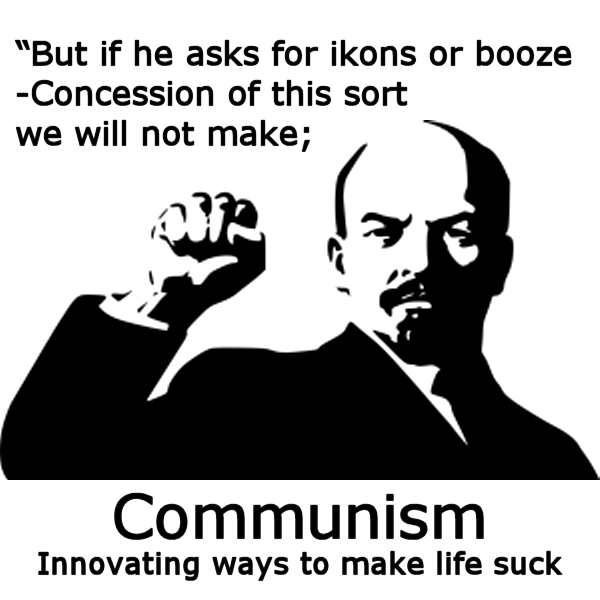
lenin the prohibitionist

Over at Econlog, Bryan Caplan cites a book showing that Vladimir Lenin was against alcohol:

“Whatever the peasant wants in the way of material things we will give him, as long as they do not imperil the health or morals of the nation,” Lenin famously declared late in life. “But if he asks for ikons or booze – these things we will not make for him. For that is definitely retreat; that is definitely degeneration that leads him backward. Concession of this sort we will not make; we shall rather sacrifice any temporary advantage that might be gained from such concessions.”

As I have written before, Lenin was a very evil man.

reality is not optional

Posted in History | 1 Comment

anthropomorphisms depict fiction

In all human cultures, human beings tend to insert figurative language in their everyday communication. It is natural. When someone claims to be “the hand of the King”, we know that they are not claiming to be connected to the King’s arm, graphed into the skin, and hold objects for the King. We associate hands with power and the ability to perform. The “hand of the King” is someone who can accomplish things for the King.

Throughout the Bible, we find these metaphors about God:

Rth 2:12 The LORD repay your work, and a full reward be given you by the LORD God of Israel, under whose wings you have come for refuge.”

In Ruth, God covers people with His “wings”. An eagle will protect its young by covering them with a large wing. Wings mean protection. When God protects His people, likewise He is covering them with His wing. An honest reader would not expect God to have literal wings. An honest reader would not also assume this precludes God from having wings. The text has nothing to do with if God does or does not have wings.

It is interesting that when Augustinian Christians want to explain how an immutable God could repent, they point to verses like Ruth 2:12 to point out figurative language about God. They will then turn to problem texts such as:

Gen 6:6 And the LORD was sorry that He had made man on the earth, and He was grieved in His heart.

or

Gen 18:21 I will go down now and see whether they have done altogether according to the outcry against it that has come to Me; and if not, I will know.”

The problem is that these verses are not metaphors. A metaphor will compare similar concepts in what is being described with what is real. God protects people “with His wing” as an eagle protects its young. God repenting does not associate with “not repenting”. An Augustinian Christian wants the text to describe the exact opposite as what it says. They call this an anthropomorphism.

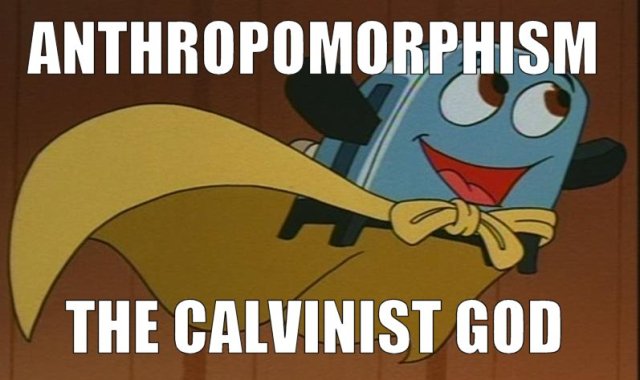
Modern Americans should be well familiar with anthropomorphism. Brave Little Toaster, Pixar’s Cars, and a whole host of movies depict human features on inanimate objects. But the problem is that these depictions are purely fictional for entertainment value. Making a talking toaster is not an “idiom”, it is fantasy. Talking toasters do not exist. Describing a talking toaster does not communicate anything. Even when people say “my computer hates me”, it is a joke. It is a joke because computers cannot hate.

Anthropomorphisms depict fiction! For the Calvinist to claim the Bible is filled with anthropomorphisms is to claim the Bible is filled with fictitious portrayals of God that communicate nothing.

open theism

Posted in Bible, Figures of Speech, God, Immutablility, Open Theism, Theology | 1 Comment

curiosities in the pythian odes

From Pindar’s Pythian Odes, on omnipotence:

God bringeth every end to pass according to his desires. He over-taketh even the winged eagle and passeth the dolphin in the sea; and he bringeth low many a proud man, granting to other glory that grows not old.

Other translations pluralize “god” to “gods”. Did the Greeks think that the gods controlled everything as in fatalism? It would be hard to argue as such. In the Greek religion and in these odes, there is a multiplicity of gods each doing their own will.

On omniscience:

Thou who knowest the final destiny of all things and all the paths thereto; all the leaves that the earth sends up in the spring, and all the sands whirled by the waves in sea and rivers and by the blasts of the winds; thou seest well the future and whence it shall come to pass.

This is about Apollo. Apollo seems to have been omniscient in that he could see the future. In Greek myth/history Apollo used the Oracle of Delphi to propagate his prophecy of the future. His prophecy always came true. The Greeks heavily believed in fatalism.

In Pindar, we are able to read the beginnings of a pantheistic worldview in which all the Greek gods are being merged into one uber-god. Pindar sometimes talks to monotheism/pantheism and sometimes to polytheism. That was the philosophical current of the day.

Posted in Greek History, Omnipotence, Omniscience | Leave a comment

king david and dirty dancing

2Sa 6:14 Then David danced before the LORD with all his might; and David was wearing a linen ephod.

In 2 Samuel, David is returning the Ark of the Covenant to Jerusalem. David dances before God wearing a linen ephod. In popular culture, people believe David danced naked before God, but this is not the case. Apparently, David dressed down from his Kingly garb, into the garb of a priest, and vigorously danced before God. David’s wife chastises him:

2Sa 6:20 Then David returned to bless his household. And Michal the daughter of Saul came out to meet David, and said, “How glorious was the king of Israel today, uncovering himself today in the eyes of the maids of his servants, as one of the base fellows shamelessly uncovers himself!”
2Sa 6:21 So David said to Michal, “It was before the LORD, who chose me instead of your father and all his house, to appoint me ruler over the people of the LORD, over Israel. Therefore I will play music before the LORD.
2Sa 6:22 And I will be even more undignified than this, and will be humble in my own sight. But as for the maidservants of whom you have spoken, by them I will be held in honor.”
2Sa 6:23 Therefore Michal the daughter of Saul had no children to the day of her death.

When David’s wife accusing David of being “uncovered”, we can assume it just means “dressed down”. David was wearing a linen ephod. Some think that David was “only” wearing a linen ephod and that is to what “undressed” refers. Whatever it was, David was acting in the eyes of his wife in an undignified manner and she criticizes him.

Because of her chastisement, God curses her with being barren. God seems to have greatly approved of David’s fervent dancing to Him.

What Christians can learn is that God likes our dancing to Him. We can please God with our praises and actions. We need not worry what others believe is undignified.

Posted in Bible, God, Jewish History, Theology | 1 Comment

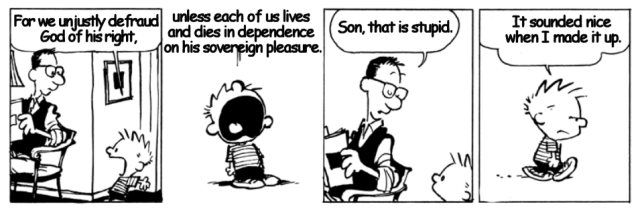
calvin on God’s sovereign pleasure

open theism

Posted in Humor | Leave a comment