repentance in Jonah

There are certain Christians who are well convinced that repentance involves only turning to God and not away from sin. Although that may be the case in some instances, it is not always the case. Take for example Nineveh:

Jon 1:2 Arise, go to Nineveh, that great city, and cry against it; for their wickedness is come up before me.

Jonah is specifically sent to Nineveh due to their “wickedness”. It seems that once a particular city reaches some sort of evilness threshold, God takes action. When God’s prophet finally arrives, he starts proclaiming an imminent destruction:

Jon 3:4 And Jonah began to enter into the city a day’s journey, and he cried, and said, Yet forty days, and Nineveh shall be overthrown.

For some reason the people take this to heart. Their immediate response is to fast and mourn. Once word reaches the King, it is apparent that Jonah’s message implied destruction due to sin. The King responds:

Jon 3:7 And he caused it to be proclaimed and published through Nineveh by the decree of the king and his nobles, saying, Let neither man nor beast, herd nor flock, taste any thing: let them not feed, nor drink water:
Jon 3:8 But let man and beast be covered with sackcloth, and cry mightily unto God: yea, let them turn every one from his evil way, and from the violence that is in their hands.
Jon 3:9 Who can tell if God will turn and repent, and turn away from his fierce anger, that we perish not?
Jon 3:10 And God saw their works, that they turned from their evil way; and God repented of the evil, that he had said that he would do unto them; and he did it not.

It seems the particular problem with Nineveh was not their Godlessness. The problem was their wickedness. The king believes so and the text describes God responding to their turn from wickedness. Either they already believed in God as the one true God (unlikely) or the text doesn’t take issue with the subject.

In short, Nineveh was flagged for destruction based on their sin. Their repentance was a repentance away from sin. God was going to physically destroy them due to this sin.

Applying this to other situations: when Jesus preaches repentance and a coming destruction, it is safe to assume that repentance involves turning from sin.

Posted in Uncategorized | Leave a comment

failed Bible prophecy and power

Prophecy, as I have written before, is primarily about God’s power. God says something will happen and then uses His power to make it come to pass. Prophecy fulfillment is about validating that power. Prophecy is not about knowledge.

In Jonah we find God declaring destruction against Nineveh, but never fulfilling His promise. The text says as much:

Jon 3:10 And God saw their works, that they turned from their evil way; and God repented of the evil, that he had said that he would do unto them; and he did it not.

The text spells it out. God said that He would do something. God repented. God never did it.

If prophecy was about knowledge then this would be a problem. If God was illustrating His grasp of future events, the prophecy of Nineveh is a complete failure. If God knew that the prophecy would never come true, this prophecy would also amount to a lie. God said He would do something, knowing He never would. There is no hint that the prophecy is conditional, and the people are unsure if the prophecy is conditional:

Jon 3:9 Who can tell if God will turn and repent, and turn away from his fierce anger, that we perish not?

Jonah was not preaching a conditional prophecy. Instead, Jonah preached exactly what God told him: In 40 days Nineveh would be destroyed by God. God was going to display His power. The people begged for mercy and this caused God to repent.

Prophecy is not about knowledge. It is about power. In response to God’s prophecy the entire nation turned from their evil. They truly believed God could bring to pass the prophecy. God, then, had no need to show His power. They already believed in it. If they had refused God, God would have used them as an example of His power and a warning to other nations.

Because prophecy is primarily about power, God does not mind when prophecy fails. God is not concerned about what people think of His “prediction” ability. Every time God speaks about true predictions, it is in this context. Every prophecy just assumes the future is not set, and God is actively working to bring about the prophecy. In this sense, each prophecy can be viewed as a blow against traditional omniscience. If God did know the future, His claim would take the form of “I know it will come to pass because I see the future”, not “I know it will come to pass because I will do it.” But the Bible is devoid of the former and filled with the latter.

God is primarily concerned that His power is known and His will be done. Prophecy is a means to an end. If events change, sometimes the prophecy is not needed. God then abandons His own prophecy. Prophecy is not about knowledge, but power.

Posted in Bible, Calvinism, Church History, God, Omnipotence, Omniscience, Open Theism, Prophecy, Theology | 7 Comments

the wayward prophet

In Jeremiah, God explains to his prophet that He selected Jeremiah as a prophet even before he was born.

Jer 1:5 “Before I formed you in the womb I knew you; Before you were born I sanctified you; I ordained you a prophet to the nations.”

The text here is not suggesting that God appointed Jeremiah as a prophet from eternity past. The idea is that right before pregancy or right after conception, God chose Jeremiah as His spokesman. This claim is all a part of a larger attempt to convince Jeremiah to become God’s prophet. Jeremiah is to be impressed with the fact that he is special and chosen. Instead, Jeremiah’s first action is to recoil and ask not to be the spokesman:

Jer 1:6 Then said I: “Ah, Lord GOD! Behold, I cannot speak, for I am a youth.”

God then spends the next few verses convincing Jeremiah to be his spokesman. It ultimately works; God sucessfully recruits His prophet whom he had been grooming for that task. But things do not always work out that way. Sometimes God tells people that they will be His prophet and then they run away:

Jon 1:1 Now the word of the LORD came to Jonah the son of Amittai, saying,
Jon 1:2 “Arise, go to Nineveh, that great city, and cry out against it; for their wickedness has come up before Me.”
Jon 1:3 But Jonah arose to flee to Tarshish from the presence of the LORD. He went down to Joppa, and found a ship going to Tarshish; so he paid the fare, and went down into it, to go with them to Tarshish from the presence of the LORD.

What results is a cat and mouse game where God goes through great lengths to recapture Jonah. God eventually swallows Jonah with a big fish and hauls him to the mission field. Needless to say, God could have chosen a more willing individual, but God was very serious about Jonah being God’s prophet.

Jonah never experiences a change of heart. Jonah remains bitter. He preaches against Nineveh, but burns in anger against God. God has impressed him into service, deposited him in a hostile nation, and then denies Jonah the satisfaction of seeing Nineveh destroyed:

Jon 4:1 But it displeased Jonah exceedingly, and he became angry.
Jon 4:2 So he prayed to the LORD, and said, “Ah, LORD, was not this what I said when I was still in my country? Therefore I fled previously to Tarshish; for I know that You are a gracious and merciful God, slow to anger and abundant in lovingkindness, One who relents from doing harm.
Jon 4:3 Therefore now, O LORD, please take my life from me, for it is better for me to die than to live!”

It seems that the theme of Jonah is to show God’s benevolence and power.

Illustrating God’s power: Against a prophet’s wishes, God can coerce them into prophesying. God can counter their resistance and have His will ultimately prevail. Even with a reluctant prophet who takes extreme action to evade God, God can force them to prophesy. This is not robotic control, God is not overriding their free will and moving their mouths. Instead God impresses the consequences of disobedience.

As to God’s benevolence: God will pardon Israel’s enemies based on their behavior. This is exactly what God declares He will do in Jeremiah 18. God thought He would destroy a nation, they repent, and then God repents. God is not as vindictive as His own prophets. Even if an evil Gentile nation repents, God will show mercy. God displays justice throughout the text. God even illustrates to Jonah the principle of unwarranted anger. The text cuts off with no indication that God’s reluctant prophet, Jonah, took God’s point to heart.

The text shows that although God is powerful, sometimes He shows mercy. If God wanted to destroy Nineveh, He could have just as He forced Jonah into ministry. But the Almighty God chose the route of forgiveness.

Posted in Bible, Calvinism, God, Jewish History, Omnipotence, Open Theism, Prophecy, Theology | 3 Comments

overview of isaiah 40

In Isaiah 40, the Prophet Isaiah is speaking to Israel. Israel had recently gone through punishment. But their time of punishment was over. Using the Old Testament standard of weighted punishments, Isaiah declares:

Isa 40:2 “Speak comfort to Jerusalem, and cry out to her, That her warfare is ended, That her iniquity is pardoned; For she has received from the LORD’s hand Double for all her sins.”

In this part of Isaiah, the punishment has ended and the reunion to God was about to begin. But Isaiah had a real problem. The people needed to be motivated to serve God. What follows is a heartfelt appeal by Isaiah that God is just, God is powerful, and as such, people needed to turn to God.

The text states that in order to become ready of this, Israel must “prepare the way of the Lord”. They are actively sought to reform their current society to make preparations for redemption. In this case, redemption will be through King Cyrus liberating the Jewish people and allowing them to go to back to Jerusalem.

God states that this return to grace will show to the rest of the world (all “flesh”) God’s power. God is said to be coming “with a strong hand”, He will rule, feed his flock, and protect his people. The context of the entire rest of the chapter is God showing people His superiority through metaphors, through comparisons, and through prophecy: the prophecy of Cyrus.

The first main metaphor is about grass. Humans are compared to grass and plants. Humans will die. God will never die.

Isa 40:8 The grass withers, the flower fades, But the word of our God stands forever.”

Isaiah is contrasting God and man. God is eternal (He will never die). Man is temporal (he will die). The figurative language builds for the reader a picture of a fleeting life. It is almost bittersweet, as people think of a beautiful flower, frail and dying. It illustrates just how little time man has on Earth. Note the comparison between God and man.

The next comparison is an interesting one:

Isa 40:12 Who has measured the waters in the hollow of His hand, Measured heaven with a span And calculated the dust of the earth in a measure? Weighed the mountains in scales And the hills in a balance?

The idea being communicated is that God has actively measured the elements of the world. God used his hand to count how much water there is. God has used the span of his arms to measure the heaven. God used a measuring spoon to count dust. And God uses weights to figure out how heavy the mountains are.

A possible figurative meaning is that God knows the quantities of elements in this world. This might be a poetic way to say that God knows these quantities. But the really interesting part of this metaphor is that it is concerning actively gaining knowledge. If the illustration was allowed to play out, God knows the quantities of elements because he counts the elements (the knowledge is not inherent). But this might be stretching the metaphor too far.

This metaphor speaks mainly to God’s power, not necessarily His knowledge. The total volume of water is just a numerical figure. That is about as impressive as the kid next to you in school that knows the circumference of the Earth. No one wants to talk to that guy.

Instead, what the text is highlighting is how God can accomplish gathering this information. Fitting the theme of the chapter, God is comparing Himself with man. God can gain knowledge through means unavailable to man. For man to count the water in the ocean using human hands would be impossible. For man to take gargantuan mountains and measure them on scales would be impossible. The point of the metaphor is to show God’s power in relation to man. God is powerful.

Isaiah then starts comparing God’s judgment to man’s.

Isa 40:13 Who has directed the Spirit of the LORD, Or as His counselor has taught Him?
Isa 40:14 With whom did He take counsel, and who instructed Him, And taught Him in the path of justice? Who taught Him knowledge, And showed Him the way of understanding?

Isaiah most likely had the Biblical accounts of King Abimelech, Abraham, and Moses all conversing with God and prevailing. In each of these cases, God’s original positions were not wrong. God condescended to man in each of these occasions and did what they wanted in spite of His better judgment. In Moses’ case, sparing the Jewish people on multiple occasions might not have worked out for the better.

In this sense, although God has taken other people’s advice, no one taught Him justice. No one taught Him a better understanding. Isaiah’s comparison between man and God rings true: God really is superior in judgment. In God’s righteous judgment, no one can compare. No one in Israel was able to stay God’s hand on the merciless judgment of which Israel is now recovering.

The text then compares God to nations, to whom they are “nothing.” This is another appeal, comparing God to human beings. Because of God’s power, they are nothing. In fact, the text continues:

Isa 40:18 To whom then will you liken God? Or what likeness will you compare to Him?
Isa 40:19 The workman molds an image, The goldsmith overspreads it with gold, And the silversmith casts silver chains.
Isa 40:20 Whoever is too impoverished for such a contribution Chooses a tree that will not rot; He seeks for himself a skillful workman To prepare a carved image that will not totter.

Verse 18 is a standard Calvinist proof text. One of their cherished concepts is God is ineffable. God cannot be compared or described. But this is not what the text is getting it. The entire chapter is one large comparison between God and man. From Act and Being:

But we find also, earlier in the chapters attributed to this prophet, apparent support for the negative theology. The question is repeated: ‘To whom then will you compare God? What image will you compare him with?’ (Isa 40.18) ‘”To whom will you compare me? Or who is my equal?”, says the Holy One’ (v. 25). The form of the questions might clearly expect the answer, ‘Nothing’, and yet the whole of the passage is set in the context of a revealed theology of creation in which affirmations of a wholly positive kind are made about God’s power as it is manifest in creative action. The God of this writer is known though his redemptive historical action, and it is this which founds Isaiah’s confidence that God is Israel’s goel, or next of kin, the word that has come to be translated ‘redeemer’ and so to form the basis for a whole theology of God’s holy love.

Contrary to the Calvinist’s claim, this is not the Calvinist’s cherished proof text that they wish. The writer was not professing a strange Platonic concept that God is fully alien to His creation. The point of the verse is that people are far beneath God. In context, powerful nations are “nothing” and people are “grass”. The statement continues to contrast God with the stone idols of the pagans. The point that “God cannot be compared” means that God is powerful. We hear this all the time in the modern world. Someone might say: “That guy is the best quarterback. No one can compare.” The figure of speech means that the subject is on another level of excellence. In the context of Isaiah, God is on such a level that mankind is basically nothing and idols are literally nothing.

The text switches to idols. Other gods are inanimate objects. They need solid bases in order to not topple over. They are worthless and powerless, contrasted to a capable God.

Staying with the theme of incomparability, the text compares God to humans (they are grasshoppers), to princes (they are nothing), and to judges (they are useless).

Then God is said to quote about incomparability yet again:

Isa 40:25 “To whom then will you liken Me, Or to whom shall I be equal?” says the Holy One.

The context is the same. The text continues on, comparing God to humans:

Isa 40:26 Lift up your eyes on high, And see who has created these things, Who brings out their host by number; He calls them all by name, By the greatness of His might And the strength of His power; Not one is missing.

God is powerful because God has a powerful army. God created this army. Unlike the kings of the Earth, God knows the name of every soldier. This ability is then translated into daily life for Israel:

Isa 40:27 Why do you say, O Jacob, And speak, O Israel: “My way is hidden from the LORD, And my just claim is passed over by my God”?

What is very interesting about this statement is that it shows a common theological conception in Israel was that God does not watch human actions. In other words, they were not Calvinists in the sense that they believed in an omnipresent, omniscient God. Isaiah criticizes them in context of God’s creation of the angels. The argument is that if God can create an army of angels, then people have little reason to believe they are not being watched. Emphasizing this, Isaiah points out that God does not rest:

Isa 40:28 Have you not known? Have you not heard? The everlasting God, the LORD, The Creator of the ends of the earth, Neither faints nor is weary. His understanding is unsearchable.
Isa 40:29 He gives power to the weak, And to those who have no might He increases strength.
Isa 40:30 Even the youths shall faint and be weary, And the young men shall utterly fall,
Isa 40:31 But those who wait on the LORD Shall renew their strength; They shall mount up with wings like eagles, They shall run and not be weary, They shall walk and not faint.

The last part of this chapter returns the listener to the introduction. People must turn to God. God is powerful. God makes the weak powerful. The argument is that if Israel turns to God then they will be made powerful. Where humans do not compare with God, God will provide the difference. God will make Israel like Him.

Posted in Bible, Calvinism, God, Jewish History, Omnipotence, Omniscience, Open Theism, Theology | 3 Comments

prophecy is not a claim of knowledge

Throughout the Bible, God prides Himself on prophecy fulfillment:

Isa 46:10 Declaring the end from the beginning, And from ancient times things that are not yet done, Saying, ‘My counsel shall stand, And I will do all My pleasure,’

Isa 14:24 The LORD of hosts has sworn, saying, “Surely, as I have thought, so it shall come to pass, And as I have purposed, so it shall stand:

Isa 41:26 Who hath declared from the beginning, that we may know? and beforetime, that we may say, He is righteous? yea, there is none that sheweth, yea, there is none that declareth, yea, there is none that heareth your words.

Isa 44:6 Thus saith the LORD the King of Israel, and his redeemer the LORD of hosts; I am the first, and I am the last; and beside me there is no God.
Isa 44:7 And who, as I, shall call, and shall declare it, and set it in order for me, since I appointed the ancient people? and the things that are coming, and shall come, let them shew unto them.

The Augustinian Christians will read these verses and take them as proof positive that God holds the Platonic attribute of Omniscience. But the texts actual indicate the exact opposite. In context (and can be seen in the individual verses), the text is actually about God’s power. God says things will happen, and then has the power to bring them about. In each verse, the author was showing how awesome God was. It is taken for granted that God does not know the future; that is what makes God so mighty. Even in a chaotic future, in which all sorts of things spoil human plans, God’s plans do not fail. That is the point.

For Augustinians to take these verses as Omniscience texts, that destroys the value of what they communicate. It is not very impressive to say “What I think, that will happen. It is because I know the future.” It is very impressive to say “What I think, that will happen. It is because I make it happen.” One is a powerless statement (unnatural in the context), and one is a power filled statement.

Prophecy is God describing His power. Prophecy is not God boasting about knowing things.

Posted in Bible, Calvinism, God, Omnipotence, Omniscience, Open Theism, Theology | 2 Comments

repeal the davis-bacon act

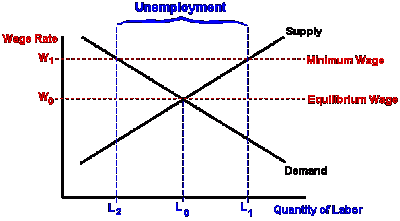
In 1931, the Davis Bacon Act (DBA) was passed. According the FAR 22.403-1 “The Davis-Bacon Act (40 U.S.C. 3141 et seq.) provides that contracts in excess of $2,000 to which the United States or the District of Columbia is a party for construction, alteration, or repair (including painting and decorating) of public buildings or public works within the United States, shall contain a clause (see 52.222-6) that no laborer or mechanic employed directly upon the site of the work shall receive less than the prevailing wage rates as determined by the Secretary of Labor.”

The DBA applies to all contracts over $2,000. This amount was set in 1931 and is equivalent to $30,652.24 in today’s dollars, although the limit still remains at $2,000 (83 years later).

Prevailing wages are defined as the “hourly wage, usual benefits and overtime, paid in the largest city in each county, to the majority of workers, laborers, and mechanics.” They are developed from surveys and collective bargaining agreements. In short, prevailing wages tend to mirror union wage rates (the goal of which is to not allow unions to be underbid in bids). As with all minimum pricing schemes, this tends to inflate the cost of government contracts. One source claims that repealing the DBA would save the taxpayers $10.9 Billion dollars annually. Those dollars could be used for other projects.

To illustrate this cost markup from personal experience, I once talked to a private sector businessman who built a luxury apartment complex for $40 million dollars, half the price of what the government paid for a building that was only half the size and less luxurious (the government job was four times as expensive!). Part of this cost differential is due to the DBA.

The DBA was specifically passed to limit the job opportunities of low skilled workers. To understand the purpose and effect of the Davis Bacon Act, a primer on economics is necessary. For any construction job, the job can be accomplished utilizing a wide array of labor mixes. Hypothetically, a roof might be shingled in a day by 4 skilled workers, or shingled in a day by 8 unskilled workers. The owner of the house has incentive to take the cheapest route to accomplish this task. Although 4 workers might work more productively than the 8, if the 4 workers are more than twice as expensive then the owner possibly would choose to employ the less productive workers. The owner might even accept lesser quality work if the premium on more quality-focused labor is too high to justify the cost.

Where productive labor can be accomplish by the less productive, there is potential for governmental interference in the market to force employment towards the productive labor. Traditionally that has taken the shape of minimum wage laws, coerced union “agreements”, and laws such as the Davis Bacon Act. What all these do is price out the low productivity competition. If those 8 workers had to be paid the same price as the 4 more productive workers, no longer would there be monetary incentive to hire the 8 workers.

In history, the less productive workers have traditionally been drawn from minority classes. These types of wage initiatives have traditionally been advocated by full and open racists. These racists argued precisely that these laws were needed to protect against “colored” labor. Walter Williams writes that the minimum wage laws (the DBA is a federal minimum wage on construction contracts) are the most anti-Black laws that were ever enacted. In today’s world, these laws disproportionately discriminate against those of Latino descent. Similar laws, such as worker verification laws, are regularly passed expressly to discriminate against “illegal” immigrants, who provide cheap competition to contractors.

The overall effect of the Davis Bacon law is textbook economics. Artificially increasing the cost of goods or services causes what is known as Dead Weight Loss to the economy. The economy is overall less productive, and the nation is more impoverished than it otherwise would have been. Jobs are lost as low skilled labor is priced out of certain markets, forced into others or withdrawn altogether.

Other losses to the economy are evident in the bureaucracy that maintains and enforces the DBA. Currently, significant resources are spent gathering data and enforcing wage rates. The Department of Labor reports that in Fiscal Year 2014, $613,794,000 was spent on Bureau of Labor Statistics and $3,555,132,000 was spent on “Worker Protection”. This spending and the “labor” of these employees represent negative impact to standard of living, because the entire purpose of these activities is to impede production (which in turn impedes consumption). These costs are understated because it does not include judicial costs, externalities of regime uncertainty, special interest lobbying and related administrative costs.

The Davis Bacon Act should be repealed. The cost of government construction would decrease significantly. The number of low skilled workers would increase (more jobs would be created). The wages of unions would decrease (as they would have to provide competitive quotes). Government projects would increase (as more money would be available for use), and Americans would be able to consume more than they otherwise would have. Socially, there would be less racial discrimination as government would hire more minority workers and force racists to confront the fact that minorities can complete jobs satisfactorily. Bureaucratically, the government would exhibit less control over people’s lives, special interests in turn would have less incentive to lobby, and freedom would increase.


REFERENCES:
Table 1.1 (Image stolen from here)

reality is not optional

Description: The DBA is a Federal Minimum Wage on Construction Contracts; this chart illustrates the effect on employment. The Triangle that is formed by L2, the Supply Curve, and the Demand Curve is known as “Dead Weight Loss”. Deadweight loss is the total consumer surplus (wealth) and producer surplus (wealth) that is lost as a result of an artificial increase in price. W0 is the wage level in a competitive environment without the DBA. As the Minimum Wage (DBA) increases, the size of the Deadweight Loss increases and the size of the unemployment effect grows. The only way the DBA could not have negative employment effects would be if the Equilibrium rate exceed the DBA rate, in which case the DBA would not be needed. The difference between L2 and L0 are workers that would have had a job if not for the DBA. The difference between L0 and L1 are workers attracted to the higher wages but are unable to find employment.

Posted in Contracting, Econ 101, Economics, Goverment, Labor, Price Controls, prices | 1 Comment

playing legos with my kids

As the plastic pieces scatter on the floor, my boys glance over to the box. The gleaming picture of a race car peaks their curiosity. The scattered mess of parts does not deter them. I open the instructions and place it before them. They eagerly search the rubble for individual pieces, carefully comparing and measuring to ensure that they have selected the right blocks.

Flipping, rotating and pressing, the boys meticulously try to replicate the colorful pictures. I pepper them with hints: “What pieces is it supposed to touch?” “Is that what the picture shows?” “Are you doing it right?” Their eyes flash and they communicate to each other how to fix their problems. Brainstorming, each boy tries to display their own insights into proper construction. They are showing off for me, their father. They occasionally glance up for approval.

I smile as their project slowly takes shape. I have built a million sets before, but this one is special: I did NOT build it. My sons have built a set on their own. I barely lifted a finger. When the project is complete, my boys push around a new shiny race car. From nothing, my boys have merged a hundred pieces together. They did it on their own. They created.

There is great joy in a father who doesn’t have to assemble his own children’s Legos. At first, I sit back and watch my boys become self-sufficient, offering fleeting advice. With a little practice and creativity, I soon will not even have to watch them. I will be presented directly with the final products. And even after that, my boys will still grow. They will disregard all instructions and build new fantastical creations of their own imaginations. That is my end goal: my boys building their own beautiful works of art.

In essence, this is a metaphor for the entirety of parenting. Our ultimate goal is always to see our children develop into their own grown adults. God is no different. God created man to have a creative companion. In fact, God’s first action after creating man is to call the animals to man to “see what man would call them”:

Gen 2:19 Out of the ground the LORD God formed every beast of the field and every bird of the air, and brought them to Adam to see what he would call them. And whatever Adam called each living creature, that was its name.

We can only imagine God’s pride as his children first start creating. This parental pride is the illustration of the Biblical text. This pride is what the author of Genesis is trying to communicate to the reader. The reader is pulled along as the story progresses. We feel as God feels. We are experiencing, along with God, man’s entry into creation. But the story soon takes us on a roller coaster.

Man, in his infancy, is tricked by Satan. We see, along with God, man’s thirst for knowledge. We see, along with God, man’s deep shame. We see, along with God, man’s attempt to disavow blame. This is man’s first actions, and we experience, along with God, man’s first chastisement. In the end, we feel, along with God, disappointment. We feel sad for Adam and sad for God. God now views Adam as failed.

That is where the story leaves us:

Gen 3:22 Then the LORD God said, “Behold, the man has become like one of Us, to know good and evil. And now, lest he put out his hand and take also of the tree of life, and eat, and live forever”
Gen 3:24 So He drove out the man; and He placed cherubim at the east of the garden of Eden, and a flaming sword which turned every way, to guard the way to the tree of life.

Posted in Bible, God, Human Nature, Open Theism, Theology | 1 Comment

prophecy is a bad argument for foreknowledge

When debating Calvinists about if God knows the future, they often point to prophecy as a way to claim that God must know every detail about the future. But by their own standards, this is highly suspect. Take for example the prophecy of Tyre.

1. In the prophecy against Tyre, the natural understanding is that it is against the current residents (not those living 250 years down the line).
2. The prophecy specifically lists what King Nebuchadnezzar would do, which never happened.
3. The Bible later concedes that the prophecy failed, and King Nebuchadnezzar is given a consolation prize of Egypt.
4. The prophecy also claims that Tyre would never be rebuilt. It was.
5. The Bible never records a successful completion of this prophecy (it records a failure), and success is only post facto read into the text by apologists.

On top of this, when the prophecy talks about “nations” coming against Israel, Nations is sometimes figuratively used for “troops” or a collective term for Gentiles. The concept is that Tyre would be swarmed and enemies, not that Tyre would hold out for 250 years then fall.

But Calvinists insist that the prophecy of Tyre was fulfilled. They claim that it was fulfilled in the person of Alexander the Great a full 250 years later. No unbiased person would read the original prophecy and then believe that if Tyre was destroyed 250 years later the prophecy would be fulfilled. In other words, Calvinists accept almost any event as “fulfilling” a prophecy (even if the prophecy never alluded to that particular type of fulfillment). So, in what way would God have to know the future if all He had to do was a tangential action sometime, somewhere to “fulfill” a prophecy?

Using the Calvinist standard of prophecy fulfillment, no one would have to know the future to make prophecy come true. This fact even undermines more specific prophecy, such as King Cyrus. It could only be coincidental that the fulfillment was close to face value of the original prophecy.

Posted in Calvinism, God, Omniscience, Open Theism, Prophecy, Theology | 2 Comments

God uses cannibalism as a weapon

I have mentioned before that cannibalism by necessity has often been a common theme throughout history. We live in an amazing world in which our main concern is eating too much food or limiting our consumption to the right foods. But in the ancient world cannibalism was often required to survive. The Bible records one instance in which a woman eats her own baby:

2Ki 6:24 And it happened after this that Ben-Hadad king of Syria gathered all his army, and went up and besieged Samaria.
2Ki 6:25 And there was a great famine in Samaria; and indeed they besieged it until a donkey’s head was sold for eighty shekels of silver, and one-fourth of a kab of dove droppings for five shekels of silver.
2Ki 6:26 Then, as the king of Israel was passing by on the wall, a woman cried out to him, saying, “Help, my lord, O king!”
2Ki 6:27 And he said, “If the LORD does not help you, where can I find help for you? From the threshing floor or from the winepress?”
2Ki 6:28 Then the king said to her, “What is troubling you?” And she answered, “This woman said to me, ‘Give your son, that we may eat him today, and we will eat my son tomorrow.’
2Ki 6:29 So we boiled my son, and ate him. And I said to her on the next day, ‘Give your son, that we may eat him’; but she has hidden her son.”

The Bible does not attribute this particular famine/siege to God’s doing, but it illustrates a common theme of sieges and poverty: people in desperation are driven to cannibalism. God, throughout the Bible, uses cannibalism as a curse.

Lev 26:27 ‘And after all this, if you do not obey Me, but walk contrary to Me,
Lev 26:28 then I also will walk contrary to you in fury; and I, even I, will chastise you seven times for your sins.
Lev 26:29 You shall eat the flesh of your sons, and you shall eat the flesh of your daughters.
Lev 26:30 I will destroy your high places, cut down your incense altars, and cast your carcasses on the lifeless forms of your idols; and My soul shall abhor you.

The illustration here is not that people would just decide that cannibalism was fun and easy. The illustration is that the people would cut off from food by invading armies. Parents would turn to cannibalism of their own children as a means to survive. God curses with “cannibalism”. This is not saying God desires cannibalism, but that God was going to punish the people to such extent that many would be driven to cannibalism. The imagery is horrific.

In Deuteronomy, the same curse is given:

Deu 28:45 “Moreover all these curses shall come upon you and pursue and overtake you, until you are destroyed, because you did not obey the voice of the LORD your God, to keep His commandments and His statutes which He commanded you.

Deu 28:52 “They shall besiege you at all your gates until your high and fortified walls, in which you trust, come down throughout all your land; and they shall besiege you at all your gates throughout all your land which the LORD your God has given you. Deu 28:53 You shall eat the fruit of your own body, the flesh of your sons and your daughters whom the LORD your God has given you, in the siege and desperate straits in which your enemy shall distress you.
Deu 28:54 The sensitive and very refined man among you will be hostile toward his brother, toward the wife of his bosom, and toward the rest of his children whom he leaves behind,
Deu 28:55 so that he will not give any of them the flesh of his children whom he will eat, because he has nothing left in the siege and desperate straits in which your enemy shall distress you at all your gates.
Deu 28:56 The tender and delicate woman among you, who would not venture to set the sole of her foot on the ground because of her delicateness and sensitivity, will refuse to the husband of her bosom, and to her son and her daughter,
Deu 28:57 her placenta which comes out from between her feet and her children whom she bears; for she will eat them secretly for lack of everything in the siege and desperate straits in which your enemy shall distress you at all your gates.

The last couple verses are amazingly disturbing. A pregnant woman would give birth and then go hide away so she can eat both her own placenta and baby without having to share! The text takes for granted that other people would willingly feast on the woman’s placenta and baby.

Throughout the Bible, the same imagery reoccurs:

Isa 9:19 Through the wrath of the LORD of hosts The land is burned up, And the people shall be as fuel for the fire; No man shall spare his brother.
Isa 9:20 And he shall snatch on the right hand And be hungry; He shall devour on the left hand And not be satisfied; Every man shall eat the flesh of his own arm.

Eze 5:10 Therefore fathers shall eat their sons in your midst, and sons shall eat their fathers; and I will execute judgments among you, and all of you who remain I will scatter to all the winds.

Zec 11:9 Then I said, “I will not feed you. Let what is dying die, and what is perishing perish. Let those that are left eat each other’s flesh.”

Jer 19:9 And I will cause them to eat the flesh of their sons and the flesh of their daughters, and everyone shall eat the flesh of his friend in the siege and in the desperation with which their enemies and those who seek their lives shall drive them to despair.” ‘

Apparently, these curses did come to pass from time to time:

Lam 2:20 “See, O LORD, and consider! To whom have You done this? Should the women eat their offspring, The children they have cuddled? Should the priest and prophet be slain In the sanctuary of the Lord?

Lam 4:10 The hands of the compassionate women Have cooked their own children; They became food for them In the destruction of the daughter of my people.

Lastly, God sometimes curses even Israel’s enemies with this curse:

Isa 49:26 I will feed those who oppress you with their own flesh, And they shall be drunk with their own blood as with sweet wine. All flesh shall know That I, the LORD, am your Savior, And your Redeemer, the Mighty One of Jacob.”

God says that people will know He is their redeemer and savior because the enemy would be driven to cannibalism. It is a fearful thing to fall into the hands of the living God.

Posted in Bible, God, History, Jewish History, Morality, Standard of Living, Theology | Leave a comment

neglected verses – isaiah 49:26

Isa 49:26 I will feed those who oppress you with their own flesh, And they shall be drunk with their own blood as with sweet wine. All flesh shall know That I, the LORD, am your Savior, And your Redeemer, the Mighty One of Jacob.”

Posted in Bible, Neglected Verses | 1 Comment