the ending of the gospel of mark

In an article entitled The “Strange” Ending of the Gospel of Mark, the author claims that Mark 16:9-19 is clearly forged:

Even though this ending is patently false, people loved it and to this day conservative Christians regularly denounce “liberal” scholars who point out this forgery…

The evidence is clear. This ending is not found in our earliest and most reliable Greek copies of Mark.

His evidence is as follows:

According to Bruce Metzger, “Clement of Alexandria and Origen [early third century] show no knowledge of the existence of these verses; furthermore Eusebius and Jerome attest that the passage was absent from almost all Greek copies of Mark known to them.”

Without getting into the fact that people like to overstate their case (really, the evidence is “clear”, the ending is “patently false”?), the evidence itself seems to be biased. No one denies that the earliest physical writings that we have do not contain those specific verses, but the fact is that the earliest manuscripts we have all are of an Alexandrian bias. As I wrote before:

Why do we even have these early Christian documents? Because they primarily were Alexandrian in origin (coincidently this gives those who argue in favor of accuracy in “earlier” manuscripts an Alexandrian bias)…

The texts that remain do so against nature. All we have is a fragmented look into the past by documents lucky enough to be located in ideal locations and surviving two thousand years of man’s destruction.

I also quote Ehrman to make this point:

As noted earlier, papyrus MSS survive only when protected from moisture – when placed in protective caves, jars, or buildings, or when buried in the soil of virtually rain-free regions of Egypt, Palestine, or Mesopotamia (though papyri must neither be too near the surface nor so deeply buried as to be affected by a rising water table).
[Bart Ehrman, The Text of the New Testament in Contemporary Research]

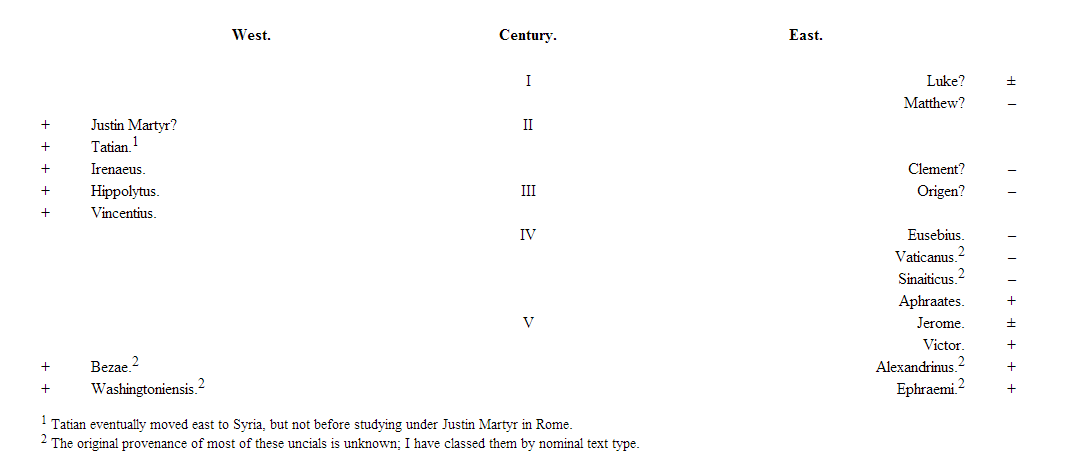
This brings us back to the reliability of Alexandrian texts. One website categorizes the opinions of the various Church Fathers on the endings of Mark. He, interestingly enough, categorizes the Church Fathers as East and West. The chart is telling:
east v west

So, the West seems to have preferred the longer ending while the East seems to have rejected it. And what documents do we have that survived? …the ones in the dry climate. This leads the author of the original article to claim the ending of Mark is a “clear” forgery. The evidence is not so clear.

Posted in Bible, Bible Critics, Church History, Ehrman, History, People, Textual Criticism | 2 Comments

huffington post is ignorant of history

On Huffington Post, there is a new article titled: “Five Things Christian Fundamentalists Just Don’t Get”. It is approximately the quality and intelligence one would expect from an organization who regularly ignores the entire established science of economics. This particular article discusses five points in which the author believes that Christians “just don’t get it”. Pointing to one example, it is clear that the author just does not get it.

On Poverty:

Jesus proclaimed several things about the “rich”. He stated that it was easier for them to “go through the eye of a needle than for a rich person to enter the kingdom of God” and that they should “go, sell all that you have and give to the poor”. Ignoring the fact that Jesus was teaching people to prepare for an imminent coming physical Kingdom which never came, the verse still does not lend weight to the author’s premise that Americans should support food stamps and welfare.

It should be obvious to any historian that the “rich” of Jesus’ day were hundreds of times worse off than the modern American poor. The best statistics we have on relative standards of living is the data from Angus Madison. Although Israel does not have a number for 1 AD, Iraq does. It is listed at $500 per capita income. In other words, living the average life in Iraq during the first century would be like living off of $500 in 1990 America. This would be not receiving American welfare supplements.

In 1990, Americans had a GDP per capita of $23,000. Doing the math and reaching a conclusion that 1990 was 43 times better than 1 AD is extremely misleading as well. Russ Roberts points out that from 1900 to today we are over 30 times better off (Angus Madison puts 1900 at $4100 per capita). Not only does the nominal number hide much of what makes life valuable, it does not even take into account the infinite tangibles that make modern life better than in the past.

Anyone familiar with the real lives of the ancient rich understands that they were miserably poor by today’s standards. They rode in carriages or on horses. They died young of disease. They had high infant mortality. Even their advanced dentistry looks barbaric. The ancients had no access to instant communication, television, cell phones, grocery stores (which provide choice unimaginable to even Caesar). They did not have access to international travel. If they did it was slow and barbaric: they would often get robbed and killed. To illustrate this point, David Henderson has an excellent article on this titled “The Top One Percent Includes You”.

The point is that when Huffington Post tried pretend that what Jesus called “the rich” is the same group which modern leftists call “the rich”, then Huffington Post is ignorantly wrong. Jesus would label most or all of America as “rich”, especially those being paid by the government not to work. But the leftists would rather have a “Jesus agrees with my social policy of forcible redistribution of wealth” than explore the context of Jesus’ statement. In other words: They are liars and the truth is not in them.

Posted in Econ 101, Economics, History, Jesus, Leftists, People, Standard of Living | 1 Comment

learning the attributes of God from Jesus

A core Christian teaching is that Jesus is God:

Joh 1:1 In the beginning was the Word, and the Word was with God, and the Word was God…
Joh 1:14 And the Word became flesh and dwelt among us, and we beheld His glory, the glory as of the only begotten of the Father, full of grace and truth.

Logically, any essential attributes of God should be visible in Jesus. If God is defined with attribute x, then how could Jesus be God without that attribute? Jesus says of himself to his disciples:

Joh 14:9 Jesus said to him, “Have I been with you so long, and yet you have not known Me, Philip? He who has seen Me has seen the Father; so how can you say, ‘Show us the Father’?

Jesus is a picture to Christians of whom God is. What did Jesus show the disciples? Was it the traditional Latin attributes of God (omniscience, omnipresence, omnipotence, timelessness, and immutability)? The answer is clearly no.

Jesus admits to not being omniscient (Mar 13:32).

Jesus was temporally located, not omnipresent. He walked to get around. He met with crowds. Mary even complains that he was not there to save Lazarus from dying (Joh 11:32).

Jesus even seems to have relied on God for his power, not his own omnipotence:

Jesus says after he healed an infirm man in John 5:

Joh 5:30 I can of Myself do nothing. As I hear, I judge; and My judgment is righteous, because I do not seek My own will but the will of the Father who sent Me.

This suggests that Jesus is just the vehicle for God’s power on earth. Jesus does not have these powers inherently. In fact he tells the disciples they can do greater powers than Jesus accomplished (Joh 14:12).

Jesus says after Peter attempts to defend him with a sword:

Mat 26:53 Or do you think that I cannot now pray to My Father, and He will provide Me with more than twelve legions of angels?

Jesus again is pointing out that the power is originating with God. In Acts, the disciples are shown to believe this:

Act 2:22 “Men of Israel, hear these words: Jesus of Nazareth, a Man attested by God to you by miracles, wonders, and signs which God did through Him in your midst, as you yourselves also know—

And again in Acts 10:

Act 10:38 how God anointed Jesus of Nazareth with the Holy Spirit and with power, who went about doing good and healing all who were oppressed by the devil, for God was with Him.

Jesus was not omnipotent. He could not do everything, and the things that he did do were through the power of God.

Jesus definitely acts in time, ages, and matures. He is not timeless or immutable.

What is even more telling is that the Bible is clear that Jesus was just like us:

Heb 2:17 Therefore, in all things He had to be made like His brethren, that He might be a merciful and faithful High Priest in things pertaining to God, to make propitiation for the sins of the people.

So in what sense did Jesus show his disciples “the Father”? It was in his actions, his relationship, his teachings, and his emotions. If Calvinists are to claim Jesus is God, they are at a loss to explain how not a single one of their championed attributes are shown through Jesus.

When a Calvinist plasters attributes of God onto a PowerPoint in church, think about which ones are shown in Jesus. This is a good test to see the differential in how Jesus portrays God and how Christians portray God. How do Christians measure up? Do they focus on the attributes that Jesus cares about? Or do they have their own private value system?

Posted in Calvinism, God, Jesus, Omnipotence, Omnipresence, Omniscience, Open Theism, Theology | 4 Comments

failed prophecies in matthew

In the Gospel of Matthew, the author (Matthew) regularly claims that parts of Jesus’ life were “fulfilled” by the Old Testament. Christians claim that these were prophecies (predictions of future events) that were fulfilled. When looking up these passages in the Old Testament, Atheists call foul. Many of the verses, in context, have nothing to do with the events that Jesus did to fulfill them. In George H Smith’s Atheism: the Case Against God, he laments:

For another astounding prophecy, turn to Matthew 2.15, which refers to Jesus’ alleged flight into Egypt to escape Herod’s mass slaughter of children…

[Joseph and Jesus] remained there until the death of Herod. This was to fulfill what the Lord had spoken by the prophet, “Out of Egypt have I called my son.”

Observe the context of this “prophecy,” which was taken from Hosea 11:1:

When Israel was a child, I loved him, and out of Egypt I called my son.

This passage and those that follow clearly indicate that the “son” refers to Israel during its exodus from Egypt (such as in Exodus 4:22, where Israel is again referred to as God’s son). This “prophecy” refers to a past event. The author of Matthew, who would have us believe that Hosea 11:1 predicts a future event, is again very brazen in his distortion.

These are only two examples out of many similar cases. Time and again, Old Testament passages are distorted, misinterpreted and quoted out of context in the attempt to manufacture prophecies for Jesus.

Where Christians and Atheists disconnect is that the culture of ancient Judaism was not like modern American culture. In order to show events were true or from God, they were compared with parallel concepts. The concepts did not have to be exact or a prophecy (as Americans think of prophecy: foretelling future events). The point was more to show precedence: to show that God was doing something in the New Testament, the Old Testament was shown to have a similar concept. The apostle Paul is known to do this (see Romans 9:25 v Hosea 1:10 and 2:23). Matthew does this to no end, infuriating critics of Christianity.

A proper rendition of “fulfilled” would be “paralleled” (or “precedented”):

Mat 2:15 and was there until the death of Herod, paralleled by that which was spoken by the Lord through the prophet, saying, “OUT OF EGYPT I CALLED MY SON.”

Dr. Joel M. Hoffman also points out this fact on his blog, GodDidntSayThat. Also, Jesse Morrell points this fact out on his blog, BiblicalTruthReasources.

Posted in Bible, Bible Critics, Prophecy, Theology | 7 Comments

atheism – the case against God

In my formative years I picked up George H Smith’s Atheism: The Case Against God. The book was actually very well written, but it seemed more like a treatise against Calvinism and Covenant Theology then it did against the God of the Bible. Some excerpts:

On limiting God:

Indeed, to say anything about God is to limit God. To say that God possesses characteristic A is to say that God lacks the characteristic not-A

On negative theology (the Latin attributes of God):

The first problem with negative theology is that, if God is described solely in terms of negation, it is impossible to distinguish him from non-existence—”any Being which had to be characterized entirely in negations would, surely, not be discernible from no Being at all.” God is not matter; neither is non-existence. God does not have limitations; neither does non-existence. God is not visible; neither is non-existence. God does not change; neither does non-existence. God cannot be described; neither can non-existence. And so on down the list of negative predicates. If the theist wishes to distinguish his belief in God from the belief in nothing at all, he must give some positive substance to the concept of God.

On omniscience:

The first problem with omniscience is that it cannot be reconciled with any theory of free will in man. If one believes in an omniscient being, one cannot consistently hold that man has volitional control over his actions. If God knows the future with infallible certainty, the future is predetermined, and man is impotent to change it.

On omniscience v omnipotence:

There is another irritating problem with the idea of omniscience: it contradicts the attribute of omnipotence. If God knows the future with infallible certainty, he cannot change it—in which case he cannot be omnipotent. If God can change the future, however, he cannot have infallible knowledge of it prior to its actual happening—in which case he cannot be omniscient. (This is similar to the issue of in what sense, if any, God can be said to have free will. Does God know his own future decisions? If so, how can those decisions be free? Perhaps God does not make decisions. If so, how can the idea of volition apply to a being with no decisions—and hence no choices—to make?)

On understanding God:

The Christian is faced with an either-or situation. Either we can use human language to speak meaningfully of God (in which case God cannot differ in kind from finite existence), or human language cannot be applied to God at all (in which case the word “God” becomes meaningless). By stipulating that God is supernatural and unknowable, the Christian effectively removes God from the domain of language and communication—thereby removing himself from the context of rational consideration.

In short, Atheism: the Case Against God is a welcome read to those who understand the Bible and have a clear disdain for pagan teachings of Calvinism.

Posted in Calvinism, God, Omnipotence, Omniscience, Open Theism, Theology | Leave a comment

when all does not mean all

All languages work in a fluid manner. Words are defined not necessarily by their dictionary definition, but by the cultural, contextual definition. So when Peter says that Jesus knows “all things”, the modern reader may be inclined to think Jesus was omniscient, but other scriptures are very clear that Jesus did not know everything possible that could be known. “All” is being used in a figurative sense, meaning “a large amount”.

Another example in the Bible in which the Bible explicitly explains that “all” does not mean “all” is found in 1st Corinthians:

1Co 15:27 For “HE HAS PUT ALL THINGS UNDER HIS FEET.” But when He says “all things are put under Him,” it is evident that He who put all things under Him is excepted.

This is very telling because Paul is taking it upon himself to explain that “all” is not all inclusive. Paul must have been under some impression that his figurative use of the word “all” would be lost on some individuals. He explains that “all” does not include God.

The Bible contains figures of speech and there are no surefire rules of identifying them. As counter intuitive as it might seem, people have to know before they read a verse what the real meaning of the verse is. A much disputed verse for this type of controversy is John 3:16:

Joh 3:16 For God so loved the world that He gave His only begotten Son, that whoever believes in Him should not perish but have everlasting life.

Calvinism claims that God died for only the elect. This is the concept of “limited atonement”. In order to hold this position, John 3:16 is required to be limited only to a select group of people. “World” they claim means mankind in general, and “whoever” is interpreted as only believers.

How do we “know” this is false from the Greek grammar or context? In short: we don’t. But we do know from the rest of the Bible the character of God. God is relational, responds to his creation (including pagans), he is love, and he responds to individuals based on individual actions. Would God be so evil as to create people with whom it is impossible to love God? All signs point to no.

“All” does not necessarily mean “all”. We know the meaning of figures of speech not necessarily from context but from understanding of the entirety of the Bible.

Posted in Bible, Calvinism, Figures of Speech, Theology | 2 Comments

misquoted verses – God does not change

Mal 3:6 “For I am the LORD, I do not change; Therefore you are not consumed, O sons of Jacob.

In Malachi there is an often quoted verse which states that God does not change. The Calvinism modus operandi is to take any verse they can possibly seize to twist it to their own theology. It is no wonder this obscure verse in Malachi is often the bedrock of the claim that God cannot change (notice also the slight shift from “does not change” to “cannot change”). Calvinists point to this verse to prove “immutability”.

There is a companion verse very similar to this about Jesus:

Heb 13:8 Jesus Christ is the same yesterday, today, and forever.

When quoted, “Jesus Christ” is often changed to “God”. This masks the intent of Hebrews 13:8. After all, Jesus grew in knowledge (Luk 2:40, Luk 2:52) and presumably will one day learn when the end times will occur (Mar 13:32). Jesus was not the same in the sense of “changeless perfection”. Jesus, however, was the same in “doctrine” or “morality”. Hebrews 13:9 talks about “strange doctrines” and the verses leading up to Hebrews 13:8 talk about how to live a Christian life. Either interpretation is valid. The interpretation that “Jesus cannot change in any aspect ever” is un-Biblical.

Back to Malachi, the immediate context explains this verse. Needless to say, understanding the context reveals the verse is evidence against (not for) Calvinism.

Mal 3:5 And I will come near you for judgment; I will be a swift witness Against sorcerers, Against adulterers, Against perjurers, Against those who exploit wage earners and widows and orphans, And against those who turn away an alien— Because they do not fear Me,” Says the LORD of hosts.
Mal 3:6 “For I am the LORD, I do not change; Therefore you are not consumed, O sons of Jacob.
Mal 3:7 Yet from the days of your fathers You have gone away from My ordinances And have not kept them. Return to Me, and I will return to you,” Says the LORD of hosts.

The immediate context shows that God is talking about a people who have turned away from him and towards sin. God did not change with them, but threatens them into returning to him. While people change their morality, and claim that sins are not sins, God’s perspective on morality stays the same. Interesting enough, God then details the changes he will do based on the repentance of Israel:

Mal 3:10 …Says the LORD of hosts, “If I will not open for you the windows of heaven And pour out for you such blessing That there will not be room enough to receive it.
Mal 3:11 “And I will rebuke the devourer for your sakes, So that he will not destroy the fruit of your ground, Nor shall the vine fail to bear fruit for you in the field,” Says the LORD of hosts;
Mal 3:12 And all nations will call you blessed, For you will be a delightful land,” Says the LORD of hosts.

So the text which says “God cannot change” is in the context of saying that God changes his curses to blessings based on the actions of his people. It shows God in time, responding to his creation and persuading them to change their actions. The context disproves “immutability”, “timelessness”, and “impassibility” all at once. It is no wonder Calvinists never quote the surrounding text.

Posted in Bible, Calvinism, Figures of Speech, God, Jesus, Misquoted Verses, Open Theism, People, Theology | 3 Comments

Jesus did not know everything

It is apparent from reading the gospels that Jesus acted in real time based on new information. He had to be informed about John the Baptist’s death (Mar 6:30). He did not cry until he was actively showed the grave of Lazarus (Joh 11:35). He “finds” the disciples asleep multiple times and is surprised (Mat 26:45). But all this is not enough to convince someone who is steeped in a pagan understanding of Christ. They try to dismiss each of these verses as a technicality or not representative of no knowledge. But one verse is impossible to deny:

Mar 13:32 “But of that day and hour no one knows, not even the angels in heaven, nor the Son, but only the Father.

Jesus refers to himself as the Son throughout the New Testament. Here he is making an affirmative claim that even he does not know something (“the day and hour” of judgement). Jesus did not have all knowledge even though individuals figuratively claimed he did:

Joh 21:17 He said to him the third time, “Simon, son of Jonah, do you love Me?” Peter was grieved because He said to him the third time, “Do you love Me?” And he said to Him, “Lord, You know all things; You know that I love You.”…

So although people in the Bible claimed Jesus “knows all things” an astute reader of the Bible will understand either the speaker is mistaken or the claim if figurative (meaning Jesus knew a whole lot of things but not literally everything). If Mark 13:32 did not exist, how many Christians would fight to the death for a literal interpretation of John 21:17? How many Christians would ignore the themes of the gospels and interject a pagan reading onto the character of Jesus? What other areas of the Bible do Christians believe based on the same evidence refuted here? The implications are far reaching.

Posted in Bible, Figures of Speech, God, Jesus, Open Theism, People, Theology | 8 Comments

hardening hearts

Street Preacher Jesse Morell explains the Biblical meaning of “Hardening Hearts”:

Here is a modern analogy: When I preach on campus and sinners reject the message, people often tell me, “You are turning people off.” Now, I am not directly going into their hearts and turning them off to the truth. I do not have direct control over their choices. They are free moral agents. But the result of me preaching the uncompromising truth is that many sinners turn themselves off to it…

Notice that in the original passage, it was the job of the preacher to blind their eyes. It was not something God was directly going to do, but something that He did through the preacher. The original scripture is, “Make the heart of this people fat, and make their ears heavy, and shut their eyes; lest they see with their eyes, and hear with their ears, and understand with their heart, and convert, and be healed.” Isa 6:10…

This understanding of the modus operandi by which God hardens the hearts of sinners helps us to understand the other passages that speak of God hardening Pharaoh’s heart, which Calvinists also use as proof-texts for their doctrine that God doesn’t want everyone to repent and be saved. The Scriptures declare that God hardened Pharaoh’s heart (Exo. 7:13, 10:1; 10:20; 10:27; 11:10), but the Bible also says that Pharaoh hardened his own heart (Exo. 8:15; 32; 9:34). It was by sending Moses with his message and by performing miracles that God hardened Pharaoh’s heart.

Posted in Bible, Figures of Speech, God, Theology | Leave a comment

deadweight loss

The concept of Deadweight Loss is the concept of mapping the basic economic principle that people respond to incentives. In trade, if the cost of producing an item goes up, forcing an increase in price, the amount bought will decrease (all else constant). Deadweight Loss is a measure of the difference between the economic activity that would have taken place and the economic activity that does take place. For example, pretend the government raised taxes on Doritos by a cent. If people as a whole buy 10 less bags of Doritos due this price increase, the Deadweight Loss is calculated by adding all the consumer surplus and the producer surplus that those 10 bags would have generated. Consumer surplus is the difference between amount that the Consumer was willing to pay and the price the Consumer does pay. Producer surplus is the difference between amount at which the producer was willing to sell and the price at which the producer does sell. On a standard Supply and Demand graph, this is represented as a triangle.

In South Dakota, my economics professor did a case study on the unemployment effects of an increase in the minimum wage (in 2006). He estimated that about 360 individuals in South Dakota would lose their jobs with a Deadweight Loss of $3.84 million to the economy. He presented this to the governor, the bill was still signed into law.

When the price of labor is artificially increased, producers demand less labor. My younger brother, a minimum wage earner, understood this and was livid when the hike was passed into law. He subsequently saw his hours cut and the prices of the things he likes to buy (like pizza) increased. Laws and regulations are not costless.

Besides price ceilings and floors, other government activity causes deadweight loss. Regulations shift costs from producing into complying, artificially increasing the overall cost of production. If producers have to hire lawyers to navigate pages of regulations, that is money that could have gone into useful production. If the producer is paying fines to the EPA, installing carbon filters, or spending time lobbying, this refocuses time, money, and material away from productive uses. This is all deadweight loss. Deadweight loss then, makes everyone poorer. The consumers pay more for goods, buy less of those goods, and consuming less than they otherwise would. Producers pay more to produce goods, sell less than they otherwise would, and divert labor to unproductive uses.

What Deadweight Loss means a real decrease in the standard of living. This is why Detroit is failing . This is why South Korea and West Germany thrived while North Korea and East Germany stagnated.

Posted in Econ 101, Economics, Goverment, Price Controls, Taxes | 2 Comments