proxy sins

In the modern world, people sometimes attempt to claim that they are not sinning because the sin is removed a few levels from their action, although their action is causing the sin. If a scientist builds a virus knowing it will escape his control and kill millions, is he guilty of murder?

An astute Christian might recall that David committed a heinous sin through proxy in which he murdered someone by merely setting up circumstances in which the person would die in a war by an enemy’s hand.

2Sa 11:14 In the morning it happened that David wrote a letter to Joab and sent it by the hand of Uriah.
2Sa 11:15 And he wrote in the letter, saying, “Set Uriah in the forefront of the hottest battle, and retreat from him, that he may be struck down and die.”

Now a crafty theologian might claim that David was not sinning. He merely wrote a note with words. It was Joab who read it, interpreted it, and followed it. David did not use his swords to kill Uriah. The enemy killed him, as happens in war. The disassociation argument did not pass God’s muster:

2Sa 12:9 Why have you despised the commandment of the LORD, to do evil in His sight? You have killed Uriah the Hittite with the sword; you have taken his wife to be your wife, and have killed him with the sword of the people of Ammon.

God first accuses David of murder, then God discerns the motive and points to the murder weapon (“the sword of the people of Ammon”). David, although his crime was accomplished through proxy, was guilty of murder.

When God uses people to lie or kill, we cannot excuse those actions because God did not do it directly. If God creates a world of people fated to sin, we cannot pretend He is not accountable. People (and God) can sin through proxy. The pagans understand this and rightly question the god that is presented by Christian Platonists. Where Calvinists have no answers, the God of the Bible (who is relational, powerful, and suffers to be in a love relationship with his creation) shines.

Posted in Calvinism, God, Morality, Open Theism, Theology | 1 Comment

sins are situational

In claiming that all lies are not sins, I have been accused of situational ethics.

The term “situational ethics” is popularly known by the concept “the ends justify the means”. Of course, this is a false concept. It would be wrong for me to kill an innocent baby to save the entire world (the baby would die in either case). Me killing the baby would be an active sin. I would be taking the life of an innocent. However, if I didn’t kill the baby, the entire world would be destroyed by someone/something else. It would be their sin, not mine. As Paul says, “we do not do evil that good may come“.

My claim is not that the “ends justify the means”, but that it is NOT immoral to NOT sin to save someone. More to the point: anything that is not a sin is at liberty to be pursued. It is not a sin to lie to those who want to kill you.

When talking about sin, everyone uses qualifiers. In a sense, all sins are situational in the sense that they are only sins based on a very specific set of circumstances. To illustrate:

Sex is not a sin in and of itself. Sex is blessed in some circumstances and cursed in others. Here are a few situations:

A man and woman are having sex.

If the man is married and the woman is not, this is a sin for both.
If the man is married to the woman, this is not a sin for both.
If the man is married to the woman but thinks he is having sex with another woman, this is a sin for him but not for his wife.
If the man is married, but it turns out his wife was really a man, this was not a sin for him but a sin for his “wife”.
If the man and woman are not married, this is a sin for both.

The situation can be morphed in literally endless ways, in turn, toggling who is sinning and who is not. Sin then has everything to do with situations. Subcategories of sex that are sins sometimes are conveniently named (“adultery”, “homosexuality”, “rape”). Sometimes they aren’t. But we should not let lack of language determine at what level to say “all of that is a sin”, such as the case with “lying“.

Situations change whether something is a sin or not. The action can be the same exact action, but the players and their motives are what change an “action” into a “sin”. This is not just being made up. The Bible explicitly talks like this when talking about killing:

Deu 19:4 “And this is the case of the manslayer who flees there, that he may live: Whoever kills his neighbor unintentionally, not having hated him in time past—
Deu 19:5 as when a man goes to the woods with his neighbor to cut timber, and his hand swings a stroke with the ax to cut down the tree, and the head slips from the handle and strikes his neighbor so that he dies—he shall flee to one of these cities and live;
Deu 19:6 lest the avenger of blood, while his anger is hot, pursue the manslayer and overtake him, because the way is long, and kill him, though he was not deserving of death, since he had not hated the victim in time past.

Deu 19:11 “But if anyone hates his neighbor, lies in wait for him, rises against him and strikes him mortally, so that he dies, and he flees to one of these cities,
Deu 19:12 then the elders of his city shall send and bring him from there, and deliver him over to the hand of the avenger of blood, that he may die.

Num 35:26 But if the manslayer at any time goes outside the limits of the city of refuge where he fled,
Num 35:27 and the avenger of blood finds him outside the limits of his city of refuge, and the avenger of blood kills the manslayer, he shall not be guilty of blood,

The logistics are tricky: if someone kills someone else and were planning to do so, they are guilty of blood, unless they are avenging blood, but they also can flee to the city of refuge if the murder was unintended, however they can be killed without guilt by the avenger if they are not in the city (even if they committed the killing unintentionally). Wow. Situations change everything. In every act described there is one individual killing another, but some are sins and some are not. The details are what change the same action from a sin to a justified action. The details (actors and motives) make the difference.

All Christians claim God cannot sin. The gnostic Marcion understood this and using his Platonic concept of god, decided the the God of the Old Testament was not the true God. In the Old Testament, we find God engaging in wars, using judgment, using deception, and being all around condemned by modern liberals. Cultural Christians will agree with modern Marcionism and claim that the actions, on face value, in the Old Testament were evil. They, like Marcion, claim that those stories do not depict the true God and then reinterpret those verses to meet their personal standard of God. Real Christians understand how righteousness works and use God’s own actions to show he was righteous. God wars against his enemies. God judges the wicked. God uses deception to kill his those who would kill his people. God does not sin.

Posted in Bible, God, History, Morality, Theology | Leave a comment

on God and the ability to lie

When attempting to discuss God and the ability to lie it is first important to define the terms. A lie is quite literally a statement with intent to deceive. If the time were 3:30 and someone, knowing the actual time, would say it was 4:30 in an effort to trick someone, this would be a lie. One person is attempting to decieve another. However, if the person does not want the other person to believe him, but to understand he is joking, such as when someone says a ridiculous time in an effort to get another person to laugh, this is not a lie. No deception was intended although a falsehood was stated.

Additionally, someone can actually lie when they are telling the truth. If the time was 3:30 but the person’s watch was off and said the time was 2:30, the person would still be lying if he told another person the time was 3:30. In this case the deceiver is only accidentally correct. The fact that he happens to be correct does not pardon his deception.

A lie is a statement with intent to deceive.

This concept of lying is heightened by what the Bible calls “Bearing False Witness”. To bare false witness is to make a situation seem to be true when it is not. For example: if Sam wishes to go on a mission trip, but Bob does not want him to go and misleads Sam on purpose to think that he is supporting Sam’s mission trip, then he is a liar. Also if Bob does not like Sam, but he pretends to like him and misleads him to that affect, he is a liar. Bearing false witness is equivalent to lying.

Exo 20:16 “You shall not bear false witness against your neighbor.

Lev 19:11 ‘You shall not steal, nor deal falsely, nor lie to one another.

These are the main Biblical verses on the prohibition on lying. Notice that both of them specifically demand that the Israelites do not lie against each other. This says nothing of their dealings with their pagan enemies.

When Corrie ten Boom lied to the Nazi’s about hiding Jews, was she sinning? When the Nazi paratrooper spies were caught in England and used to send back false information to Nazi Germany, were the British sinning? When the allies did everything they could do to trick the Nazis into thinking that they were not landing in Normandy, going as far as to send inflatable tanks to Italy, were they sinning?

Lies can sometimes be useful to protect the innocent. In the case of Germany, the Nazis were committing genocide and rightly were destroyed. This is also why lying is not only acceptable in some situations but also Godly. Let us look at a few Biblical examples:

1Sa 16:2 And Samuel said, “How can I go? If Saul hears it, he will kill me.” But the LORD said, “Take a heifer with you, and say, ‘I have come to sacrifice to the LORD.’

Here Samuel is afraid of being killed by Saul for anointing a new king. The Lord tells him to tell a half-lie. Half-lies are still lies. If a man decides to go to a party to see his ex-girlfriend, and his wife asks him why he is going, it would be a lie to say “to see my friend, Bob” even if Bob was attending. This is a lie of misdirection. God commands Samuel to tell this lie of misdirection. This is the same caliber of lie as Abraham’s lie about Sarah being his sister, and forgetting to mention she was also his wife. This happened twice:

Gen 12:12 Therefore it will happen, when the Egyptians see you, that they will say, ‘This is his wife’; and they will kill me, but they will let you live.
Gen 12:13 Please say you are my sister, that it may be well with me for your sake, and that I may live because of you.”

Gen 20:2 Now Abraham said of Sarah his wife, “She is my sister.” And Abimelech king of Gerar sent and took Sarah.

In both these situations, God gets angry at the king, not Abraham. Abraham was doing a reasonable thing in trying to save his own life. Just as with Samuel, God does not think it is sinning to lie. A lie is not a sin in and of itself.

Another situation similar to Abraham and Samuel is Rahab the prostitute:

Jos 2:4 Then the woman took the two men and hid them. So she said, “Yes, the men came to me, but I did not know where they were from.
Jos 2:5 And it happened as the gate was being shut, when it was dark, that the men went out. Where the men went I do not know; pursue them quickly, for you may overtake them.”
Jos 2:6 (But she had brought them up to the roof and hidden them with the stalks of flax, which she had laid in order on the roof.)

Jam 2:25 Likewise also was not Rahab the harlot justified by works, when she had received the messengers, and had sent them out another way?

Heb 11:31 By faith the harlot Rahab perished not with them that believed not, when she had received the spies with peace.

Here God blesses Rahab for lying. Lying was the Godly thing to do; it saved the lives of God’s chosen people. Unlike Samuel, Rahab was not told directly by God to lie. She was instead intelligent enough to figure out that it was the right thing to do in the situation. God even adds her to Jesus’ lineage as reward for her actions. This is reminiscent of the Hebrew midwives when they saved the lives of Hebrew babies:

Exo 1:17 But the midwives feared God, and did not do as the king of Egypt commanded them, but saved the male children alive.
Exo 1:18 So the king of Egypt called for the midwives and said to them, “Why have you done this thing, and saved the male children alive?”
Exo 1:19 And the midwives said to Pharaoh, “Because the Hebrew women are not like the Egyptian women; for they are lively and give birth before the midwives come to them.”
Exo 1:20 Therefore God dealt well with the midwives, and the people multiplied and grew very mighty.

God blesses the midwives explicitly because they lie and save the lives of the Hebrew children. The midwives were not criticized in the least for their lies.

God, in his righteousness, also commands Israel to use deception in war. In Joshua, the Bible describes a scene in which God has communicated a feint in order to lure enemies from a city.

Jos 8:4 And he commanded them, saying, Behold, ye shall lie in wait against the city, even behind the city: go not very far from the city, but be ye all ready:
Jos 8:5 And I, and all the people that are with me, will approach unto the city: and it shall come to pass, when they come out against us, as at the first, that we will flee before them,
Jos 8:6 (For they will come out after us) till we have drawn them from the city; for they will say, They flee before us, as at the first: therefore we will flee before them.
Jos 8:7 Then ye shall rise up from the ambush, and seize upon the city: for the LORD your God will deliver it into your hand.
Jos 8:8 And it shall be, when ye have taken the city, that ye shall set the city on fire: according to the commandment of the LORD shall ye do. See, I have commanded you.

The feint works and the city is taken. God specifically works through Joshua to take this city of Ai. The story is intertwined with credit to God and accounts of Israel following God’s commandments. This was a Godly and glorious battle.

1 Kings 22 describes an even more interesting scene. Walter Brueggeman describes it as thus:

In 1 Kgs 22:20-22, surely a “primitive” prophetic tale, the reader of the text is imagined into a discussion in “the divine council,” a cabinet meeting of Yahweh’s heavenly government (see parallels in Job 1-2). The discussion turns on the way in which King Ahab can be “enticed” to a military maneuver that will cause his death. The purpose of the narrative, and the purpose of the discussion in the divine council, is to assert Yahweh’s decisive hostility toward Ahab and the dynasty of Omri and to assert Yahweh’s hand in the governance of history–even royal history.

What interests us is the conversation in the government of Yahweh… The strategy is to entice Ahab into foolish policy by a prophet who is credentialed by Yahweh to give bad advice to the King… The conversation is unambiguous. What is being planned is a massive deception of the king.

We read in 1 Kings 22:

1Ki 22:19 Then Micaiah said, “Therefore hear the word of the LORD: I saw the LORD sitting on His throne, and all the host of heaven standing by, on His right hand and on His left.
1Ki 22:20 And the LORD said, ‘Who will persuade Ahab to go up, that he may fall at Ramoth Gilead?’ So one spoke in this manner, and another spoke in that manner.
1Ki 22:21 Then a spirit came forward and stood before the LORD, and said, ‘I will persuade him.’
1Ki 22:22 The LORD said to him, ‘In what way?’ So he said, ‘I will go out and be a lying spirit in the mouth of all his prophets.’ And the LORD said, ‘You shall persuade him, and also prevail. Go out and do so.’
1Ki 22:23 Therefore look! The LORD has put a lying spirit in the mouth of all these prophets of yours, and the LORD has declared disaster against you.”

Of course, King Ahab does not believe Micaiah and ends up dying in battle. God’s purpose was fulfilled. This story is repeated in 2 Chronicles 18:18-22.

Christians naturally struggle with verses like this. All lies, in any circumstance, in any setting (they claim), is a sin. This would be like claiming when Corrie ten Boom lied to the Nazis to save some Jews, she was sinning (she personally struggled with this “sin”). Rahab was sinning. The Hebrew midwives were sinning. Joshua was sinning. Gideon sined. Even God sinned (according to the “all lies are sins” theory). If all lies are sins, God is made into a sinner. The Bible explicitly condemns “making him a liar”:

1Jn 1:10 If we say that we have not sinned, we make Him a liar, and His word is not in us.

It should be hoped that all Christians understand this verse is not literal in the sense that anything we can do would make God a liar. Lies are statements with the intent to deceive, a third party cannot make someone lie. The use is figurative, “we portray God as a liar”. Understanding figurative statements in the Bible, or understanding the context brings to light the meaning.

While most Christians will take 1 John 1:10 as a idiom, they refuse to take other verses in the same fashion:

Heb 6:17 Thus God, determining to show more abundantly to the heirs of promise the immutability of His counsel, confirmed it by an oath,
Heb 6:18 that by two immutable things, in which it is impossible for God to lie, we might have strong consolation, who have fled for refuge to lay hold of the hope set before us.

Christians tweak this verse to mean “it is impossible for God to lie”, as opposed to the clear text “in which it is impossible for God to lie”, referring to God’s oath (that it is a strong oath that God would never violate). If the text means the later, then the implication is that God is able to (if he so wants) to lie. In fact it has been demonstrated that God has used lies and deception throughout the Bible to destroy his enemies. Christians will latch onto Heb 6:18 and then turn it into a universal and proceed to reinterpret the entire Bible based on this concept. This is an intellectually dishonest way to treat the text. The text is better understood that God has doubly reassured us that his oath is true.

When Paul declares to Titus that God “cannot lie” (Tit 1:2), the word he uses is a simple negation of “pseudo” meaning “false”, Paul is actually declaring that God is not false. Paul is implying that God chooses truth over falsehood. Calvinist translators have morphed a declaration of God’s righteousness into a Platonic concept. In fact, every time the Bible declares Jesus was without sin or that God is good, implicit is the fact that this was a choice. Why would the authors point out that Jesus did not sin or lie if the alternative was not even possible?

God can lie, and has used lies strategically throughout the Bible against his enemies. Lying to our neighbor is a sin. It is a sin for me to tell my children that Santa is coming for Christmas. It is a sin to tell a dying friend that they will make it. It is a sin for a man to tell his wife that he is going to grab a bite to eat when he is meeting another woman at a restaurant. It is NOT a sin to tell murderous Nazis that you are “not hiding Jews”.

edit:

Relevant

open theism

Posted in Bible, Figures of Speech, God, Jesus, Morality, People, Theology | 7 Comments

the origin of impeccability

Impeccability is the doctrine that God (and/or) Jesus “could not” sin, as opposed to “did not” sin. There is a distinction. In one model God and Jesus are incapable of sinning and in the other model God and Jesus choose not to sin. In one model, God and Jesus are good because they cannot choose otherwise and in the other model, God and Jesus are good because they choose goodness. In one model, “good” is an impersonal force and in the other “good” is defined as choosing righteousness. As the Latin origins of the term suggest, “impeccability” is a pagan concept.

The Platonists claimed that god was good. Here is Plato:

the good is to be attributed to God alone; of the evils the causes are to be sought elsewhere, and not in him.

Plato’s teaching was that god is good and there is no evil in him. Plato’s later successors built a systematic theology around this concept. By the time of Plotinus, “good” was morphed into an impersonal concept. To Plotinus, god was not just “good”, god “was” good. In fact, if “good” was a dependent concept then god was not good at all. “The One” was above predicates. Plotinus interchanges the terms “the good” and “the one” to refer to his concept of god:

It cannot be, itself, The Good, since then it would not need to see or to perform any other Act; for The Good is the centre of all else, and it is by means of The Good that every thing has Act, while the
Good is in need of nothing and therefore possesses nothing beyond itself.

Once you have uttered “The Good,” add no further thought: by any addition, and in proportion to that addition, you introduce a deficiency.

Do not even say that it has Intellection; you would be dividing it; it would become a duality…

Because any positive attributes would create god into a “duality” (note that Norman Geisler defines the God of the Bible as “simple”), god can only be known through negative attributes. Frederick Copleston writes in his History of Philosophy:

Since God is one, without any multiplicity or division, there can be in the One no duality of substance and accident, and Plotinus is accordingly unwilling to ascribe to God any positive attributes.

Plotinus then describes god only by negative attributes. Here is a sample of negative attributes:

Omnipotent, omniscient, omnipresent, infinite, eternal, immutable, simple, indefinable, unknowable, without form. Negative attributes are those which place God as “incomparable” to created beings: in itself, that is a Platonic concept.

It was from Plotinus that Augustine received all his theology. Remember his confession in his book Confessions:

By reading these books of Platonists I had been prompted to look for truth as something incorporeal, and I caught sight of your [God’s] invisible nature, as it is known through your creatures… I was certain both that you are and you are infinite, though without extent in terms of space either limited or unlimited… (Conf. vii.20)

Augustine understood God as negative. It was from Plotinus, that Augustine derived his concept of Impeccability. To Augustine, “good” was an impersonal force. If “good” was an action, then God could not be good. Like the Platonists, Augustine saw matter as evil, and the goal of life was to return from unperfected matter to perfect being. This intangible state was “the good”. Evil, was a departure from “the good”. Augustine brought this definition of “good” and “evil” into the heart of Christianity. In The City of God:

This I do know, that the nature of God can never, nowhere, nowise be defective, and that natures made of nothing can…

Notice Augustine is contrasting created “natures” with God’s nature. He continues a few sentences later:

There is, then, no natural efficient cause or, if I may be allowed the expression, no essential cause, of the evil will, since itself is the origin of evil in mutable spirits, by which the good of their nature is diminished and corrupted; and the will is made evil by nothing else than defection from God—a defection of which the cause, too, is certainly deficient… And this will was not made evil by their good nature, unless by its voluntary defection from good; for good is not the cause of evil, but a defection from good is.

Augustine is describing the clearly Platonic belief that created things are a diminished nature of “the good”. Creation, a departing from “the good”, creates evil.

In On Genesis:

Evil, you see, is not a nature of any kind, but the loss of the good has been given this name.

The unchangeable good, of course, is God, whereas human beings, as far as the nature is concerned in which God made them, are indeed a good, but not an unchangeable one like God. Now the changeable good, which comes after the unchangeable good, becomes a better good, when it clings to the unchangeable good by loving and serving it with its own rational will. This is indeed the nature of a great good, that it also received the ability to cling to the nature of the highest good. (viii:31)

So the perfect “good”, to Augustine, was static and was from which created beings departed. It was the goal of created beings to attain the immutable good of God. Anyone familiar with Platonism will notice that this is exactly the neo-Platonistic teaching. Augustine was not lying when he stated he received his theology from the Platonists.

Impeccability is the Latin term for this Platonic concept. God is defined not as “good”, but God IS “good”. Calvinists take the term “good”, turn it from the voluntary goodness found in the Bible, create it into an impersonal concept (as if “good” can exist without actors to whom to be good). They then reshape the God of the Bible into the impersonal “good” of Plotinus, reinterpreting the whole of the Bible to fit this concept.

The Bible rails against impeccability. God swears by his own name to prove that he is not going to lie to Abraham:

Gen 22:16 and said: “By Myself I have sworn, says the LORD, because you have done this thing, and have not withheld your son, your only son—
Gen 22:17 blessing I will bless you, and multiplying I will multiply your descendants as the stars of the heaven and as the sand which is on the seashore; and your descendants shall possess the gate of their enemies.

Why would God do this if lying is impossible for him? Hebrews expounds upon this passage:

Heb 6:17 Thus God, determining to show more abundantly to the heirs of promise the immutability of His counsel, confirmed it by an oath,
Heb 6:18 that by two immutable things, in which it is impossible for God to lie, we might have strong consolation, who have fled for refuge to lay hold of the hope set before us.

The Calvinists tweak this verse to mean “it is impossible for God to lie”, as opposed to the clear text “in which it is impossible for God to lie”, referring to God’s oath (that it is a strong oath that God would never violate). If the text means the later, then the implication is that God is able to (if he so wants) to lie. In fact, God uses deception and lies throughout the Bible to destroy his enemies.

When Paul declares to Titus that God “cannot lie” (Tit 1:2), the word he uses is a simple negation of “pseudo” meaning “false”, Paul is actually declaring that God is not false. Paul is implying that God chooses truth over falsehood. Calvinist translators have morphed a declaration of God’s righteousness into a Platonic concept. In fact, every time the Bible declares Jesus was without sin or that God is good, implicit is the fact that this was a choice. Why would the authors point out that Jesus did not sin or lie if the alternative was not even possible?

And how was Jesus tested in all ways like man, if he could not sin:

Heb 4:15 For we do not have a High Priest who cannot sympathize with our weaknesses, but was in all points tempted as we are, yet without sin.

If Jesus could not sin, the temptations were meaningless. Why would Satan even tempt Jesus if he believed Jesus “could not” sin? If Calvinists and Open Theists were to agree on one thing, it should be that Satan did not believe Jesus was impeccable.

The concept of impeccability is rooted in neo-Platonic thought. It is the outgrowth of a pagan cosmology, and has no place in Biblical studies.

Posted in Augustine, Bible, Calvinism, God, Morality, Open Theism, People, Plato, Plotinus, Theology | 2 Comments

God is who He is

Exo 3:14 And God said to Moses, “I AM WHO I AM.” And He said, “Thus you shall say to the children of Israel, ‘I AM has sent me to you.’ ”

Calvinists use this verse as their cornerstone. In Creating God in the Image of Man, Norman Geisler uses this single verse to prove: aseity, simplicity, necessity, immutability, impassibility, eternity, and unity (such a creative man). But there is reason, and strong reason, to think that Geisler is misusing this verse. From Act and Being: Towards a Theology of the Divine Attributes:

First is that there is a case for translating the expression in the future tense: ‘I will be who I will be’, which makes its reference to God as a ‘sea of being’ more questionable. ‘God announces that his intentions will be revealed in his future acts, which he now refuses to explain.’ Second, the expression is glossed by the writer as referring to ‘the God of Abraham, the God of Isaac and the God of Jacob’, a somewhat clear instance of naming. God hides himself while naming himself, but he does not give us that name, an actual description, albeit one which has to be filled out by future historical acts.

When Moses is literally (not the figurative use of the word “literal”) asking God what his name is, God responds not by giving him a static god of Platonism, but a God of possibility. “I am” is the prefix to a million other phrases. “I am the God who led you out of Egypt”, “I am the God of your fathers”, “I am the God who gave you Canaan”. God links himself to his actions with “I am”. He is not making some mystical case for immutability. In fact, immutability directly contradicts his purpose while contradicting the story in which this event takes place (Moses talking to God).

Posted in Bible, Calvinism, God, Open Theism, Theology | Leave a comment

minimum wage maximum economic ignorance

Huffington Post is it at again. Showing their disdain for science, a new article declares that:

The minimum wage debate is a shining example of the left’s vigor and academic prowess.

Sadly, that is true. The minimum wage debate is a shining example of the left’s lack academic prowess. Denying that minimum wage causes unemployment is tantamount to claiming that the demand curve does not slope downwards. Econ 101 students will notice that this is like claiming the “Earth is flat”. The ignorance is outstanding.

For non-economists, it is apparent that as the cost of thing increase, people buy less. As the price of workers increase, people buy less workers. The Nation, after criticizing Wal-Mart’s wages, came to this conclusion on their own after they decided to increase(!) the pay of several of their workers to the minimum wage. The California higher minimum wage advocates learned this when hiring workers to canvas neighborhoods. They sued to be exempt from minimum wage laws. When prices increase, people buy less. Additionally, a worker becomes unemployable when an employer cannot at least get more value out of a worker than the worker brings to the company.

I once listened to a highly paid economist talk about what he does for a living. “It is easy,” he said. “I go around to companies and tell them that they can only pay up to the amount of value an employee brings to a company.” If an executive brings in $200,000 dollars, the company can pay him up to $200,000 dollars. Anything over the amount means a loss for a company and they would be better off without the worker. For low skilled workers, sometimes they do not bring in the value of minimum wage. This results in unemployement. But nevermind that, states the author:

But, in a sense, we don’t really have to prove this. When debating the Kyoto Protocol we don’t ask whether unemployment will drop by 1% or 2%, but whether it’s morally appropriate for two dozen or so developed nations to benefit from GHGs that will primarily affect the world’s poorest people.

What they author is really saying is “we don’t care that people lose their jobs and get zero income because we think the new minimum wage is fair. Never mind that the real minimum wage is zero and we have just impoverished real human beings. Never mind that every government law has massive unintended consequences and quickly becomes subject to special interests. Never mind that government law is impossible to adapt or reverse if the outcome is different than expected. Never mind the deadweight loss and compounding hit to our potential standard of living. Just trust the government to increase people’s quality of life.” The author is living in some sort of fantasy bubble where we can just legislate nice ideas and that makes them work.

The author continues:

We must ask ourselves whether we want to live in a society when the poorest working people can not afford to purchase basic necessities.

I do not understand why the author focuses on the “working people”. Why not all people? With a turn of phrase the author is saying “please ignore the people I just impoverished with my laws”. Here is an idea, if the minimum wage was increased to $100 the author could state:

We must ask ourselves whether we want to live in a society when the poorest working people cannot afford to purchase new cars, houses with rooms for every family member, and the best organic food.

Why doesn’t the author propose a $100 minimum wage?

Minimum wage advocates regularly ignore questions asking them why we don’t raise the minimum wage to $100 or $1000. It is because they know that the demand curve slopes downwards. They inherently know that unemployment results and a high minimum wage would be poison to society. They do not want people to understand that they have no metric for determining the optimal minimum wage besides a “nice feeling in their tummy”. They do not want people to know that minimum wage increases have negative effects for some of the lowest skilled workers. They do not want people to see any doubt that their grand ideas will have good consequences.

Although the author waxes confident, economists seem to disagree. Bryan Caplan seems to believe there is strong nonsupport and points out that this represents a surprisingly large overcoming of biases. Of those economists who support increasing the minimum wage, their understanding of the consequences are not as naive as the Huffington Post article.

The mass of evidence shows increasing the minimum wage has exactly the effects predicted by Econ 101. The studies purporting to show that the demand curve does not slope downwards, suffer from methodological errors and, from what I can tell, are designed to boost prestige of the authors among the economically illiterate (as if Krugman has any other goal these days).

None of the economists who say the minimum wage causes unemployment then claim that it is “apocalyptic” as the author claims (again showing his dishonesty). Cutting yourself hurts proportionately to how big the cut is. A paper cut is different than having a leg chopped off. If the minimum wage is increased to $100 per hour, expect massive consequences. If the increase is by 1 penny, expect minor changes. But that also does not mean we should embrace paper cuts. Besides this, only around 2% of hourly workers earn minimum wage. How will we see “apocalyptic” results if only around 2% of hourly (as opposed to all) workers are effected?

The author is correct in saying that Economics is not normative; it can tell us the effects of actions but not the morality of actions. But he is incorrect when he says “That is why raising the minimum wage is the only moral option available to us today.” A third party, armed with guns, telling two consenting adults what minimum or maximum price they can agree to for legal activities, that is what is immoral and unconscionable. Impoverishing low skilled workers. Displacing youth from learning job skills. Increasing the overall costs of consumers (myself, I am raising 4 children). That is immoral. Using guns to enforce his preferences, that was just the first tipoff of McElwee’s immorality.

Posted in Econ 101, Economics, Goverment, Labor, Price Controls, Standard of Living, State Worship | 1 Comment

mcdonalds and losing weight

There is immense social hate towards McDonalds. Whenever McDonalds appears in the news, it is as if the entire country joins in the “two minutes of hate”. Opponents of McDonald’s believe that McDonald’s provides magical food. They believe that McDonald’s hamburgers have unique health properties that experts are still discovering. The poor of this country have two options: starve to death or become massively obese by McDonald’s food. There is no such thing as a skinny or healthy person who eats only McDonald’s (maybe they all died of malnourishment). It is claimed (and I talk to these people all the time) that the poor cannot afford healthy food and are forced to eat McDonald’s food (which makes them fat). Tell me your secrets, McDonald’s.

I go to McDonald’s, and I go often (because I get a steep discount). If I was paying full price, I don’t know how I could afford it. A hamburger meal might cost $8-9 dollars. That is feeding one individual! When I host company at my house I serve Caesar Salad because the per person cost is extremely low. $1.50 for the Romaine lettuce, $1 for the Caesar dressing, $3 for chicken and seasoning, and $1 for cheese. This feeds 4-5 people with leftovers. This is less than $2 per person. For $2, one person cannot even get two items from the dollar menu (remember tax). The claim that the poor cannot afford to eat healthy is a gross distortion of reality.

But beyond all that, my meals at McDonald’s have netted me a weight loss over the last few months. The trick is their 5 calorie lemonade (I haven’t seen any official policy stating obese people are required to drink pop, although I haven’t yet looked in the manager’s office). Limiting consumption is key. Soso Whaley showed that she could eat healthy at McDonald’s around the same time Morgan Spurlock was proving that eating an ungodly amount of food makes someone fat. Also listen to this audio which mocks Mr Spurlock.

The health harms are vastly overstated, as evident by this girl (still alive) who has eaten nothing but McDonalds chicken nuggets over the last 15 years. This is eating one food type, which no one in their right mind should do for 15 years. But she is still alive. Notice also that she isn’t fat (by my subjective definition of the word).

Contrary to the two minutes of hate, McDonalds is a wonderful organization who provides good food to poor Americans. They serve “billions and billions”, not because they are serving poison on a stick, but because they give people good food for their money. This is not to mention the amazing boon to cross country drivers with young children. McDonalds’ PlayPlace (or as my children call it “Old McDonnald’s had a Playplace”) might have saved millions of children from aggravated homicide by frustrated parents.

Posted in Standard of Living | 3 Comments

gdp and trade deficits

A recent letter to the editor which stated that the American trade deficit lowers America’s GDP. Specifically: “When an American firm moves production offshore, the United States’ Gross Domestic Product declines by the amount of offshore production, and the foreign GDP increases by that amount.”

This statement is correct but not in the way the author expects. The reported levels of GDP might not change, because what a country imports in goods it exports in capital (money). While America has a “trade deficit” it runs an equal “capital account surplus”. Due to this “capital account surplus” the US government can borrow money readily and engage in “deficit spending”. In other words, American consumers can consume more than they produce and also the government can spend more than it raises in taxes, simultaneously. This occurs because the dollar is internationally considered a safe investment. But because government spending is included in GDP figures, the “trade deficit” might not impact GDP.

GDP fetishism is where people overemphasis the value of the measures of GDP. GDP is useful, but the fact is that GDP calculations are calculated in bizarre ways. Like a sausage factory, people don’t want to know what goes into the equation. One error is that GDP equates $1 of government spending to $1 of private spending. Pretend there are two countries equal in population and production. One government spends 90% of all income. The other government spends 10% of all income. Which country is richer? Naturally, people should understand that an individual spending their own money on their own priorities is better than an impersonal bureaucrat spending other people’s money on political objectives. The country with 90% government spending will be shown to be severely impoverished comparatively. This would be even though the two countries have the same GDP.

So, do trade deficits hurt the economy? To the extent that the trade deficits increase government spending, it is to that extent that trade deficits are harmful. Do trade deficits reduce GDP? If GPD is controlled to account for government spending.

Posted in Economics, Goverment, Standard of Living, Trade | Leave a comment

safeguard your children from molesters

Today I listened to a couple child sex crime detectives discuss the state of child pornography and child sex crimes in America. The audience cringed and squirmed as the detectives cited their statistics. They had a backlog of 80 cases and had submitted over a million child sex photos to a national database. They even splashed 40 dots on a map of people sharing child pornography. The audience exited the presentation mortified and began talking about their own children.

I perhaps was the only one that dismissed the statistics as overhyped. I googled the area they were policing. My own estimates put the population at under 5 million. 80 cases in 5 million people is nothing (cases are not to be confused with actual crimes because they do not include undetected crime and they include false positives). Fear mongering sells, but no news agency will publish the fact that children are safe and the world is getting safer.

Bryan Caplan writes about the relative harms for children in the modern world. From Caplan’s book Selfish Reasons to Have More Kids:

If my parents were worried about kidnapping thirty years ago— when people were nice—how often does it happen in modern America?

Almost never. For children under twelve years old, the chance of a stereotypical kidnapping is one in a million per year…

For twelve- to twenty-fouryear- olds, the incidence rate is about one in 144 for aggravated assault, and less than one in 500 for rape/sexual assault.

Since this survey is based on interviews with victims twelve and older, it does not count crimes against young children. But according to police reports, kids under twelve are much safer than twelve to seventeen-year-olds. Their assault rate is about seven times lower, their robbery rate about twelve times lower, and their forcible sex rate about two times lower. The world is far from perfect, but serious crimes against children are rare—and getting rarer.

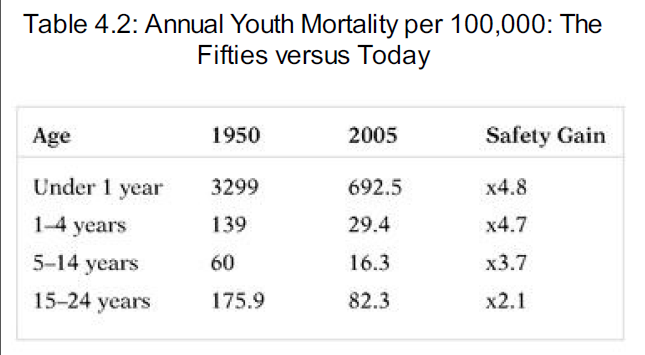
Of course, reported stats are overstated by false reports and understated by undetected crime, but this is the best evidence we have. Using morality statistics (a cleaner stat), we see the same pattern. From Caplan’s book Selfish Reasons to Have More Kids:

child safety

So the world is getting safer for our children, but why then do people believe that it is not? When you tell people about the worst mom in America, they will be horrified and then tell you a story about a friend’s friend who had something bad happen.

Two items of note. One, did the parents of that particular child engage in protective parenting? If so, how is that an argument for being protective?

Two, the story is never about a personal friend or their own children. It always happened to “someone” who lives in town or “someone” my sister knows. Statistically speaking, this makes sense. Each individual knows about 600 people. Assuming the contacts are unique, the maximum immediate reach of “people known by people we know” is 360,000 people (600 x 600). Add to that the fact that any news story will stick out in people’s minds, or the fact that “children being hurt” gossip spreads like wildfire among parents, then statistically yes, anyone someone talks to will have some sort of antidotal evidence that is some way related to their point. This evidence is manifestly not representative of the state of American crime.

But shouldn’t Americans rather be safe than sorry? Fear mongering creates a safer environment for children at the margin. This is true, but increased worries about crime, sexual abuse, and the evils of this world heavily dissuade people from having children. Fear mongering leads to the death of babies through abortion and the nonexistence of valuable human beings through increased use of birth control. The entire thesis of Bryan Caplan’s book is that the perceived cost of (harms to) children are not accurate, if we start believing the evidence we would have more children. More children makes the world a better place.

Posted in Abortion, Goverment, History, Human Nature, Standard of Living, Statistics | Leave a comment

overstating your case

People inherently think that they are correct. If people did not think they were correct, they would not hold those particular views. And although everyone claims not to be perfect, few people show real actions that confirm that they think their own knowledge is flawed. The best indicator is a change of mind based on new information (preferably about something that actually matters to the individual).

The Bible is against those who are know-it-alls:

1Co 8:2 And if anyone thinks that he knows anything, he knows nothing yet as he ought to know.

In both my previous posts, I confront authors who are very sure of something that even their own evidence does not confirm.

In regards to the ending of Mark, James Tabor writes that “this ending is patently false” and “the evidence is clear.” I show that the evidence is not all that clear.

In regards to women and the Bible, Sean McElwee writes:

Although the right often claims the Bible supports their absurd ideas about gender roles (just like the Bible supported anti-miscegenation) such claims have been thoroughly debunked by theologians.

Going to his link (titled “thoroughly debunked”) we get to a page by N. T. Wright (whom I respect as an author). NT Wright is not quite as confident as his minion about the merits of his argument:

That’s a lot of ‘perhaps’es. We can only guess at the dynamics of the situation – which is of course what historians always do. It’s just that here we are feeling our way in the dark more than usual.

The best approach for understanding complex situations using fragmentary evidence is humility. Intellectual opponents might have valid points or possible points (their conclusions still might not be correct), but dismissing their arguments out of hand or overstating your own case is intellectually dishonest. Sometimes a “yeah, but” is more honest than a “this is patently true”. Confidence might win debates in the eyes of spectators, but it blurs the real issues and is discouraged by the Bible.

Also see: omnipresence and rational irrationality

Posted in Bible, Bible Critics, critical thinking, Human Nature, Women | Leave a comment