the hedonist king sardanapalus

In Athenaeus’ Banquet of the Learned, we read about a hedonist King named Sardanapalus, a somewhat legendary figure. While other historians write of him, Athenaeus seems to provide a complied account including variants of Sardanapalus’ death. Sardanapalus, by all accounts, was born into royalty, lived each day for pleasure and was killed/died due to a resentful soldier. Athenaeus writes:

And another king of this sort was Sardanapalus, whom some call the son of Anacyndaraxes, and others the son of Anabaxarus. And so, when Arbaces, who was one of the generals under him, a Mede by birth, endeavoured to manage, by the assistance of one of the eunuchs, whose name was Sparamizus, to see Sardanapalus; and when he with difficulty prevailed upon him, with the consent of the king himself, -when the Mede entered and saw him, painted with vermilion and adorned like a woman, sitting among his concubines carding purple wool, and sitting among them with his feet up, wearing a woman’s robe, and with his beard carefully scraped, and his face smoothed with pumice-stone (for he was whiter than milk, and penciled under his eyes and eyebrows ; and when he saw Arbaces, he was just putting a little more white under his eyes), most historians, among whom Duris is one, relate that Arbaces, being indignant at his countrymen being ruled over by such a monarch as that, stabbed him and slew him.

But Ctesias says that he went to war with him, and collected a great army, and then that Sardanapalus, being dethroned by Arbaces, died, burning himself alive in his palace, having heaped up a funeral pile four plethra in extent, on which he placed a hundred and fifty golden couches, and a corresponding number of tables, these, too, being all made of gold. And he also erected on the funeral pile a chamber a hundred feet long, made of wood; and in it he had couches spread, and there he himself lay down with, his wife, and his concubines lay on other couches around. For he had sent on his three sons and his daughters, when he saw that his affairs were getting in a dangerous state, to Nineveh, to the king of that city, giving them three thousand talents of gold. And he made the roof of this apartment of large Stout beams, and then all the walls of it he made of numerous thick planks, so that it was impossible to escape out of it. And in it he placed ten millions of talents of gold, and a hundred millions of talents of silver, and robes, and purple garments, and every kind of apparel imaginable. And after that he bade the slaves set fire to the pile; and it was fifteen days burning. And those who saw the smoke wondered, and thought that he was celebrating a great sacrifice; but the eunuchs alone knew what was really being done. And in this way Sardanapalus, who had spent his life in extraordinary luxury, died with as much magnanimity as possible.

… “Sardanapalus was the most happy of all monarchs, who during his whole life preferred enjoyment to everything else, and who, even after his death, shows by his fingers, in the figure carved on his tomb, how much ridicule all human affairs deserve, being not worth the snap of his fingers which he makes [missing word] anxiety about other things.”…

And Amyntas, in the third book of his Account of the Posts, says that at Nineveh there is a very high mound, which Cyrus leveled with the ground when he besieged the city and raised another mound against the city ; and that this mound was said to have been erected by Sardanapalus the son of King Ninus; and that on it there was said to be inscribed, on a marble pillar and in Chaldaic characters, the following inscription, which Chaerilus translated into Greek, and reduced to metre. And the inscription is as follows —

I was the king, and while I lived on earth,
And saw the bright rays of the genial sun,
I ate and drank and loved; and knew full well
The time that men do live on earth was brief.
And liable to many sudden changes,
Reverses, and calamities. Now others
Will have th’ enjoyment of my luxuries,
Which I do leave behind me. For these reasons
I never ceased one single day from pleasure.

Was Paul aware of this story when he wrote “Let us eat, drink, and be merry. For tomorrow we die.“? He was quoting Isaiah 22:13, but the context of his quote seems to fit Sardanapalus.
Posted in History, Human Nature | 2 Comments

repentance in the Bible

Repentance is a very versatile word. It can be used in various contexts to express various meanings. Christians often fall for the mistake of trying to force only a single meaning onto this one word. Some people say repentance always is about repenting of sins and some people say repentance is never talking about repenting of sins. Myself, I believe the quote by Edwin Hatch is extremely relevant:

We tend also to attach an undue importance to phrases which occur in such writers; few, if any, writers write with the precision of a legal document, and the inverted pyramids which have been built upon chance phrases of Clement or Justin are monuments of caution which we shall do well to keep before our eyes.

Repentance in the Bible is used concerning a wide berth of subjects, and the actor we find repenting the most in the Bible is God.

Gen 6:6 And it repented the LORD that he had made man on the earth, and it grieved him at his heart.
Exo 32:14 And the LORD repented of the evil which he thought to do unto his people.
Deu 32:36 For the LORD shall judge his people, and repent himself for his servants, when he seeth that their power is gone, and there is none shut up, or left.
1Sa 15:11 It repenteth me that I have set up Saul to be king: for he is turned back from following me, and hath not performed my commandments. And it grieved Samuel; and he cried unto the LORD all night.
1Sa 15:35 And Samuel came no more to see Saul until the day of his death: nevertheless Samuel mourned for Saul: and the LORD repented that he had made Saul king over Israel.
2Sa 24:16 And when the angel stretched out his hand upon Jerusalem to destroy it, the LORD repented him of the evil, and said to the angel that destroyed the people, It is enough: stay now thine hand. And the angel of the LORD was by the threshingplace of Araunah the Jebusite.
1Ch 21:15 And God sent an angel unto Jerusalem to destroy it: and as he was destroying, the LORD beheld, and he repented him of the evil, and said to the angel that destroyed, It is enough, stay now thine hand. And the angel of the LORD stood by the threshingfloor of Ornan the Jebusite.
Jer 18:8 If that nation, against whom I have pronounced, turn from their evil, I will repent of the evil that I thought to do unto them.
Jer 26:3 If so be they will hearken, and turn every man from his evil way, that I may repent me of the evil, which I purpose to do unto them because of the evil of their doings.
Jer 26:13 Therefore now amend your ways and your doings, and obey the voice of the LORD your God; and the LORD will repent him of the evil that he hath pronounced against you.
Jer 26:19 Did Hezekiah king of Judah and all Judah put him at all to death? did he not fear the LORD, and besought the LORD, and the LORD repented him of the evil which he had pronounced against them? Thus might we procure great evil against our souls.
Jer 42:10 If ye will still abide in this land, then will I build you, and not pull you down, and I will plant you, and not pluck you up: for I repent me of the evil that I have done unto you.
Amo 7:3 The LORD repented for this: It shall not be, saith the LORD.
Amo 7:6 The LORD repented for this: This also shall not be, saith the Lord GOD.
Jon 3:10 And God saw their works, that they turned from their evil way; and God repented of the evil, that he had said that he would do unto them; and he did it not.

And now for the kicker:

Jer 15:6 Thou hast forsaken me, saith the LORD, thou art gone backward: therefore will I stretch out my hand against thee, and destroy thee; I am weary with repenting.

God gets weary of repenting! I got weary of quoting about Him repenting, and this list does not even include the times God repents not using the word “repent” or the times the word “repent” is translated differently.

Now Pastor Anderson correctly notes that the NKJV translates all these verses differently. He sees this as a vast conspiracy to disassociate God from repentance to then trick people into thinking repentance has to do with sin. The more likely explanation is that the Calvinist translators were embarrassed by God’s repentance and were covering up the text of the Bible.

Pastor Anderson seems to make the mistake of interpreting repentance as never involving sins. But Jesus links repentance and sins:

Mat 9:13 But go ye and learn what that meaneth, I will have mercy, and not sacrifice: for I am not come to call the righteous, but sinners to repentance.

So Jesus is here calling “sinners” to repentance. If the repentance did not involve sins, then why is the group labeled “sinners”. The one defining characteristic of the group called to “repent” is that they “sin”. Jesus uses the word repent concerning the “Kingdom of God”. Whenever Jesus extrapolates on the conditions for entering the Kingdom of God, it involves following commandments. See the rich young ruler:

Mat 19:17 And he [Jesus] said unto him, Why callest thou me good? there is none good but one, that is, God: but if thou wilt enter into life, keep the commandments…
Mat 19:24 And again I say unto you, It is easier for a camel to go through the eye of a needle, than for a rich man to enter into the kingdom of God.

Jesus answered a question about inheriting eternal life by saying that someone inherits eternal life by “keeping the commandments”. So Jesus links sin, eternal life, the Kingdom of God, commandments, and repentance. This is not an isolated example. The concepts seem linked in Jesus’ ministry.

But repent is not always used in conjunction with sin. Jesus uses the word to illustrate a change of mind in one parable:

Mat 21:28 But what think ye? A certain man had two sons; and he came to the first, and said, Son, go work to day in my vineyard.
Mat 21:29 He answered and said, I will not: but afterward he repented, and went.

Paul uses the word to show he is not sorry about an action that is not even a sin:

2Co 7:8 For though I made you sorry with a letter, I do not repent, though I did repent: for I perceive that the same epistle hath made you sorry, though it were but for a season.

Repentance in English culture, just as the Greek and Hebrew cultures, can mean various things. In the Bible, the word is no different. Repentance is used of God, of Paul changing his mind about offensive actions, of people deciding to do different things, and of people turning from sins. It is a mistake to advocate a fixed and inflexible definition of the word.

Posted in Bible, Dispensationalism, God, Open Theism, Textual Criticism, Theology | Leave a comment

paul was afraid of different heresies than the disciples

I have written before about the separate ministries of Paul versus the rest of the apostles. One such minor issue which illustrates their different gospels is what heresies each group condemns. Both groups, that of Paul and that of the twelve, spoke volumes about what kind of heresies and false teachers were infiltrating the church, but Paul seems to identify groups entirely different than the apostles. And the apostles seem to ignore the groups that Paul worries about.

Here is a sampling of the apostles:

Jud 1:4 For there are certain men crept in unawares, who were before of old ordained to this condemnation, ungodly men, turning the grace of our God into lasciviousness, and denying the only Lord God, and our Lord Jesus Christ.

Notice the “lasciviousness”. Jude was speaking about people coming into the church and promoting a sinful lifestyle.

2Pe 3:16 As also in all his epistles, speaking in them of these things; in which are some things hard to be understood, which they that are unlearned and unstable wrest, as they do also the other scriptures, unto their own destruction.
2Pe 3:17 Ye therefore, beloved, seeing ye know these things before, beware lest ye also, being led away with the error of the wicked, fall from your own stedfastness.

Peter points to people using Paul to twist his words “unto their own destruction” “with the error of the wicked”. He seems to be talking about sinful behavior.

1Jn 4:1 Beloved, believe not every spirit, but try the spirits whether they are of God: because many false prophets are gone out into the world.
1Jn 4:2 Hereby know ye the Spirit of God: Every spirit that confesseth that Jesus Christ is come in the flesh is of God:

John identifies those that do not recognize Jesus as having come in the flesh. This is somewhat paralleled in 1 Corinthians 15 when Paul addresses those who do not believe Jesus rose from the dead.

2Jn 1:9 Whoever transgresses and does not abide in the doctrine of Christ does not have God. He who abides in the doctrine of Christ has both the Father and the Son.

Here John writes against “transgressions”. Earlier in the same chapter John talks about “walking in the commandments”. This seems also to be about sin.

Rev 2:14 But I have a few things against you, because you have there those who hold the doctrine of Balaam, who taught Balak to put a stumbling block before the children of Israel, to eat things sacrificed to idols, and to commit sexual immorality.
Rev 2:15 Thus you also have those who hold the doctrine of the Nicolaitans, which thing I hate.
Rev 2:16 Repent, or else I will come to you quickly and will fight against them with the sword of My mouth.

Here John condemns two groups of heretics in the church of Pergamos. The first group follows Balak, which has individuals eat things sacrificed to idols (food) and commit sexual immorality. As a shocking side note: these are the exact two issues that Paul tells people are not critical in 1Co 6:13. He explicitly was mentioning food sacrificed to idols and sexual immorality. Paul taught the exact opposite of Rev 2:14.

The second group identified in Revelation 2 is a group called the Nicolaitans. This is a very enigmatic group and should probably best be understood by Irenaeus’ explanation in his book Against Heresies:

3. The Nicolaitanes are the followers of that Nicolas who was one of the seven first ordained to the diaconate by the apostles. They lead lives of unrestrained indulgence. The character of these men is very plainly pointed out in the Apocalypse of John, [when they are represented] as teaching that it is a matter of indifference to practise (sic) adultery, and to eat things sacrificed to idols. Wherefore the Word has also spoken of them thus: But this you have, that you hate the deeds of the Nicolaitanes, which I also hate.

With this sampling, it was clear that the apostles were afraid of those who taught people to sin. John was furthermore concerned with people who denied Christ came in the flesh and with people who ate food sacrificed to idols (a symbolic ordinance). Whether the other apostles included symbolic law in their “works” and “sin” proclamations is ambiguous.

Paul’s concerns were very different:

Gal 1:8 But even if we, or an angel from heaven, preach any other gospel to you than what we have preached to you, let him be accursed.
Gal 1:9 As we have said before, so now I say again, if anyone preaches any other gospel to you than what you have received, let him be accursed.

Paul’s main fear was that people who come and preach a different doctrine or gospel. We do not find him worrying about people coming into the church to convert people to a sinful life. Although Paul does say to cast out sinners from the church 1Co 5:1, Paul says it is for their own good such that “his spirit may be saved” (1Co 5:5). Paul seems more concerned about the sinner than other people converting to sin.

Gal 2:4 And this occurred because of false brethren secretly brought in (who came in by stealth to spy out our liberty which we have in Christ Jesus, that they might bring us into bondage),

The theme of Galatians is consistent: people are converting Paul’s converts to a works salvation. Paul equates the “law” to bondage, a theme also not found in the 12 disciples.

2Co 11:13 For such are false apostles, deceitful workers, transforming themselves into apostles of Christ…
2Co 11:15 Therefore it is no great thing if his ministers also transform themselves into ministers of righteousness, whose end will be according to their works…
2Co 11:22 Are they Hebrews? So am I. Are they Israelites? So am I. Are they the seed of Abraham? So am I.

In 2 Corinthians, we see a repeat of the Galatians and Acts 15 incident which concerns those telling Paul’s apostles to convert to works (like circumcision). This is not about people converting to sin.

Act 20:29 For I know this, that after my departure savage wolves will come in among you, not sparing the flock.
Act 20:30 Also from among yourselves men will rise up, speaking perverse things, to draw away the disciples after themselves.

This text is ambiguous whether the “perverse things” are “perverse as in sin” or “perverse” as in “false”, then word mentioned in Galatians 2:4. I think we are safe to assume it references the same teachings Paul addresses elsewhere.

2Th 3:6 But we command you, brethren, in the name of our Lord Jesus Christ, that you withdraw from every brother who walks disorderly and not according to the tradition which he received from us.
2Th 3:7 For you yourselves know how you ought to follow us, for we were not disorderly among you;
2Th 3:8 nor did we eat anyone’s bread free of charge, but worked with labor and toil night and day, that we might not be a burden to any of you,

The context of this verse is talking more about freeloaders than heretics. Paul warns against freeloaders.

Rom 16:17 Now I urge you, brethren, note those who cause divisions and offenses, contrary to the doctrine which you learned, and avoid them.
Rom 16:18 For those who are such do not serve our Lord Jesus Christ, but their own belly, and by smooth words and flattering speech deceive the hearts of the simple.

In Romans, although Paul again is concerned about “doctrine”, this might have more to do with 2 Thessalonians than Galatians. Paul references people’s bellies. People were using the gospel to get rich. In Philippians, Paul seems not to mind the harmless self-seekers:

Php 1:15 Some indeed preach Christ even from envy and strife, and some also from goodwill:
Php 1:16 The former preach Christ from selfish ambition, not sincerely, supposing to add affliction to my chains;
Php 1:17 but the latter out of love, knowing that I am appointed for the defense of the gospel.
Php 1:18 What then? Only that in every way, whether in pretense or in truth, Christ is preached; and in this I rejoice, yes, and will rejoice.

Paul’s fears about heresies were centered around people preaching another gospel and people who were self-focused. The apostles feared sin and lawlessness. There does not to be much overlap in their respective fears. This is just a minor illustration of the different ministries of Paul and that of the apostles.

Posted in Bible, Dispensationalism, Theology | 3 Comments

taking things by faith

In modern Christian discussions, when one hears that Christians must “take things by faith” that is usually code for “taking what the pastor says by faith” and ignoring the Bible. Man’s teaching is being elevated higher than the Bible. This is usually the cop out for anyone struck by a clear Bible text that contradicts their core understanding of the Bible.

Those who feel some obligation to be true to the Bible cannot ignore pointed questions for long. The hardcore Calvinist will avoid them all day, using any excuse not to answer straightforward questions like the scary “what does this text mean?” and the dreaded “what is happening in this text?”. That is the beauty of the Bible: a straightforward reading trumps pagan interpretation.

Try asking any of the following to a Calvinist and see what happens:

1.

Gen 18:20 And the LORD said, Because the cry of Sodom and Gomorrah is great, and because their sin is very grievous;
Gen 18:21 I will go down now, and see whether they have done altogether according to the cry of it, which is come unto me; and if not, I will know.

Q: What does “I will go down now, and see” mean?

2.

Jer 18:8 If that nation, against whom I have pronounced, turn from their evil, I will repent of the evil that I thought to do unto them.

Q: What does “I thought to do” mean?

3.

1Ki 22:19 Then Micaiah said, “Therefore hear the word of the LORD: I saw the LORD sitting on His throne, and all the host of heaven standing by, on His right hand and on His left.
1Ki 22:20 And the LORD said, ‘Who will persuade Ahab to go up, that he may fall at Ramoth Gilead?’ So one spoke in this manner, and another spoke in that manner.
1Ki 22:21 Then a spirit came forward and stood before the LORD, and said, ‘I will persuade him.’
1Ki 22:22 The LORD said to him, ‘In what way?’ So he said, ‘I will go out and be a lying spirit in the mouth of all his prophets.’ And the LORD said, ‘You shall persuade him, and also prevail. Go out and do so.’
1Ki 22:23 Therefore look! The LORD has put a lying spirit in the mouth of all these prophets of yours, and the LORD has declared disaster against you.”

Q: List the events that are being described in this text?

The Calvinist’s first instinct is to try to avoid the clear text of the Bible. They might appeal to generalities “God does not lie” or “God knows everything”, but the best strategy is to focus on the text. Don’t let debating semantics derail the conversation. Debating semantics is how the Calvinist walks away still confident in their own beliefs. Keep asking the question until they answer. With enough times repeating the question, the real point will be clear that the individual cannot explain the clear text of the Bible. The plain text of the Bible discredits their belief! That is what the Calvinist needs to understand.

In my experience, at this point the Calvinist will retreat to “we need to take things by faith.” This means they need to trust their pastor over the Bible. The hardcore Calvinist will just say the text is anthropomorphism. But the point should then be pressed that even figures of speech have meaning, there is no rational figurative meaning and nowhere in the text does it suggest the audience was to take the text figuratively. The Calvinist is left taking Platonism by faith.

As an afterthought: When your Achilles’ Heel is the Bible, you may want to re-examine your beliefs.

Posted in Bible, Calvinism, Christian Cliches, Open Theism, Theology | Leave a comment

paul taught salvation by faith alone

1Co 6:12 All things are lawful unto me, but all things are not expedient: all things are lawful for me, but I will not be brought under the power of any.

In 1 Corinthians Paul tells Christians that “all things are lawful” for him. He is using himself as an example for others, saying “all things” are lawful for all Christians. This is in the direct context of Paul listing moral sins (as opposed to symbolic laws such as circumcision).

1Co 6:9 Know ye not that the unrighteous shall not inherit the kingdom of God? Be not deceived: neither fornicators, nor idolaters, nor adulterers, nor effeminate, nor abusers of themselves with mankind,
1Co 6:10 Nor thieves, nor covetous, nor drunkards, nor revilers, nor extortioners, shall inherit the kingdom of God.
1Co 6:11 And such were some of you: but ye are washed, but ye are sanctified, but ye are justified in the name of the Lord Jesus, and by the Spirit of our God.

So what does 1Co 6:12 mean? To illustrate this verse Paul then uses two examples: food and fornication:

1Co 6:13 Meats for the belly, and the belly for meats: but God shall destroy both it and them. Now the body is not for fornication, but for the Lord; and the Lord for the body.

Food concerns the symbolic law and fornication concerns the moral law. It is not a coincidence that Paul uses these examples. Paul says “all things” are lawful for him, and places this between two sets of verses talking about moral sins. Paul is saying that he very well can sin because he is not under the law. Both the symbolic and the moral law do not apply to him. Paul tells us not to sin because “it is not expedient”. Sinning hurts ourselves and others, but it will not lead to damnation.

So what how do modern Christians criticize “salvation by faith alone”? One way is to play on moral outrage. This takes multiple forms:

1. Pointing out that persistent sinners might go to heaven. For example: “Are you saying a serial killer that keeps killing children will go to heaven?”

2. Pointing out that there are no incentives to not sin. For example: “If that is true, then there is no reason not to sin.”

3. Pointing out that if we are shown grace by being forgiven of our sins, then the more we sin the more grace will be shown to us.

Paul was not immune to the same criticism. Paul actually spends his time addressing these concerns:

Rom 5:19 For as by one man’s disobedience many were made sinners, so by the obedience of one shall many be made righteous.
Rom 5:20 Moreover the law entered, that the offence might abound. But where sin abounded, grace did much more abound…
Rom 6:1 What shall we say then? Shall we continue in sin, that grace may abound?

Paul’s critics were saying that Paul’s gospel led to the logical conclusion of continuing in sin. Paul was well aware of these criticisms as uses Romans 6 to address them. He answers and says:

Rom 6:2 God forbid. How shall we, that are dead to sin, live any longer therein?

His point is not that people will not be saved, but that we should abandon sin. He reemphasizes this point later:

Rom 6:14 For sin shall not have dominion over you: for ye are not under the law, but under grace.
Rom 6:15 What then? shall we sin, because we are not under the law, but under grace? God forbid.

Paul’s critics were saying that Paul was giving people licence to sin. Paul’s response is not “oh no, you do not understand me. Salvation is only to those who do not sin.” No, Paul responds by saying sin is hurtful and we should be servants of God (see also 1 Cor 6:12). It is not a matter of salvation or damnation; it is a matter of principle:

Rom 6:16 Know ye not, that to whom ye yield yourselves servants to obey, his servants ye are to whom ye obey; whether of sin unto death, or of obedience unto righteousness?

In Paul’s theology there was no such thing as losing salvation due to subsequent sin. In Paul’s theology faith in a historical event was the main focus (1 Cor 15). In Paul’s theology Christians did not have to persist in good works to continue in salvation. If modern preachers are not getting the same criticisms that Paul was receiving, they might want to reevaluate what they are preaching.

Posted in Bible, Dispensationalism, Morality, Theology | 10 Comments

a gnostic Jesus

The Gospel of Thomas was discovered in the Nag Hammadi library, a collection of gnostic texts discovered in 1945. Most scholars date the original Gospel of Thomas to the middle of the second century. One of the most interesting facets of this text is that it is a “sayings” gospel. It does not provide narrative, but only a list of sayings by Jesus (almost no one believes they are authentic quotes). Contrast to this the four gospels in the Bible; each can be described as a passion narrative with a long intro. In other words, Matthew, Mark, Luke, and John focus on the death and resurrection of Jesus. The Gospel of Thomas does not mention the death and resurrection of Jesus, only quotes. The quotes listed in the Gospel of Thomas somewhat mirror Matthew, Mark, Luke and John. But sometimes the quotes widely vary from what it found in the Bible:

77 Jesus said, “I am the light that is over all things. I am all: from me all came forth, and to me all attained. Split a piece of wood; I am there. Lift up the stone, and you will find me there.”

It may be hard to understand the exact point of this verse. The Gnostics wrote very cryptic sayings. The point of Gnosticism was so that only a select few would understand the true meaning.

If the Gnostics were mirroring the Mystery religions, this text might be proclaiming something like a focus item. The Mystery religions held mundane items as contemplative objects mean to inspire spirituality. Splitting a piece of wood or lifting stones might be a contemplative action.

But if the Gnostics were mirroring the Platonists, this verse might really be a claim for omnipresence of Jesus. Jesus might be said to be in all things. They have Jesus saying “I am all”, which might be related to Plato’s theory of Forms. Jesus is everywhere and nowhere, representing perfection.

If the latter is true, the Gnostic were much closer to the Calvinist’s perceptions of Jesus than the Calvinists might like to admit.

Posted in Gnostics, History, Jesus, Mystery Cults, Omnipresence, Theology | 1 Comment

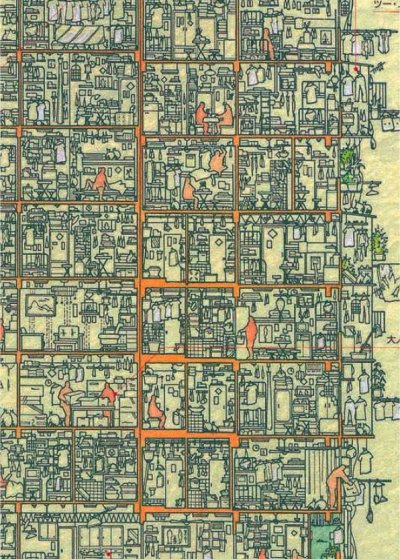
anarchy in the walled city

All this intensity of random human effort and activity, vice and sloth and industry, exempted from all the controls we take for granted, resulted in an environment as richly varied and as sensual as anything in the heart of the tropical rainforest. The only drawback is that it was obviously toxic. City of Darkness

My favorite example of a successful anarchist state is that of the Kowloon Walled City. This is not a white European anarchist experiment, like Pennsylvania or Moresnet, but it is an experiment by the dregs of society within the state of Hong Kong. What is very telling is this anarchist state did not collapse on its own (like so many utopian experiments). The people were forcefully evicted and the government tore down the structure (1993).

The Kowloon Walled City began as a fluke of history. The Chinese retained control of this area when Hong Kong was leased to the British, although the British later claimed jurisdiction. With the Chinese still claiming title, the residents threatened to start international incidences if the British tried to exert control. Without a real government, the Kowloon Walled City grew into “six-and-a-half acres of solid building, home to 33,000 people”. It was home to drug dealers, opium dens, prostitutes and a thriving black market industry, including unregulated cigarettes, medicine, and dentistry (oh mi!).

There were no thoroughfares in the City – and no vehicles except the odd bicycle – only hundreds of alleys, each different. From the innocuous, neutral outside you plunged in. The space was often no more than four feet wide. Immediately, it dipped and twisted, the safe world outside vanished, and the Walled City swallowed you up.

The city itself was a labyrinth of hallways and small rooms. It grew steadily upwards. There was no central planner directing upwards construction. The power grid was haphazardly erected. On ground level, no light could be seen. The main source of physical threat to the residents was the triads, who had more interest in protecting their opium trade than regulating the lives of citizens.

Medical and dental care were no problem at all: many of the residents were doctors and dentists with Chinese qualifications and years of experience but lacking the expensive pieces of paper required to practice in the colony. They set up their neat little clinics in the City, oases of cleanliness and order, and charged their patients a fraction of what they would pay outside.

With no building inspectors or code enforcers, the room rents were cheap. With no government regulators, any person could work for any business or create any business they liked. Without any colonial police, no person was asked for citizen papers or harassed in any like manner. Interviews with residents show normal people, living normal lives.

The government of Hong Kong refused to allow the Walled City to tap into their public water system. The Walled City assembled 77 wells, pumped it to the roofs and then a series of “ad hoc” pipes funneled the water throughout the complex. In spite of the government, the city was able to provide water to 33,000-50,000 people living in a 6 acre area.

While the Walled City was not without flaws, it sustained tens of thousands of people with minimal to no government involvement.

There are two main books of the Kowloon Walled City. Jackie Pullinger published Crack in the Wall in 1993, relating 25 years worth of her experiences as a missionary inside the Walled City. The second book is called City of Darkness, written by a journalist and is written in the fashion of character profiles of various people living within the city. Both reveal the genius decentralized human action.

On the design website 99percentinvisible.org, they host several photos of the walled city, and also link to a Jean-Claude Van Damme movie featuring the city.

What fascinates about the Walled City is that, for all its horrible shortcomings, its builders and residents succeeded in creation what modern architects, with all their resources of money and expertise, have fail to: the city as ‘organic megastructure’, not set rigidly for a lifetime but continually responsive to the changing requirements of its users, fulfilling every need from water supply to religion, yet providing warmth and intimacy of a single household.

Kowloon Walled City

Posted in Economics, Goverment, History, Human Nature, Standard of Living, Trade | Leave a comment

understanding the dollar and exchange rates

It is a common talking point by laymen that the US dollar should trade at par or greater than the Canadian dollar, the British Pound or the EU dollar. If they wish to make the point that the EU is doing better than the US, they might ask how many Euros can one get for a dollar (the current exchange rate is $0.74 USD per Euro). The thing about this is that nominal monetary denominations are absolutely worthless in determining the relative strengths of economies. In reality, there is no reason to assume any basic unit of money should be equal to a unit of money in another country. The value of money is determined by the output of society relative to the amount of currency in circulation (and how fast it circulates). If a nuke blew up the entire EU, the Euro would quickly plummet in value (maybe trading at millions per US dollar).

Americans get stuck in a strange mindset that a dollar should be a dollar of a foreign currency anywhere else in the world. It should not. Where it is close (like the US and Canada), it is coincidental. An American dollar can get 13 Pesos in Mexico. That does not mean that the American can then go buy 13 Double Cheeseburgers from the dollar menu at McDonald’s. In fact, it turns out that the price of McDonald’s products are subject to the law of one price, and are roughly the same amount of money (converted into any currency) all over the world. The Economist publishes regularly the Big Mac index to illustrate this.

Converting the Euro price of a Big Mac to American currency results in a price of $4.66. The American price of a Big Mac currently averages $4.56. By my account, the dollar is doing better than the Euro because we can by more things with the same amount of money (while at the same time making more money per person). The current exchange rate does not matter as much as the products people can buy with the same money.

This is why economists look at changes in exchange rates instead of nominal exchange rates. And even that can be deceiving.

Posted in Economics, prices, Trade | Leave a comment

your pastor might be a psychopath

On Big Think. This video relates to the person you are “dating” but the same concepts apply to other areas of our lives as well: our boss at work, a friend in college, and even some pastors in churches:

The “tells”:

1. They play on their pity. They excuse their bad behavior with excuses.
2. Narcissistic. They believe the world centers around them.
3. Charming and manipulative in crowd. Controlling in private.

What should we do:

1. Watch their behavior, not their words.
2. Get a second opinion.
3. Don’t cover for them.

Posted in Human Nature, videos | Leave a comment

how God is eternal

One negative attribute of God described in the Bible is that God is eternal. The Calvinists see this word and instantly prescribe a scenario in which God lives in an “eternal now”. This is not a concept found in the Bible, much less alluded to in the Bible. Israel understood God as eternally existing, but acting always in the present (the future was always contingent and changing). The idea that there could even be such a thing as an eternal now is foreign to Israel’s testimony about God. God acts in time. God is relational. God responds as events occur. The testimony of the Old Testament concerns how God is interacting with Israel in their own day.

But in regards to the Biblical definition of eternal, Psalms describes the actually meaning of this word:

Psa 90:2 Before the mountains were brought forth, or ever thou hadst formed the earth and the world, even from everlasting to everlasting, thou art God.

“From everlasting to everlasting” is the technical definition of “eternal”. The concept is repeated elsewhere in the Bible. In Isaiah the claim is made that God’s name is from everlasting (Isa 63:16). Elsewhere the Bible says God’s years will never end (Psa 102:27) and it does so in the context of man aging.

Notice how all these concepts involve timeframes. God has no beginning and no end, but has always existed and always will. The past and future are presented as points of time (infinite). This should be contrasted to the Calvinist’s picture that God resides outside of space and time. There is nothing in the text which describes the “eternal now” popular among Calvinists.

In Isaiah 57, God is said to “inhabit eternity”:

Isa 57:15 For thus says the High and Lofty One Who inhabits eternity, whose name is Holy: “I dwell in the high and holy place, With him who has a contrite and humble spirit, To revive the spirit of the humble, And to revive the heart of the contrite ones.

God “inhabits eternity”. Literally translated this mirrors Isaiah 63:16. God “resides” from “of old” or “from eternity past to eternity future”. Elsewhere, Isaiah uses the same word “eternity” in conjunction with human beings:

Isa 26:4 Trust ye in the LORD for ever: for in the LORD JEHOVAH is everlasting strength:

Isa 45:17 But Israel shall be saved by the LORD With an everlasting salvation; You shall not be ashamed or disgraced Forever and ever.

At first glance, one might think that the same word used for “eternal” in Isaiah 57:15 is paralleled by the words “everlasting” in Isaiah 26:4 and Isaiah 45:17. But it is not. The word “Forever” is actually the same word for “eternal”. In these verses “eternal” is an attribute relational to human beings. People should trust God “eternally” and will not be ashamed “forever”. “Eternal” is not an “eternal now” but an actual timeframe.

The concept of God as depicted in the Bible is one in which God has always existed and always will. Israel, in the Old Testament, uses God’s eternal nature to stress His power. As with the rest of their testimony, stressing God’s eternity is always in the context of what God can do or will do for Israel. It is not used in the context of stressing a lofty metaphysical concepts, as the Calvinist would have us believe.

One thing to note about “eternity” is that the Old Testament has 23 thousand verses. There are about 8 verses used to ask questions about God’s “eternal” nature. Israel primarily was unconcerned about this concept, and when Christian today so heavily focus on these things they are disregarding what the Bible says is important about God. Contrast that with the 48 times God is called “Almighty” and countless others stressing God’s power.

Posted in Bible, Calvinism, God, Open Theism, Theology | 2 Comments