Jesus and godhead

Norman Geisler has a specific book entitled “Creating God in the Image of Man”. In this book, Geisler criticizes Open Theists for not accepting the negative attributes (Simple, perfect, eternal (in the timeless sense), omnipresent, omnipotent, omniscient, immutable, impeccable, ineffable, invisible, infinite, unknowable) of God. Geisler argues that God is: Aseity, Simplicity, Necessity, Immutability, Impassability, Eternity, and Unity. If these do not sound like Biblical concepts, it is because they are not. They come straight from the pages of Plato and Plotinus.

The Apostle Paul fought the same Gnostics in his day. In the time of Jesus and Paul, Platonism taught that the physical was evil and inferior to the metaphysical. The goal of Platonism was to escape the physical. When the Gnostics began merging Platonism and Christianity, they had a real problem: Jesus’ divinity. Gnostics began building complicated theories on how Jesus could be divine but have physical aspects. In other words, the Gnostics built a negative theology concerning Jesus. Paul responds:

Col 2:8 Beware lest anyone cheat you through philosophy and empty deceit, according to the tradition of men, according to the basic principles of the world, and not according to Christ.
Col 2:9 For in Him dwells all the fullness of the Godhead bodily;

Colossians 2 is all about Platonism. Paul critiques, mocks, and counters Platonism throughout this text. In Colossians 2:8 and 9, Paul writes not to let anyone cheat “you through philosophy”. Paul explains his meaning in the next verse: In Jesus dwells all the fullness of the Godhead bodily. Paul was countering the Gnostic claim that physical humanity could not be divine. Jesus is our picture of God. God is not a list of negative attributes, but living and breathing.

Geisler and Calvinists like him represent the modern Gnostics. The Calvinists argue time and time again that Jesus “lay aside his divine attributes (such as omniscience)”. The Calvinists begin creating complicated theories on how Jesus could be man yet divine. Paul counters this Gnosticism. Paul says “look at Jesus” and “that is God”. The physical is not separate from the divine. The negative attributes of God are not Godhead. Paul was countering Calvinism when it was still known as Gnosticism.

Posted in Bible, Calvinism, Gnostics, Jesus, Open Theism | 8 Comments

when God was called baal

An interesting passage from Joe Hoffman’s And God Said: How Translations Conceal the Bible’s Original Meaning. It shows how the English translations miss certain imagery depicted in the Bible:

Even though it is Hosea who is married to the harlot, Hosea specifically calls God the “husband,” using two Hebrew words for the metaphor. The first word is ishi –literally, “my man.”… The second is ba’ali – literally, “my lord.” But ba’al is also the name of a pagan god, which we spell with a capital letter: Baal. So the two names for God are “my husband/man” and “my husband/pagan god”!

Hosea’s imagery depends closely on the word he chooses. Things will right themselves when (Hosea 2:1, numbered 2:3 by Jews) people will call their brothers “My-people” (as opposed to “Not-my-people”), when they call their sisters “Loved” (as opposed to “Unloved”), and when their God (2:16, 2:18, for Jews) is ishi, “my husband,” with no connotations of pagan worship, instead of ba’ali, “my husband,” who shares a name with the pagan god Baal.

Also see: understanding Hosea 1

Posted in Figures of Speech, God | Leave a comment

when Jesus marginalized the poor

In the book of Mark, there is a scene in which a sinful woman (as a side note, this is probably NOT a prostitute but a Jewish woman who did not keep the symbolic law), pours over a year’s worth of wages over Jesus’ head:

Mar 14:3 And being in Bethany at the house of Simon the leper, as He sat at the table, a woman came having an alabaster flask of very costly oil of spikenard. Then she broke the flask and poured it on His head.
Mar 14:4 But there were some who were indignant among themselves, and said, “Why was this fragrant oil wasted?
Mar 14:5 For it might have been sold for more than three hundred denarii and given to the poor.” And they criticized her sharply.

The apostles rally in disgust. They respond: “What about the poor?”. But Jesus was not interested in “social justice” or “public welfare”, Jesus responds by marginalizing the poor:

Mar 14:6 But Jesus said, “Let her alone. Why do you trouble her? She has done a good work for Me.
Mar 14:7 For you have the poor with you always, and whenever you wish you may do them good; but Me you do not have always.

The “poor will always be with you” is not a statement that “we always need to remember the poor and look out of them”. This is instead a statement by Jesus marginalizing the poor. It is the equivalent of a wife saying to her husband: “you can always watch TV, but let’s go to the concert tonight.” The TV is made less important by comparison to something that is fleeting. Jesus is saying “forget about the poor for a moment and focus on me.” You won’t find that on any Christian leftist meme.

Jesus meme

Posted in Bible, Jesus | Leave a comment

misquoted verses – one day is like a thousand years

In theological debates, Christians often point to 2 Peter 3:8 whenever they want to speak to God’s interaction with time:

2Pe 3:8 But, beloved, do not forget this one thing, that with the Lord one day is as a thousand years, and a thousand years as one day.

This verse is used to say that God is outside of time, or God experiences time in some sort of different manner (for than just regarding time differently). But in context, that explanation makes no sense. If placed in context, those understandings of the verse are not intelligible. The context is about a delay in the coming apocalypse:

2Pe 3:1 Beloved, I now write to you this second epistle (in both of which I stir up your pure minds by way of reminder),
2Pe 3:2 that you may be mindful of the words which were spoken before by the holy prophets, and of the commandment of us, the apostles of the Lord and Savior,

Jesus’ primary gospel was the coming of the Kingdom of God, an event in which angels would round up the wicked and kill them. Jesus preached that individuals should turn from their sins and hold fast. Peter here is reminding his listeners of both these things. By the time 2 Peter was written, doubts about the coming apocalypse were circulating. Peter sets up the reader to address this particular point. He continues:

2Pe 3:3 knowing this first: that scoffers will come in the last days, walking according to their own lusts,
2Pe 3:4 and saying, “Where is the promise of His coming? For since the fathers fell asleep, all things continue as they were from the beginning of creation.”

Christians or former Christians were beginning to spread doubts about the second coming. “Where is the promise of his coming?” We see an element of time has passed: the “fathers had fallen asleep”. The problem was that people began “walking according to their own lusts”. Peter was confronting a general rebellion against the ministry of Jesus, a brooding skepticism. Peter next reminds them that judgment was historically real:

2Pe 3:5 For this they willfully forget: that by the word of God the heavens were of old, and the earth standing out of water and in the water,
2Pe 3:6 by which the world that then existed perished, being flooded with water.
2Pe 3:7 But the heavens and the earth which are now preserved by the same word, are reserved for fire until the day of judgment and perdition of ungodly men.

God created the earth and previously destroyed it. Peter’s critics were Jews and believed as much; they just now rejected Jesus’ message about coming doom. Peter appeals to their belief in Noah’s flood. And then Peter claims they are wrong to think a similar judgment is not imminent. It is in this context, Peter utters those famous words:

2Pe 3:8 But, beloved, do not forget this one thing, that with the Lord one day is as a thousand years, and a thousand years as one day.

Peter is not shuffling in some unrelated statement of God being outside of time. This would not make sense in context: “Be assured the end is nigh, because God is outside of time.” That is not what this verse is communicating. Instead Peter is offering reasons why the apocalypse has been delayed and offering assurances that it will soon come to pass.

One day is as a thousand years. God is powerful and could bring to pass His grand plan in one day, in the time it would take people thousands of years. Even if people do not see signs that the end is nigh, one day is all it takes for God to accomplish His will.

A thousand years is as one day. God is patient waiting for repentance. God could wait a thousand years, and it would be as man waiting patiently for one day. That is the contrast.

Peter reinforces this idea:

2Pe 3:9 The Lord is not slack concerning His promise, as some count slackness, but is longsuffering toward us, not willing that any should perish but that all should come to repentance.
2Pe 3:10 But the day of the Lord will come as a thief in the night, in which the heavens will pass away with a great noise, and the elements will melt with fervent heat; both the earth and the works that are in it will be burned up.

So Peter’s argument is that people should be prepared because the apocalypse could come at any moment, any day without foreshadowing. It has only been delayed because God is allowing time for repentance. This reinforces the ideas of the previous verses. Verses 9 and 10 are an explanation of Peter’s metaphor in verse 8! Peter concludes:

2Pe 3:11 Therefore, since all these things will be dissolved, what manner of persons ought you to be in holy conduct and godliness,
2Pe 3:12 looking for and hastening the coming of the day of God, because of which the heavens will be dissolved, being on fire, and the elements will melt with fervent heat?
2Pe 3:13 Nevertheless we, according to His promise, look for new heavens and a new earth in which righteousness dwells.
2Pe 3:14 Therefore, beloved, looking forward to these things, be diligent to be found by Him in peace, without spot and blameless;

Peter reminds his audience that the apocalypse would happen and Peter tells them to remain righteous because the end was coming. Peter was giving credibility to the premise that the end could come at any time and an apology as to why it had not happened as of yet. Peter uses the time illustration for this end. Peter was not interjecting a strange metaphysical concept in the middle of a pointed passage.

What is really interesting is that Peter was trying to convince people that the apocalypse would happen in their own lifetimes, not thousands of years in the future. This entire passage is a plea to prepare for the end, not a claim that the apocalypse would not soon happen. When Augustinian Christians try to explain 2 Peter 3:8, they need to explain how it fits in context. What was Peter communicating in the overall passage? What are his points? How does the time metaphor fit the overall theme? Without this, the verse is unintelligible.


Posted in Bible, Calvinism, Dispensationalism, Figures of Speech, God, Omnipotence, Open Theism, Theology | 2 Comments

new feminism

Tammy Bruce talks about the perils of feminism. She criticizes the feminist desire to emulate men, their new-found disregard for inhibition, and their marginalization of men. She right draws attention to the fact that feminism has destroyed itself, result in a dying generation of women filled with regret about family and careers:

Posted in Human Nature, videos, Women | Leave a comment

knowledge redefined by calvinism

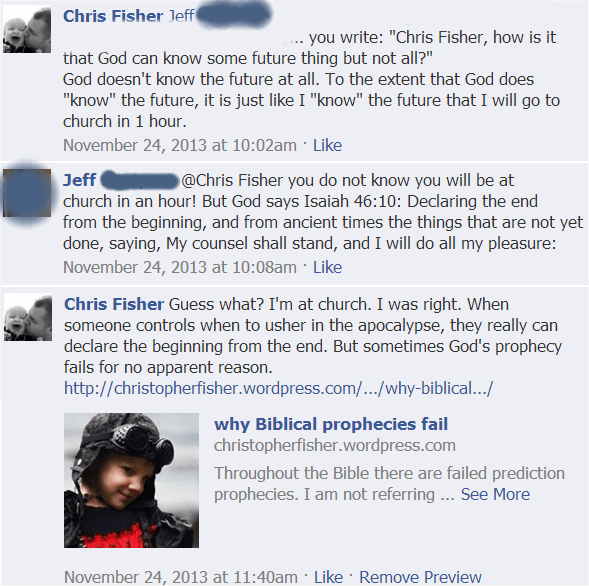
Without fail, every time I go to Walmart I encounter the same experience. I pick items off the shelf and the cashier lets me purchase them. I may have gone yesterday, today, and may go tomorrow; every time the employee will accept my money in exchange for goods. I can be confident that in the years to come Walmart employees will continue to act the exact same fashion. Not a single one will tell me they will not let me purchase toothpaste, chips, or a new shirt. I do not actually know anyone who works at Walmart, so my knowledge is not based on knowing individuals. I do not know their names, their faces, nor anything about their personal life, but even without this knowledge I can foreknow my future experiences at Walmart. I know the future.

Although human beings are free, actions can be predictable. It is not as if Walmart hires robots or androids. Walmart does not hypnotize employees. Walmart does not even hold a gun to their employee’s heads. Walmart incentivizes free will people to act rationally. I can be confident in Walmart employee collective actions, not because I foreknow every single minute action in the future, but because I know the character of the owners of Walmart. The interesting thing is that it does not particularly matter who owns Walmart, I know their character without knowing the individuals. I even foreknow future actions of unknown individuals (future owners and employees of Walmart), many of whom are not yet born.

This knowledge does not make me very powerful. This knowledge does not make me omniscient in any sense of the word. But I know the future none-the-less. The standard definition of knowledge is a “justified true belief”. The same standard which I can say “I know I am currently wearing pants”, “I know that if I tickle my daughter she will laugh”, and “I know that I was once a baby”, is the same standard which I can say “I know that if tomorrow I walk into Walmart, no employee will stop me from handing over cash in exchange for merchandise.”

Now critics can try to be clever. They always try. They say “You do not know that for sure. The world might end tomorrow.” The funny thing is that they are always wrong, and I am always right. But using extreme hypotheticals, the Augustinians open themselves up to claims that they are nihilists. Their definition of knowledge seems to be a 100% certainty without possibility, no matter how slight, of error.

By the Augustinian standard of “knowledge” I do not know I was once a baby. Maybe I am some programed robot or phantasm in a dream that only thinks I was once a baby. Maybe also, I do not know my daughter will laugh when I tickle her. Maybe my daughter is merely a figment of my imagination. I may be highly schizophrenic. Maybe the pants I am wearing are an elaborate mirage induced by crazy scientists messing with my brain.

When critics claim I do not know the future by citing absurd hypotheticals (which never materialize) they undermine the case for knowing anything at all. They make themselves into nihilists, all in the effort to paint an unbiblical picture of God. The Augustinian standard of “knowing” is downright absurd and untenable for rational conversation.

Open Theism

Posted in Calvinism, Human Nature, Prophecy, Theology | 7 Comments

What is Open Theism?

Reprinted from God is Open:

Open Theism has been called many things by many people. A leading critical webpage defines Open Theism as: “the teaching that God has granted to humanity free will and that in order for the free will to be truly free, the future free will choices of individuals cannot be known ahead of time by God.” Although this describes some conclusions of Open Theism, it does not serve as a very good defining characteristic.

Another critical website claims Open Theism is: “the belief that God does not exercise meticulous control of the universe but leaves it “open” for humans to make significant choices (free will) that impact their relationships with God and others.” Although this definition is better, it still just breaks the surface of what the Open Theist movement entails.

The same site also lists the definition by a leading Open Theist, Pastor Bob Enyart of Denver Bible Church. Enyart states: “The future is open because God is free and God is creative. The settled view of God denies God’s own freedom and the ability to create, do something new, etc. God was, is and always will be free. God was, is and always will be a creative God.” This is really the heart of the matter. God is free to do as God pleases. God can write new songs, create new relationships, and even change the future. This is the God that the Bible depicts; a God eternally interacting with His creation, reacting and moving, living and creating, planning and accomplishing all His goals.

Open Theism is the Christian doctrine that the future is not closed but open because God is alive, eternally free, and inexhaustibly creative.

Open Theism is the belief that the Bible depicts God as God truly is. The God of the Bible is truly loving, powerful, dangerous, faithful, vengeful, relational, and desperately beautiful. God raises up nations and destroys them (Isaiah 40:23). God is heartbroken by rebellion and exacts retribution (Genesis 6:6-7). God pleads with His people to return to Him and attempts everything He possibly can to make them love Him (Isaiah 5:4). God is nauseated by heinous sin (Jeremiah 19:5). God forgets His people’s sin for God’s own sake (Isaiah 43:25). God feels scorned and rejected when we abandon Him (Hosea 1:2).

But most of all, God is love (1 John 4:8). God so loved mankind that God made us in His image (Genesis 1:26). Imagine the God of the universe making lowly man into God’s own image! The picture is beautifully breathtaking. God created man for a love relationship! All God’s actions point to God’s love, even His vengeance. God desperately wants man to love Him and will go through extreme lengths to make it happen.

God describes Himself as relational and powerful. God can do everything; God can test people and learn that people love Him (Genesis 22:12), God can listen to new songs (songs WE(!) write for Him) (Psalms 33:3), and God can perform new creations (2 Corinthians 5:17). God even explains His relationship to mankind in the most loving way; God states that He will stop judgment against a nation if they repent (a judgment God “thought to bring upon” the nation)( Jeremiah 18:8). Amazing and righteous! God thinks He is going to destroy a nation, but repents based on human repentance. We see this wonderfully illustrated in Jonah, where the most wicked people on Earth repent and then God does not bring upon them “what He said He would bring upon them” (Jonah 3:10).

God so loved sinners that time and time again He laments about our unbelief. In fact God states that He tried so hard to save us that He expected(!) us to turn to God, but we did not (Jeremiah 3:7). In God’s infinite love, God has given us the ability to interact with Him, and the freedom to reject Him despite His best efforts! The God of the Bible responds to His creation.

Because God is righteous, God answers criticism. God answers the pagan king Abimelech when the king questions God (Genesis 20:4). God responds to critics. He does not ignore them as if their reasoning did not matter.

This is the God of the Bible. Open Theism claims that the Bible should not be ignored when it speaks about who God is and what God is like. The God of the Bible is truly loving, powerful, dangerous, faithful, vengeful, relational, and desperately beautiful. God is a complex, free, and wonderful person. God is hopelessly personal. That is the position of Open Theism.

Posted in God, Omnipotence, Open Theism | Leave a comment

understanding hosea 1

Hos 1:1 The word of the LORD that came to Hosea the son of Beeri, in the days of Uzziah, Jotham, Ahaz, and Hezekiah, kings of Judah, and in the days of Jeroboam the son of Joash, king of Israel.
Hos 1:2 When the LORD began to speak by Hosea, the LORD said to Hosea: “Go, take yourself a wife of harlotry And children of harlotry, For the land has committed great harlotry By departing from the LORD.”

In the time of Hosea, Israel seems to have become very rich, powerful, and haughty. They forsake God and turn to idols. God sees this as pure adultery, so God sets in motion a plan to train up a prophet who can empathize with God. God chooses Hosea.

Hosea was unmarried man. God sets the tone for Hosea’s entire ministry by commanding Hosea to marry a prostitute. This must have been very mentally devastating to Hosea. God was using Hosea’s devastation to mirror God’s own devastation at the state of Israel. God wanted a prophet who felt how God felt, and could use that emotion to reach out to Israel. One increadibly devastating factor is that God tells Hosea to have “children of harlotry”. Hosea would have children, but most likely they were bastard children of other men.

Hos 1:3 So he went and took Gomer the daughter of Diblaim, and she conceived and bore him a son.
Hos 1:4 Then the LORD said to him: “Call his name Jezreel, For in a little while I will avenge the bloodshed of Jezreel on the house of Jehu, And bring an end to the kingdom of the house of Israel.
Hos 1:5 It shall come to pass in that day That I will break the bow of Israel in the Valley of Jezreel.”

God then tells Hosea what to name his children. God starts with Jezreel, meaning “God will scatter” and couples this with a dire prophecy that God will massacre Israel. “Break the bow” was an idiom which meant “utterly defeat”. God will be exacting vengeance upon Israel. God then names Hosea’s daughter:

Hos 1:6 And she conceived again and bore a daughter. Then God said to him: “Call her name Lo-Ruhamah, For I will no longer have mercy on the house of Israel, But I will utterly take them away.
Hos 1:7 Yet I will have mercy on the house of Judah, Will save them by the LORD their God, And will not save them by bow, Nor by sword or battle, By horses or horsemen.”

Hosea’s daughter is then named “not pitied”. Her name parallels God’s lack of mercy for Israel. God states that He would “utterly take them away”. This seems to be referring to 2 Kings 17:6 when the Assyrian army takes Israel captive. God contrasts this with His treatment of Judah (south of Israel). God will show Judah mercy and Judah would not have to even fight. This seems to be referring to 2 Kings 19:35 in which God sends an angel into the Assyrian camp at night and just kills thousands of soldiers. This causes instant Assyrian retreat.

Hosea has one more child.

Hos 1:8 Now when she had weaned Lo-Ruhamah, she conceived and bore a son.
Hos 1:9 Then God said: “Call his name Lo-Ammi, For you are not My people, And I will not be your God.

This may be one of the most disturbing lines in the Bible. God tells Israel that He is no longer their God and they are no longer His people. An astute reader can feel the pain in this statement. Hosea’s son is literally named “not my people”. But God has not forgotten His promise to Abraham:

Hos 1:10 “Yet the number of the children of Israel Shall be as the sand of the sea, Which cannot be measured or numbered. And it shall come to pass In the place where it was said to them, ‘You are not My people,’ There it shall be said to them, ‘You are sons of the living God.’

God predicts a repentance from Israel. In the next few chapters God makes clear that this will only be a remnant of Israel. God is opting to a contingency plan, much like the one He offered Moses on multiple occasions.

Hos 1:11 Then the children of Judah and the children of Israel Shall be gathered together, And appoint for themselves one head; And they shall come up out of the land, For great will be the day of Jezreel!

God predicts that Israel would be rejoined to Judah. He refers back to Jezreel (“God will scatter”) and alludes to a coming harvest. God states that they would have one head, the face value meaning that Israel and Judah would reunite. But this never happens historically. Some people believe this may still happen in the future. But this interpretation seems to stretch the prophecy too thin. The Assyrian captivity, unlike the Babylonian captivity, had no general release to resettle Israel.

The book of Hosea paints a grim picture with a faint ray of hope. God feels as a husband scorned in adultery. God is angry. God is sad. God is hurt. God then rejects and abandons Israel. God declares a harsh judgment against Israel. But then also tells them one day, they will return. This is God using punishment to break an adulterous wife.

Posted in Bible, Figures of Speech, God, History, Jewish History, Open Theism, Prophecy, Theology | 1 Comment

when krugman was sane

At some point in the last decade or so, a very good economist by the name of Paul Krugman morphed into a very bad rhetorician. My own personal theory is that he saw a very lucrative opportunity to fill the leftist void for economic theory, and decided fame, fortune, and power were better than humble truth seeking.

Of course, this opened Krugman up for humorous criticism pitting Krugman the economist against Krugman the rhetorician. But it is good to remember that Krugman was once a solid read. In his article Ricardo’s Difficult Idea he examines why people do not understand comparative advantage. Here is a section in which he gets to the heart of the modern terrible quality of economics reporting in the news:

And yet if one tries to explain the basic model to a non‐economist, it soon becomes clear that it really isn’t that simple after all. Teaching the model, to docile students, is one thing: they get the model in the course of a broader study of economics, and in any case they are obliged to pay attention and learn it the way you teach it if they want to pass the exam. But try to explain the model to an adult, especially one who already has opinions about the subject, and you continually find yourself obliged to backtrack, realizing that yet another proposition you thought was obvious actually isn’t. Just before this paper was written, I was trying to explain to an editorial writer for a major U.S. newspaper why international trade is probably not the main cause of the country’s ills. After a confused interlude, it became clear what one of the blocks was: he just didn’t understand, even after being told the numbers, why a situation in which productivity increases were not being shared with workers would necessarily be reflected in a decline in the labor share of income ‐‐ and therefore why the stability of that share in practice is a crucial piece of evidence. Eventually I was reduced nearly to baby‐talk (“suppose the factory produces 10 tons of cheese, and pays out wages equal in value to 6 tons; now suppose that the workers become more productive and turn out 12 tons of cheese, but that wages haven’t changed …”). This was not a successful conversation: he wanted to talk about global trends, and instead I was teaching him first‐grade arithmetic.

Also see Krugman’s In Praise of Cheap Labor.

Posted in Econ 101, Economics, Human Nature, Trade | Leave a comment

property rights are the basis of a civil society

From LearnLiberty:

Posted in Economics, Goverment, Trade, videos | 1 Comment