economics in video games

Mises.org has a must-read article about monetary inflation in video games. Video games, especially massive multiplayer online video games, serve as mini experimentations in economics. When free people are able to transact (to create wealth) in video games, then an economy is created. To see an impressive market economy, one has to look no further than SecondLife. Some people have full time real jobs playing the SecondLife video game.

Sometimes game designers fall for the same human errors as world leaders. Hyperinflation has always and forever been caused by governments printing money. Where money is rapidly increasing, prices rapidly increase faster. Queue Diablo III.

Some games, however, accidentally create thriving economies. RuneScape is a game in which trader markets were not built into maps, but spontaneously formed. In RuneScape, individuals can fish, mine, chop trees, cook, or pick from a dozen other skills to level. Each skill produces items which can be sold to a vendor or alternatively sold to other players.

Video games are notorious for underpricing objects being sold to computer players. The intent is usually to try to sink player money, but in a market economy the result was a thriving player to player auction house. Players quickly realized that they had more items than they needed and other players were willing to buy those items for more money than the computer was willing to give. They began selling to other players.

Although not designed as a market, the storage bank soon was flooded with players bartering their wares. People had easy access to a place to store their wares, and could retrieve items to sell very easily. Hundreds of players would stand in groups outside banks to do business. Markets, in turn, spawned players who would forgo traditional work (like mining and wood chopping) and instead focus on selling and buying. I was one such individual. They would watch the market for chances to buy low and sell high.

Each item gravitated to a natural market price. For example, Rune Scimitars could be sold at $25k each, but often people would be found selling them at $20k each. Myself, I started specializing in Rune Scimitars before moving onto Coal, Iron Ore and other resources. The middle man created value. Whereas I would buy Rune Scimitars (an item I could not even craft) in bulk for $20-24k each, I would sell them to adventurers at market price, $25k each. I benefited, the crafter benefited, and the customer benefited.

At one point I was in the business of commissioning miners to retrieve resources for me to resell. Sub-contracting!

Price inflation was present in the initial RuneScape as well. On every holiday there would be a special “drop”. One Christmas drop gave players a Santa Hat that would never be distributed in the future. Because the game creators did not understand inflation they made this hat tradable (future special items were made to not be tradable). Because of this, the amount of Santa Hats was fixed, although the number of players in the game were increasing (in turn creating more bidders on the scarce resource and driving the price higher). When I quit playing Runescape, the Santa Hat was at $30 million and is now at $150 million.

Where the game designers also undervalued items, players quickly capitalized on the developers’ mistake. Some players spent all their time logging into different servers to check the local computer operated stores to buy out all the items of which the store was priced less than the market price. Those players would turn around and sell their items in the ad hoc markets.

Like all markets, a sub-culture of scammers rose up, switching out iron ore for bronze ore during trades and iron scimitars instead of rune scimitars. The developers gradually built in checks to ensure this didn’t happen. But once in a while scammers would steal money from the unsuspecting.

My time playing Runescape was a beautiful thing. It showed markets in action. It allowed players to be free, to bid, negotiate, set prices, sub-contract, and otherwise have fun. But all good things come to an end, the market dissipated after the developers instituted market houses that automated trading (impersonal and controlled).

Posted in Economics, Inflation, Trade | 2 Comments

econ 101 – wealth creation

When economists talk about wealth creation, they are usually referencing the differentials in what value people are willing to pay from something and what the value the seller would be willing to sell for that same thing. This is known as consumer surplus and supplier surplus.

For example, I buy pop at $7 per 24-pack. If it is on sale for $6 per 24-pack then over $1 of wealth is created (my $1 consumer surplus plus whatever supplier surplus there is). The seller might really be willing to sell the pop for $5.50 per 24-pack. In this scenario the transaction creates $1.50 of surplus. Both parties gain more than their value of the item. This is why trade, even international trade, is a win-win scenario. Both parties win and are better off than they are before the transaction.

As a corollary, where there is no trade there is no wealth. People only can consume what they themselves can produce. This is impoverishing, as illustrated by the video of an individual attempting to make his own toaster (even then he uses countless inputs from other people).

Think of how wealthy my $30 internet connection makes me. There is a YouTube video in which they ask people how much money they would be willing to accept in order to never use the internet again. Average people are getting millions of dollars worth of consumer surplus per person although they contribute and pay next to nothing. This is wealth, not monochrome pictures of dead presidents.

Posted in Econ 101, Economics, Standard of Living, Trade | 1 Comment

the new and old king james

While I tend to use the KJV (because it is free), the NKJV is a good translation. It is not good in the sense of being amazingly accurate or properly worded. When people talk about the quality of the translation, they are missing the point. The NKJV is good in the sense that the translation is based off of the Majority text of the Bible (also known as the Byzantine text which is represented by over 80% of existing Greek manuscripts). Most every other Bible is based off a fraudulent “cut and paste” version of the Bible known as the Wescott & Hort (or Critical) text. Wescott and Hort grabbed what were incomplete and shoddy texts and cut/copy/pasted them together based on faulty criteria (such as favoring more difficult sentences over the more simplistic). Entire sections of the Bible are missing from the Wescott Hort text. Check the footnote of any Bible (except the KJV and NKJV) concerning Mark 16 9-20. The Great Commission (11 verses) is not present in the Greek text on which the NIV is based!

The King James, on the other hand, is based off of the Textus Receptus. The KJV has some problems of its own. For example, sometimes the KJV used the Latin Vulgate to fill in some missing pieces, and it also renders words like “ox” as “unicorn”. Overall the Textus Receptus mirrors the Majority text quite well, and the KJV does have its advantages over the NKJV.

Take for example God repenting. “KJV only” preacher Pastor Anderson points out that the NKJV removes the word “repent” in reference to God. He points to this as proof that the NKJV is not a valid Bible. As pointed out in a previous post, flaws do not make a translation unacceptable, but his evidence is valid. The NKJV, translated by modern Calvinists, downplays God’s repentance. Note that repentance is a change of mind, not “turning from sins”.

(KJV) Gen 6:6 And it repented (nachan) the LORD that he had made man on the earth, and it grieved him at his heart.
(NKJV) Gen 6:6 And the LORD was sorry (nachan) that He had made man on the earth, and He was grieved in His heart.

“Sorry” is a good translation, but repent is better. We can see the word being used elsewhere:

Exo 13:17 And it came to pass, when Pharaoh had let the people go, that God led them not through the way of the land of the Philistines, although that was near; for God said, Lest peradventure the people repent (nachan) when they see war, and they return to Egypt:

In Exodus 13 “repent” is used to indicate that people changed their minds. In fact the NKJV has an excellent translation that says just that. The problem is that they never use “change of mind” when the exact same word is used of God, even when it is appropriate:

(KJV) Exo 32:14 And the LORD repented (nachan) of the evil which he thought to do unto his people.
(NKJV) Exo 32:14 So the LORD relented (nachan) from the harm which He said He would do to His people.

“Relent” implies a partial action. “Repent” is total and complete. In Exodus 32 God said he was going to destroy Israel. He intended to do it, but then he did not. This is repentance. “Relent” is a bad translation. In Samuel, the bias of the translators is even clearer:

1Sa 15:11 “I greatly regret (nachan) that I have set up Saul as king, for he has turned back from following Me, and has not performed My commandments.” And it grieved Samuel, and he cried out to the LORD all night.

1Sa 15:29 And also the Strength of Israel will not lie nor relent (nachan). For He is not a man, that He should relent (nachan).”

1Sa 15:35 And Samuel went no more to see Saul until the day of his death. Nevertheless Samuel mourned for Saul, and the LORD regretted (nachan) that He had made Saul king over Israel.

Although the exact same word, just verses apart, the translators hide the clear text of the Bible. This was definitely a change of mind. Samuel declares in verse 28: “The LORD has torn the kingdom of Israel from you today, and has given it to a neighbor of yours, who is better than you.” So God “repents” of making Saul the King and promptly takes his throne away. This is a change of mind, not merely regret. And when the text says God will not “relent”, a better translation is that he will not “repent”. God states he “repented” of making Saul the King, is taking away his land, and will not “repent” of taking away his land. The NKJV hides this.

In short, the NJKV has its problems, and the KJV has its problems, but they both are fairly good for the average reader. Having both and also access to the original Hebrew and Greek is probably the best way to understand the text.

Posted in Bible, Calvinism, Textual Criticism, Theology | Leave a comment

monetary inflation in the Bible

One interesting property of both gold and silver is that they do not rust. Rust is a property of iron. The only way gold or silver can rust is if iron is added to the gold or silver. Interestingly enough where gold or silver is used as currency, fraudsters (whether it is the government or individuals) have found a way to cheat the system. If they melt down their silver or gold, they can mix those metals with iron, recast the coins, and double their currency using cheap iron. Several emperors tried this to ill effect.

Just like modern counterfeit money, the ancient counterfeit money was detectable. This they did by weight or water displacement or other means. One sure means was rust; it was proof of an impure coin. Sadly, the coin may have passed to an innocent, unsuspecting individual by the time it was caught. In James, he addresses this:

Jas 5:3 Your gold and silver are corroded, and their corrosion will be a witness against you and will eat your flesh like fire. You have heaped up treasure in the last days.
Jas 5:4 Indeed the wages of the laborers who mowed your fields, which you kept back by fraud, cry out; and the cries of the reapers have reached the ears of the Lord of Sabaoth.

Notice that the gold and silver is rusted which means that iron has been added. Notice that the metals are “witnesses” against them. Notice how dire the rest of the verse sounds. The next verse talks explicitly about what they had done: “kept back wages”. When paying with devalued coins, an employer is defrauding the employee. They had agreed on a price, the worker completed their end of the bargain, and the employer tricked the employee into accepting a devalued payment.

An understanding of economics, history, and metallurgy allows the reader to fully appreciate the illustration in James.

Posted in Economics, History | 2 Comments

racism and hl mencken

An interview with Thomas Sowell, a brilliant writer and economist, led me to this quote from HL Mencken:

…the negro, no matter how much he is educated, must remain, as a race, in a condition of subservience; that he must remain the inferior of the stronger and more intelligent white man so long as he retains racial differentiation. Therefore, the effort to educate him has awakened in his mind ambitions and aspirations which, in the very nature of things, must go unrealized, and so, while gaining nothing whatever materially, he has lost all his old contentment, peace of mind and happiness.

For all the good Mencken wrote against the state, we shouldn’t ignore his atheism and racism.

Posted in Race | 1 Comment

calvinist lies

From Norman Geisler’s Creating God in the Image of Man (p 87):

Proponents of the new theism assert that “God repents in a variety of circumstances.”… However this allegation overlooks several important things. For one thing Genesis 6:6 does not use the same Hebrew word for “repent” as does 1 Samuel 15:29. Samuel uses shaqar, which means that God will not cheat, lie, deceive, break a convent, act falsely, or be untrue. But the Hebrew word nacham used in Genesis 6:6 is translated “sorry”.

Calvinism is based on lies. It is no wonder Geisler would publish a boldface lie in his text against Open Theism. The word nacham is used for repent in 1 Sa 15:29. Maybe Geisler was not counting on free Bible software accessible to everyone, instantly, when he first penned the lie. Here is the verse:

1Sa 15:29 And also the Strength of Israel will not lie (shaqar) nor repent (nacham): for he is not a man, that he should repent (nacham).

Of course Calvinists have a hard time with this verse. They want to claim it is a universal truth: that God never repents ever. But the Open Theists point out that Calvinists take this verse woefully out of context. Not only is the same word used in Genesis 6:6 (“ And it repented (nacham) the LORD that he had made man on the earth”), but 1 Sam 15:29 is literally sandwiched between two verses saying God repents:

1Sa 15:11 It repenteth me that I have set up Saul to be king: for he is turned back from following me, and hath not performed my commandments. And it grieved Samuel; and he cried unto the LORD all night.

And,

1Sa 15:35 And Samuel came no more to see Saul until the day of his death: nevertheless Samuel mourned for Saul: and the LORD repented that he had made Saul king over Israel.

So why would God (through Samuel) say he is not a man that he would repent and then place this literally between verses saying he repents? The answer is that this is about God’s relationship with Saul. After God is betrayed by Saul, he decides he is through with Saul. He repents of making Saul king. He casts Saul out of his favor and says he is not a man that he would take Saul back. It is human to be persuaded to allow abuseful and disappointing individuals back into favor. An abused wife might invite her abusive husband back home. God is rejecting this. He confirms he is through with Saul. He repents of making Saul king. And then doubles down saying he will not repent of taking away Saul’s kingship.

These verses show God’s personal interaction, his hurt, and his nature. It is no wonder the Calvinist lie about these verses.

Posted in Calvinism, God, Open Theism, Theology | 6 Comments

the amazing increase in the worlds standard of living

Worth showing anyone who thinks the standard of living is falling.

Posted in Economics, History, Standard of Living, videos | Leave a comment

lies and statistics – presenting irrelevant information

Today the Huffington Post published a graphic depicting total tax as a percent of various sources. This was published under a column titled “The 1 Chart That Reveals Just How Grossly Unfair The U.S. Tax System Has Become”:

The author states:

What this shows is how dramatically corporate tax contributions have shrunk in the past several decades, and how our personal taxes have risen to fill the gap. Payroll taxes now make up 35 percent of all federal government tax receipts, up from 11 percent in 1950. Corporate income taxes, meanwhile, now make up less than 10 percent of federal revenue, down from about 26 percent in 1950.

Anytime anyone offers up charts or statistics to prove a point, people should examine to see if the data supports the conclusions. One common trick, as illustrated in the article, is to show a misleading and irrelevant graph to stir up false rage. As a corollary, just today when I was talking about how increasing government spending leads to falling economic productivity, someone counted by saying Obama reduced the spending deficit (that is the difference between what the government spends and what it takes in). A government can have zero deficits if it taxed 100% of all economic activity and spent 100%, but that would make all Americans miserable poor. But yeah, the deficit would be eliminated. One thing has nothing to do with the other. Ensure the presented facts support the conclusions.

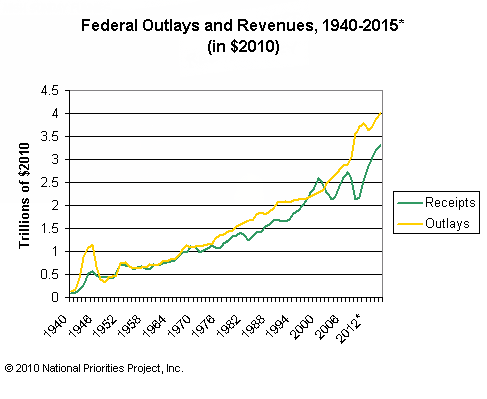
Back to the chart. This chart might be served better if they provided a side by side comparison of nominal taxes as well. Over the same timeframe, government spending increased from about $0.5 trillion to $4 trillion (adjusted for inflation):

So while the percentages might change, not only does the original graph coverup the scope of the change, but also the net scope of the measured sources. It is more than likely that all sources all experienced increased taxes and no decreased taxes, but the mix was in flux. The percent chart hides this.

The biggest problem with the chart, however, is that it just assumes taxes can be targeted. As a thought experiment, assume a local baker is informed there will be a new tax on business. All bakers will have to implement the tax. Will the baker look at her income, deduct the amount of the tax and then just write a check to the IRS, leaving all else unchanged? Because people respond to incentives, the baker will raise the price of her bread. Of course customers will consume less (this is known as deadweight loss). But the baker will not just take the entire cost of the new tax straight from her salary. The tax has to come in part from the customer, who is presented with higher prices (or less service, or less bread). The cost must come from somewhere. This can be seen in action as people watch the results of Obamacare.

What the chart just ignores is that money is fungible. Consumers end up paying most of the taxes, whether they are called Individual, Corporate, Payroll, or Excise. For an excellent article on this, see The New Confusion about Taxes by D.W. MacKenzie.

Posted in Economics, Statistics | Leave a comment

econ 101 – people respond to incentives

Economics is all about the allocation of scarce resources, whether those resources be money, time, space, mental effort or any other reason. Human beings have unlimited wants, but limited resources to attain their wants. This means they must prioritize their wants in order to determine where to put their resources. This is not necessarily a conscious determination. A pedestrian might subconsciously determine to spend a little bit of time to wait for a walk signal, because walking across a busy street might end up being too costly. The pedestrian makes these calculations instantaneously as conditions change. Each individual decides second by second and day by day their best use of scare resources.

My children love playing Nintendo. They wish to dedicate 100% of their time to playing video games, but the needs of reality sometimes trump their video game wishes. They might take a break to go to the bathroom, to eat, to sleep, or even to figure out what candy their sister received and ask for some themselves. Although my children wish to play Nintendo 100% of available time, they prioritize more pressing concerns. Time they spend sleeping (judging from their behavior one assumes they do not value sleep at all) is time not spent playing Nintendo. Time they spend asking for candy is time they do not spend playing Nintendo. Time spent at the store is time spent not playing Nintendo.

People respond to incentives. An incentive merely is the change of a cost relative to other costs. Because changing the cost of an item necessarily changes the ranking of preferences, the rule is that human beings respond to incentives. If my wife places time limitations on the amount of time my children can play video games, suddenly they become much more willing to take a trip to the store, play with toys in the basement, or even run around outside. In essence, a time limit on video games is an increase in the cost of video games. My boys might try to play longer than their time limit, but there may be parental repercussions. The boys naturally understand the cost is too high after their time limit is reached. Not using this time on Nintendo then frees up resources which the boys can then devote to their lesser prioritized tasks.

The fact that people respond to incentives leads observers to a general second rule: people consume more or something when the costs are low and people consume less of something when the price is high. Conversely, people want to provide more of something when the profits are high and want to provide less of something when the profits are low. The law of supply and demand.

Posted in Econ 101, Economics, Human Nature | Leave a comment

can climate scientists do multiple regressions

Multiple regression is a technique used to figure out linked variables as they relate to other variables. For example, an economists might use multiple regression to figure out if being more educated makes one more libertarian. To do that, they would want to look at a large group of equivalent people. Ideally, you want to compare a one person that has all the same traits as another except differing in views on liberty and one other variable. Then one can see if that variable has any effect. To do that you would have to try to control for all factors of relevance. This might include: income, race, number of parents, church attendance, etc. For the record, more education looks like it makes people more libertarian.

Bryan Caplan wants to know if Climate scientists have regressions showing Carbon and Warming are linked. This might not exist, as warming has paused for the last decade. Couple this with the fact that scientists are reluctant to release the data and some of it has been destroyed (a good general rule is not to trust anyone who is not transparent). But Caplan posts a valid question, where is the regression:

The baseline regression I suggested – temperature on CO2 and a linear time trend – is one that any competent first-year stats student should take seriously. It’s a standard way to see if your story that “X is making Y go up” is superior to “Y just seems to be going up.” Why add other trending variables? To see if the data are more consistent with your story than random made-up stories. Inquiring minds want to know.

Posted in Science | Tagged | Leave a comment