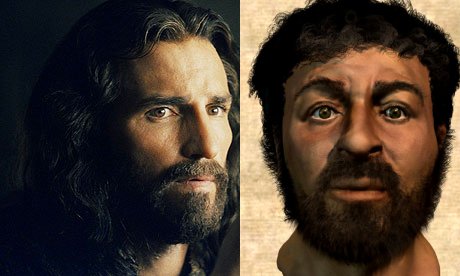
Jesus had short hair

In almost every depiction of Jesus, he is seen as some sort of Fabio model with flowing long hair. But James Caviezel probably should have kept his short haircut if he wanted to better portray Jesus. Not only was a short cut more in style at that time, but Paul writes against long hair (long hair was spurned by Judaism):

1Co 11:14 Does not even nature itself teach you that if a man has long hair, it is a dishonor to him?

I would say that the popular “recreated Jesus” is much more likely than the Hollywood pictures.

Posted in Jesus | 3 Comments

liberal Jesus meme

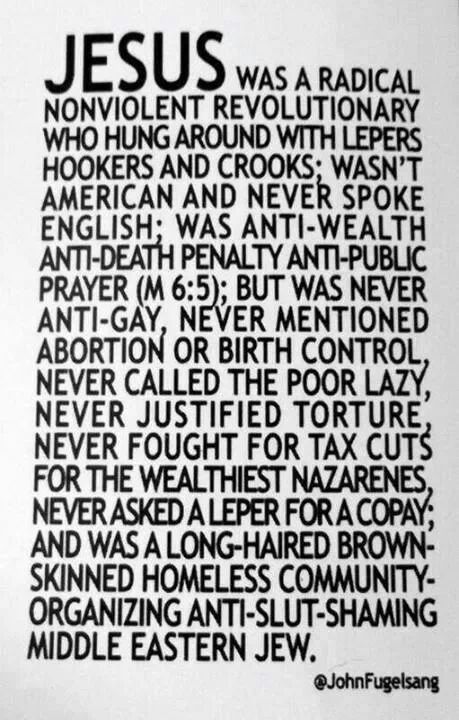
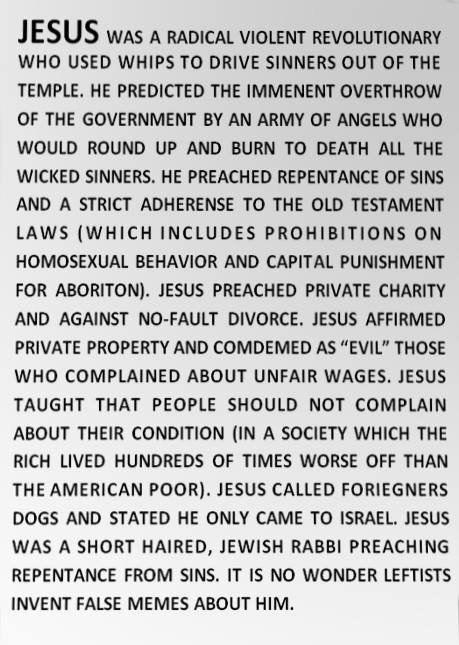
My wife tipped me off that the leftist were publishing a meme that falsely characterizes Jesus. People like to recreate Jesus in their own ideology. For example, if people support homosexuality and they like Jesus, then they will look for reasons to say a 1st century Jewish apocalyptic supported homosexuality. It is really mind boggling.

Jesus should not be made to mirror modern sensibilities (or theology). It is dishonest. Instead, we should attempt to understand what Jesus thought based on the cultural context and his specific teachings. He should not be a prop for our preferences.

Here is the meme:

Here is my response:

Posted in Humor, Jesus | 4 Comments

Jesus did not preach circumcision

Circumcision in the Bible is the process of removing the foreskin in order to follow God’s symbolic ordinances. God at one time almost killed the Hebrew patriarch, Moses, because Moses did not circumcise his son. Interestingly enough, the New Testament talks about circumcision about twice as much as the Old Testament. Almost all of these instances are by the apostle Paul (Jesus only mentioned it once and it is never mentioned by the twelve apostles in their letters).

So why does Paul talk about circumcision in over thirty verses and why does Jesus and the twelve ignore the issue? The answer is that Paul focused on circumcision because he was preaching something new and controversial, whereas Jesus just assumed circumcision into his teachings. Jesus believed circumcision was both necessary and lawful. The reason Jesus did not preach about circumcision was because he already agreed with his audience.

We see this is true by Israel’s reaction to Paul’s message throughout Paul’s ministry. “Circumcision” is the primary reason Paul was persecuted. Paul even states as much:

Gal 5:11 And I, brethren, if I yet preach circumcision, why do I yet suffer persecution?…

From town to town, the Jews revolted against Paul for teaching not to circumcise. Paul was forced to bring the matter before the twelve apostles in Acts 15, and he obtained a letter exempting Gentiles from the practice. In Acts 16, Paul circumcises Timothy due to a fear of the Jews. In Acts 21, James even goes so far as to force Paul to pay to have people purified because a rumor (a true rumor) broke out that Paul was teaching the Jews not to circumcise:

Act 21:20 … “You see, brother, how many myriads of Jews there are who have believed, and they are all zealous for the law;
Act 21:21 but they have been informed about you that you teach all the Jews who are among the Gentiles to forsake Moses, saying that they ought not to circumcise their children nor to walk according to the customs…
Act 21:24 Take them and be purified with them, and pay their expenses so that they may shave their heads, and that all may know that those things of which they were informed concerning you are nothing, but that you yourself also walk orderly and keep the law.

Even this is not enough to quell the Jews. A riot(!) ensued involving both Christian and Judaic Jews. This is just because Paul dared to teach the Jews not to circumcise. In the day of Jesus, the Jews would easily escalate any preaching against circumcision. Even Christian Jews!

The point is that Jesus did not have these worries. Jesus was not assaulted (nor any of twelve) because he taught “not to circumcise”. If Jesus was preaching against circumcision then the Bible would record massive retaliation against him. But the Bible is silent on any fallout for Jesus’ stance on circumcision. When circumcision is addressed in relation to Jesus, we find that Jesus was circumcised as a baby and that Jesus uses it as an example of a command that trumps the Sabbath day:

Joh 7:23 If a man receives circumcision on the Sabbath, so that the law of Moses should not be broken, are you angry with Me because I made a man completely well on the Sabbath?

This is a respectful reference. We do not find the same hostility to circumcision that is found throughout the writings of Paul. Jesus is ultimate arrested due to driving out money changers in the temple with whips. Paul is ultimately arrested due to a riot about circumcision. This illustrates their different ministries. Jesus did not teach against the law, but preached it explicitly:

Mat 5:17 “Do not think that I came to destroy the Law or the Prophets. I did not come to destroy but to fulfill.
Mat 5:18 For assuredly, I say to you, till heaven and earth pass away, one jot or one tittle will by no means pass from the law till all is fulfilled.
Mat 5:19 Whoever therefore breaks one of the least of these commandments, and teaches men so, shall be called least in the kingdom of heaven; but whoever does and teaches them, he shall be called great in the kingdom of heaven.

So Jesus says that whoever teaches men to break the law (including not circumcising) will be called the least in the Kingdom of Heaven. This is directly after saying that the law will not pass away anytime soon. Jesus taught the law.

Bart Ehrman, in one of his lectures, points out that the only way to understand who Jesus was is to understand Jesus as a first century Jew. When Jesus preaches to the crowds, he does not spend any time arguing for a monotheistic God or arguing that Israel was a chosen people. His audience already understood and accepted this. Likewise, Jesus did not have to explain the importance of circumcision, they were already in agreement.

The conflicts that Jesus faced were not “whether or not to follow the law” but “how to follow the law”. When Jesus faces criticism it is about how to apply the law. We find Jesus explaining what works are allowed on the Sabbath and the requirements for divorce. Jesus uses his preaching to expound on requirements of the law: Not only should you not murder your brother, but also not think evil thoughts of him. Not only should you not commit adultery, but you should even think about committing adultery. Not only should you love your neighbor, but you should love your enemy. To Jesus the point of the law was to “Love God with all your heart/mind/soul” and to “Love your neighbor as yourself”:

Mat 22:37 Jesus said to him, ‘YOU SHALL LOVE THE LORD YOUR GOD WITH ALL YOUR HEART, WITH ALL YOUR SOUL, AND WITH ALL YOUR MIND.’
Mat 22:38 This is the first and great commandment.
Mat 22:39 And the second is like it: ‘YOU SHALL LOVE YOUR NEIGHBOR AS YOURSELF.’
Mat 22:40 On these two commandments hang all the Law and the Prophets.”

These two commandments, to Jesus, summarize all of the Old Testament law. Jesus preached that if a hearer accomplished these two things, then they would not be guilty of violating the law. These two principles were used by Jesus to interpret the rest of the law: Circumcision, picking food, and rescuing donkies trumped the Sabbath because all were helping mankind. Men should stay married to their wives, regardless of Moses’ allowances. The additional requirements created by the Pharisees were void of substance and should be ignored.

A critic would be hard pressed to find examples of Jesus violating the law. Jesus did violate certain Pharisaic interpretations of the law along with extra-Biblical traditions, but Jesus never violated the law itself. When accused, Jesus is always quick to show how the law is being misapplied. In short, Jesus both followed and preached the law.

Posted in Bible, Church History, Dispensationalism, Jesus, Morality, Theology | 5 Comments

God kills king ahab

In 1 Kings 22 (mirrored in 2 Chronicles 18), the text starts off with the Israelite King Ahab preparing to go to war. Ahab calls all his prophets together to prophesy about the outcome. They all prophesy success. Wanting more affirmation, Ahab calls in God’s own prophet, Micaiah, to verify. At first, Micaiah does prophesy the same thing. But the King detects that something is wrong and presses him on the issue. Micaiah then tells the King that the King will die and describes God’s elaborate plot to kill him:

1Ki 22:19 Then Micaiah said, “Therefore hear the word of the LORD: I saw the LORD sitting on His throne, and all the host of heaven standing by, on His right hand and on His left.
1Ki 22:20 And the LORD said, ‘Who will persuade Ahab to go up, that he may fall at Ramoth Gilead?’ So one spoke in this manner, and another spoke in that manner.
1Ki 22:21 Then a spirit came forward and stood before the LORD, and said, ‘I will persuade him.’
1Ki 22:22 The LORD said to him, ‘In what way?’ So he said, ‘I will go out and be a lying spirit in the mouth of all his prophets.’ And the LORD said, ‘You shall persuade him, and also prevail. Go out and do so.’
1Ki 22:23 Therefore look! The LORD has put a lying spirit in the mouth of all these prophets of yours, and the LORD has declared disaster against you.”

God hated king Ahab and sought to kill him. God wanted Ahab to die in Ramoth Gilead. But God was not controlling Ahab. God does not use human beings as puppets. Instead God needs to convince Ahab to actually go to Ramoth Gilead to die. He crowdsources the angels to figure out how to do this. The text reads that various angels proffer ideas. We can imagine what they say: “We can get his wife to nudge him”, “We can make him angry at his enemy”, “We can get a neighboring King to pledge support in the battle”, “We can appeal to his pride”. But God finally listens to one angel that outright says to use lies to promote the idea that Ahab is going to win in battle. God likes this plan and endorses it.

Sure enough, King Ahab takes the advice of his prophets and ignores God’s prophet who clues Ahab in on the plot against him. King Ahab then dies at Ramoth Gilead.

Some take-aways from the text.
1. God does have plans, and those plans can be achieved through a multitude of routes.
2. God does not predecide all avenues, and sometimes consults others for ideas.
3. God is not opposed to deception to further specific goals. This does not mean deception is always used by God, but in some cases He believes it is acceptable.
4. God’s prophets are allowed their own judgment in how to communicate God’s plans. Micaiah was allowed to even reveal God’s deception before the event took place.
5. Although God could have struck Ahab dead (we learn from other parts of the Bible), God preferred a more natural cause of death and sought to create circumstances to affect it. God does not always prefer the most direct and miraculous route.
6. Human beings are not directly controlled by God. In order to motivate human beings to act, God uses persuasion and events.
7. Angels are in heaven, advising God and helping God affect God’s plans.

Problems for the Calvinists
1. Omniscience. Did God not know from eternity past how the King was going to die? Why did he consult with angels? What was the purpose of brainstorming in heaven? If it was a way to bring to the front already known knowledge, what purpose is this serving? Did the angels believe they were affecting God?
2. Omnipotence. Why is God crowdsourcing His approach? Does God not control everything? Has not God already decided what to do? Do the angels assume God’s mind is fixed (are they Calvinists)? Is there any indication in the text of God having already decided how He would control the entire situation?
3. Summum Bonum. Did God lie? He sent deceiving spirits with the intent to deceive Ahab. God wanted Ahab to believe a lie. God’s own prophet told this lie, knowing it was a lie. How is this not God using and approving of deception?

Posted in Bible, Calvinism, God, Jewish History, Omnipotence, Omniscience, Open Theism, Theology | 13 Comments

the real Christmas story

christmas

Everyone knows the story of the birth of Jesus: Joseph and Mary traveled to Bethlehem, they checked all the hotels but all rooms were sold out, they then came across kindly strangers who offered to allow them to stay in their barn, and there Mary gave birth to Jesus. Shepherds and wise men both converged on the scene to celebrate. It is a nice story, but almost everything about it is false.

The birth account of Jesus is found in only two of the Gospels (Matthew and Luke). Those two accounts are very divergent in themselves. They almost replicate no information between each other. They do fit together, however, if they are understood as they are written.

According to the book of Luke, Joseph and Mary were living in Nazareth when they decide to travel to Bethlehem for a Roman census. While in Bethlehem, Mary gives birth to Jesus. The text of Luke says that Mary wrapped Jesus in cloth and placed him in an animal feeding trough because there was no room for them in the inn:

Luk 2:7 And she brought forth her firstborn Son, and wrapped Him in swaddling cloths, and laid Him in a manger, because there was no room for them in the inn.

Modern readers are quick to think that the word “inn” means a hotel, like Holiday Inn or the Marriot Inn. But this is not the word being used. That meaning does not make sense in context either. Joseph is traveling to a city from which he has relatives. He stays in this city for some time, waiting for the census to be accomplished. It is supposed he checks for motel rooms, and after not finding any he decides to sleep in a barn for weeks until Mary gives birth. That is not how the story goes.

Instead “inn” is the word for guestroom. In Luke 22:11, this “guestroom” is used for the place of the house where Jesus has his last supper. Guestroom was a part of any house reserved for guests. When Luke 2:7 says that there was no room in the guestroom, Joseph is at a relative’s house. Every Christmas all of America experiences the same thing: too many relatives are staying in one location and not everyone gets the nice bed. Joseph and Mary never checked for a hotel, instead their extended family called dibs on the nice places to sleep at a relative’s house. It is that or because they were expecting the birth they wanted more floor space for convenience. In this case, the relocation would be voluntary.

Furthermore, Joseph and Mary were not forced outside to have Jesus in a barn. In the modern world we think of great red barns when we think of farmers. The animals live in nice pens, and the farmer sleeps in some sort of white farmhouse. But in ancient times, farmers lived with their animals. Animals provided warmth at night. And rural peasants could not necessarily afford a second structure dedicated just to animals. The farmer lived where they worked and worked where they lived.

Part of the Joseph’s relative’s house was reserved for animals. It is this part of the house in which Mary gave birth. The text points to this. It says “Mary laid Jesus in a manger [animal feeding trough] because there was no room in the guestroom”. Mary had to relocate to a different part of the house to have Jesus. The nearest place to lay a newborn baby was a small structure filled with hay: the manger.

After Mary gives birth, Luke describes how shepherds come and worship him. There is no mention of the wise men so common to modern depictions. And there is a good reason for this: the wise men did not visit for another year or so. Matthew’s account does not detail the birth of Christ, but instead events soon after.

When the wise men first come to Judea, this is to find the already born “King of the Jews”. The star apparently appeared as Jesus was being born and it takes the wise men quite some time to travel to Jesus’ location. The text refers to Jesus as a “young child” several times. This is the same word for when the young children approached Jesus in his later ministry. Young child meant anything from toddler to teenager.

This is the age of Jesus when he met the wise men. The text does not talk about the shepherds or the circumstances of Jesus’ birth. All of these things are assumed to be in the past. Jesus was born long before, and seems to have continued living in Bethlehem for several years before he moved to Egypt (fleeing those who wish to harm him).

Because Jesus was born at the appearance of the star, this is why Herod kills all children less than 2 years of age. Herod wanted to kill his rival “King of the Jews” who had already been born sometime before. They were seeking a child aged between a newborn and a toddler.

The last misunderstanding is commonly known. Although various renditions of Jesus’ encounter with the wise men show only three wise men, the precise number of wise men is unknown. It is just assumed that there are three wise men because they present three types of gifts: gold, and frankincense, and myrrh.

In Monty Python’s The Life of Brian, three wise men are shown offering the gifts. The mother of Brian shows hesitance at the myrrh but accepts the frankincense and gold. In ancient times, all three of these gifts were valuable commodities. Each wise man might have presented a little from one or more categories (along with unnamed presents) or multiple wise men might have presented duplicate gifts (no one has ever complained about getting two or more gifts of cash for Christmas). The number of gifts does not limit the number of wise men.

Compounding the problem, in later accounts the three wise men are named and given backstories (Melchior, Jaspar, and Balthazar). This helped cement the image of three wise men in Christmas stories. But the names and number of wise men can most definitely be described as later embellishments of the account in Matthew.

The Real Story

If the accounts in both Matthew and Luke are correct, Joseph and Mary travel to Bethlehem for a census. They stay with a relative for a time, but because too many people were staying over (or Mary needed more birthing space) they sleep with the animals in the main part of the house. When Mary finally gives birth to Jesus they place Jesus in a feeding trough as shepherds come to worship. Joseph decides to stay with his relatives for some time in Bethlehem, and within a couple of years a group of wise men appear to worship and give gifts. Joseph is then warned that Herod wishes to harm Jesus, and Joseph moves to Egypt (financed by the wise men). It doesn’t make for a good Hollywood depiction of Jesus’ birth, but that is how the text reads.

Posted in Bible, Church History, History, Jesus | 2 Comments

precursors to the gospel of Jesus

Mat 1:21 And she shall bring forth a son, and thou shalt call his name JESUS: for he shall save his people from their sins.

Before Jesus preached his “gospel of the Kingdom”, two gospel accounts (Matthew and Luke) give us precursors to Jesus’ own gospel. Joseph is told by an angel that Jesus will “save his people away from their sins”. Then an angel explains to Jesus’ mother that her son will claim the throne of Israel:

Luk 1:31 And behold, you will conceive in your womb and bring forth a Son, and shall call His name JESUS.
Luk 1:32 He will be great, and will be called the Son of the Highest; and the Lord God will give Him the throne of His father David.
Luk 1:33 And He will reign over the house of Jacob forever, and of His kingdom there will be no end.”

Jesus is said to inherit a throne, he will reign over Israel forever, and his kingdom will have no end. These are Kingdom prophecies and give us hints what the Kingdom will entail. Mary believes the angel and she prophesies:

Luk 1:46 And Mary said: “My soul magnifies the Lord,
Luk 1:47 And my spirit has rejoiced in God my Savior.

Luk 1:51 He has shown strength with His arm; He has scattered the proud in the imagination of their hearts.
Luk 1:52 He has put down the mighty from their thrones, And exalted the lowly.
Luk 1:53 He has filled the hungry with good things, And the rich He has sent away empty.
Luk 1:54 He has helped His servant Israel, In remembrance of His mercy,

God is said to be Mary’s “savior”. She gives us hints as to her meaning as she speaks about what God is going to do: put down the mighty from their thrones, send away the rich empty, and help Israel. This sounds like both the angel and Mary believe that Jesus will be instrumental in overthrowing the Roman government. The imagery is one of nations: thrones, kingdoms, strength, reigning. There is no hint of a figurative meaning.

When wise men visit the current King of the Jews, King Herod, they ask where the “King of the Jews” is being born. Herod, furious because he considers himself the King of the Jews, inquires of different wise men about prophecies. They too echo this Kingdom terminology:

Mat 2:6 And thou Bethlehem, in the land of Juda, art not the least among the princes of Juda: for out of thee shall come a Governor, that shall rule my people Israel.

The ancient prophets declare that the Messiah will be a ruler, a governor, a prince. The scribes were expecting a physical ruler of the nation of Israel. They were expecting a new Kingdom to be established.

The next precursor to Jesus’ gospel is the angel’s prophecy to Zacharias. The angel explains to Zacharias that he will have a son, and his son will prepare the way for the Lord:

Luk 1:16 And he will turn many of the children of Israel to the Lord their God.
Luk 1:17 He will also go before Him in the spirit and power of Elijah, ‘TO TURN THE HEARTS OF THE FATHERS TO THE CHILDREN,’ and the disobedient to the wisdom of the just, to make ready a people prepared for the Lord.”

The angel says John the Baptist’s ministry is about “turning Israel to God”, correcting the disobedient, and readying Israel for God. Zacharias expands on this with his own prophecy:

Luk 1:67 Now his father Zacharias was filled with the Holy Spirit, and prophesied, saying:
Luk 1:68 “Blessed is the Lord God of Israel, For He has visited and redeemed His people,
Luk 1:69 And has raised up a horn of salvation for us In the house of His servant David,
Luk 1:70 As He spoke by the mouth of His holy prophets, Who have been since the world began,
Luk 1:71 That we should be saved from our enemies And from the hand of all who hate us,

Zacharias starts with praising God for visiting His people (Israel). He explains that God raised up a “horn of salvation”. It cannot be determined if he means Jesus, John the Baptist, or is just using a general meaning. But God was doing something new, and this new thing will save God’s people (Israel). Salvation to Zacharias is “from our enemies”. We can understand that he means the Roman overlords and their puppet rulers. The “rich” were also commonly classified as enemies (as already shown through Mary’s statement). Zacharias goes on:

Luk 1:72 To perform the mercy promised to our fathers And to remember His holy covenant,
Luk 1:73 The oath which He swore to our father Abraham:
Luk 1:74 To grant us that we, Being delivered from the hand of our enemies, Might serve Him without fear,
Luk 1:75 In holiness and righteousness before Him all the days of our life.
Luk 1:76 “And you, child, will be called the prophet of the Highest; For you will go before the face of the Lord to prepare His ways,
Luk 1:77 To give knowledge of salvation to His people By the remission of their sins,
Luk 1:78 Through the tender mercy of our God, With which the Dayspring from on high has visited us;
Luk 1:79 To give light to those who sit in darkness and the shadow of death, To guide our feet into the way of peace.”

Zacharias was concerned with the state of Israel. He focused on Israel’s enemies, Israel’s covenant. This was a very Israel-centric prophecy. He mentions that the coming salvation included the Jews being able to “serve God without fear” from the hand of their enemies. In Zacharias’ mind, the coming system would overthrow the Romans. When Zacharias was talking about serving God without fear, this was not “no fear because of the knowledge of heaven” but instead a “no fear because no one would dare harm God’s people while God reigned.”

Zacharias then touches upon the mechanism for preparing this coming kingdom: repentance of sins. He talks about serving God forever in holiness and righteousness. Then Zacharias talks about giving “knowledge of salvation” by “remission of their sins”. When God returned to exact vengeance on the unrighteous, the people who had remission of sins would know they would be saved. In fact, Zacharias shows that it is God’s mercy which could forgive these sins. This echoes the entirety of the Old Testament prophecies to Israel: that if they returned to God then God would bless them and save them from their enemies. Zacharias believed this.

When Jesus was yet a baby, Mary brings him to Jerusalem and there they meet Simeon. Simeon had been promised by God that he would not die before he saw the Messiah. He exclaims:

Luk 2:29 “Lord, now You are letting Your servant depart in peace, According to Your word;
Luk 2:30 For my eyes have seen Your salvation
Luk 2:31 Which You have prepared before the face of all peoples,
Luk 2:32 A light to bring revelation to the Gentiles, And the glory of Your people Israel.”

To Simeon, Jesus was the Messiah (the savior). Whereas before, Israel was a defeated and subjugated nation, Jesus would restore Israel’s prominence in the world. Israel was always intended to be a priest nation, serving as a light for the Gentiles. Jesus was going to free Israel so they could perform this duty. Simeon goes on to explain to Mary that Jesus is a sign for Israel and will lead to a disruption of Israel’s castes:

Luk 2:34 Then Simeon blessed them, and said to Mary His mother, “Behold, this Child is destined for the fall and rising of many in Israel, and for a sign which will be spoken against
Luk 2:35 (yes, a sword will pierce through your own soul also), that the thoughts of many hearts may be revealed.”

The last precursor to Jesus’ ministry was John the Baptist. He preached a coming Kingdom of God. John preached explicitly the “kingdom of heaven” (“kingdom of God”):

Mat 3:2 and saying, “Repent, for the kingdom of heaven is at hand!”

John was warning Israel to flee idolatry and sin because when the Kingdom of heaven arrived, the wicked would be killed. If people did not repent of their sin, they too would be among the wicked that were killed. John is explicit:

Mat 3:7 But when he saw many of the Pharisees and Sadducees coming to his baptism, he said to them, “Brood of vipers! Who warned you to flee from the wrath to come?
Mat 3:8 Therefore bear fruits worthy of repentance,

Baptism was symbolic of being cleansed from sin. When the Pharisees and Sadducees came to John, his first exclamation is that they were “fleeing the wrath to come” by appearing before John. He advises them to “bear fruits worthy of repentance”. John knew that these people might get baptized but might not agree with John’s ministry. He tips them off that he is on to their dual mindedness. They were to show through their actions that they actually were repentant.

Mat 3:9 and do not think to say to yourselves, ‘We have Abraham as our father.’ For I say to you that God is able to raise up children to Abraham from these stones.
Mat 3:10 And even now the ax is laid to the root of the trees. Therefore every tree which does not bear good fruit is cut down and thrown into the fire.

A common claim among Israel was: “It doesn’t matter what we do. We are the chosen people of God. When God returns to Israel he will spare us as His children. If God did kill us, then God’s promises to Israel would never come true.” But John says that is a false statement. Like God’s dialogue to Moses shows, God can fulfill his promises through alternative means. John stresses that the wicked of Israel would be killed along with the Roman oppressors. It is precisely the “those who do not bear good fruit” that would be killed. John continues:

Mat 3:11 I indeed baptize you with water unto repentance, but He who is coming after me is mightier than I, whose sandals I am not worthy to carry. He will baptize you with the Holy Spirit and fire.
Mat 3:12 His winnowing fan is in His hand, and He will thoroughly clean out His threshing floor, and gather His wheat into the barn; but He will burn up the chaff with unquenchable fire.”

After John’s ministry, the Messiah would come and kill people with fire. This fire is a literal death to which John is speaking. The fire is coming with the Messiah, this fire was to spur John’s listeners to action, and John stresses this in the context of the Kingdom coming. This suggests that this is not just a general “non-Christians going to hell” statement. How will Christ baptize with fire? Some might say this was fulfilled when a handful of individuals had images of fire above their heads, but this is not what the context suggests. The fire is compared to a threshing floor. On a threshing floor, the good and bad parts of wheat are separated and the bad is burnt to oblivion. This is the fire with which the Messiah was to baptize. The Messiah was going to kill the wicked! This is what John says the Pharisees are fleeing. This is the wrath John preaches.

In Luke, John the Baptist is described as giving examples of the “good works” that would save people from being “cut down and thrown into the fire”:

Luk 3:11 He answered and said to them, “He who has two tunics, let him give to him who has none; and he who has food, let him do likewise.”
Luk 3:12 Then tax collectors also came to be baptized, and said to him, “Teacher, what shall we do?”
Luk 3:13 And he said to them, “Collect no more than what is appointed for you.”
Luk 3:14 Likewise the soldiers asked him, saying, “And what shall we do?” So he said to them, “Do not intimidate anyone or accuse falsely, and be content with your wages.”

John the Baptist teaches that charity and integrity will save people. He taught that the wicked (those who didn’t do good works) would be killed in a coming judgment. John was expecting the soon return of the Kingdom of God at which time all these things would happen.

What all this shows is that before Jesus emerged on the scene, it was commonly thought, predicted, and prophesied that the Messiah (the Christ) would be a physical ruler over Israel who would turn many of Israel away from their sins, dispose of the Romans and their puppet governments, dispose of the wicked, and establish a righteous Kingdom for those of Israel who followed God. The Messiah’s line and lineage would last forever. From here Israel would act as a priest nation towards the Gentiles. In short, this is the Gospel of the Kingdom, and I will show later that this was what Jesus preached during his own lifetime.

Posted in Bible, Church History, Dispensationalism, Goverment, History, Jesus, Jewish History, Morality, Prophecy, Theology | 13 Comments

stanford prison experiment

My favorite psychologist, Peter Gray, explains why some psychological studies are flawed. He uses the famous Zimbardo prison experiment as a prime example. For those who are unfamiliar, this experiment assigned random students to roles as guards and prisoners and then observed increasing hostilities. This experiment is used to suggest that when there is power differentials, hostilities naturally occur. This study is also used to claim that people are impressionable and naturally adhere to a group norm.

Peter Gray claims that this study is not evidence of the sort. He points out a major flaw is that participants in studies naturally act out the role they think the researchers are wishing to see:

In a nutshell, here’s the criticism, somewhat simplified. Twenty-one boys (OK, young men) are asked to play a game of prisoners and guards. It’s 1971. There have recently been many news reports about prison riots and the brutality of guards. So, in this game, what are these young men supposed to do? Are they supposed to sit around talking pleasantly with one another about sports, girlfriends, movies, and such? No, of course not. This is a study of prisoners and guards, so their job clearly is to act like prisoners and guards—or, more accurately, to act out their stereotyped views of what prisoners and guards do. Surely, Professor Zimbardo, who is right there watching them (as the Prison Superintendent) would be disappointed if, instead, they had just sat around chatting pleasantly and having tea. Much research has shown that participants in psychological experiments are highly motivated to do what they believe the researchers want them to do. Any characteristics of an experiment that let research participants guess how the experimenters expect or want them to behave are referred to as demand characteristics. In any valid experiment it is essential to eliminate or at least minimize demand characteristics. In this experiment, the demands were everywhere.

This is called “demand characteristics”. Furthermore, another huge problem with the study is it used an actual inmate who directed the guards in their activities:

In the article, Prescott expressed great regret for his involvement in the study and said that it was he, not the guards in the mock prison, who came up with the ways of psychologically humiliating and harassing the prisoners.

This is not to say that power does not corrupt, but just that this particular study is a bad study to use as evidence. When we see studies purporting to prove some sort of human characteristic, we need to keep in mind how studies are conducted have a major influence in what results are achieved. When those performing the studies come to the same conclusion as their hypothesis, we should be leery of accepting the study without examination.

Posted in Human Nature, Statistics | 1 Comment

learning from a titan of industry

The other day I had the good fortune to sit next to a very interesting man on a flight to Chicago. It turned out that he was an independent consultant and premium priced contractor for various factories around the world. His job was to fix specialized machines, not himself, but to supervise the existing workers while they fixed the machines. He had several competitors in this very niche field, and he commanded the highest prices.

One area I asked him about was his hiring practices. He stated off the bat that he does not hire young men. Young men tend not to be able to handle pressure. Some of these factories lose $20,000 per minute while their machines are broken. He cannot chance hiring someone who cannot deal with the pressure of that factory owner; his people need to be able to stay calm under pressure, reassure the owners, and be able to throw off any meddling.

I asked him if these skills were inherent or could be learned, and he was fairly emphatic that these character traits were innate. He stated that he could teach technical skills, but force of character was something that no one could teach.

If he hired any subpar worker, he jeopardized his own business reputation, which would be a fatal business mistake in a world where he was the premium name in the business. To command premium wages, he also held his workers to strict standards: Clean clothes every day, freshly shaved (even in remote locations), and even hard expectations for working hours (14+ hour days). At $200 per hour, he would not allow subpar performance (he stated he had to price under $200 because there was a mental breaking point for his customer).

Men in his industry did not stay married for long. This is one reason he preferred to hire unmarried men and men without young families. Hand in hand with premium prices were long work hours and 2 weeks at a time per month away from the family. The contractor stated he had an acute hiring problem. It was almost impossible to find competent and able workers.

This contractor also detailed his dealings with foreign nationals. He adopted the practice of cash-up-front with those businesses in India due to their consistent defaulting and attempts to underpay after the job is complete. He stated it was general practice to hire out contractors, and then offer them 25% less when the job was completed. One way businesses could hedge against this was to overprice by about 25% and then take the deduction. He instead offers a take-it-or-leave it (no negotiation) route. He also had to verify prior to taking their job his mode of transportation and housing, such that in that area he was not abused.

Some practical take aways:

1. Professionalism and image are critical to businesses. If a business is in the practice of being unprofessional or of delivering inferior product, they will lose market power. The only reason this contractor commanded a premium was due to his reputation. Reputation matters.

2. Not all workers are qualified for all jobs. Even well paying jobs have a hard time attracting qualified workers.

3. Discriminating during hiring is useful and commonsense. Laws against discriminating based on age, marital status, and age can not only hurt the workers, but can cripple a business.

4. Bad business practices have consequences. In the case of the Indian companies, short sited short changing leads to higher costs and less mutual trust. It does not pay to rip people off. You may get away with it once or twice, but there are real-world consequences.

5. Premium prices can be commanded based on a premium image that includes factors that are irrelevant to job performance. Business transactions involve much more than an exchange of goods or services for money.

In all it was a fruitful conversation. I ended the conversation by talking about the modern miracle of flight (to which this titan of industry had become immune with his persistent traveling). I remarked that we live in an amazing world in which he can fly from the Caribbean to the remote north and back again within a couple days. He agreed, and we left on a mutual admiration of our circumstances.

Posted in Economics, Human Nature, Labor | Leave a comment

justification and salvation in james

Those who claim that Paul and James taught the exact same gospel have an understandably hard time understanding the book of James. James outright contradicts Paul on several occasions. The most pronounced example is that of Justification:

Jas 2:24 You see then that a man is justified by works, and not by faith only…
Jas 2:26 For as the body without the spirit is dead, so faith without works is dead also.

Rom 3:28 Therefore we conclude that a man is justified by faith apart from the deeds of the law.

Paul links works and “the law” throughout Romans, using them as synonyms. If Paul directly says salvation is not of works, and James directly states that it is, then Christians have a very distinct problem. Paul and James would be preaching different things at the exact same time (their ministries overlapped).

The Acts 9 Dispensationalist easily points out that James was written to the Jews (Jas 1:1). Paul’s ministry was to the Gentiles. James himself produced a letter stating that the Gentiles could be saved without the works of the law (such as circumcision). But later on, James learns that Paul is teaching Jews not to circumcise and James goes ballistic (commanding Paul to pay to have people circumcised).

But some Christians just do not want to believe that there were theological differences between Paul and James. They attempt to bypass the contradiction in James and Romans by word definitions. To the “moral works equals salvation” they will claim that works decried by Paul are only the symbolic works (like circumcision). To the antinomian, they claim that justification means different things in James and Romans. I will address the later.

This point is made by notable Soul-Winner, Pastor Anderson.

Now James uses plenty of terminology commonly found in Paul: “faith”, “save”, “justified”, “works”, “law”, “righteousness”, and “judgment”. The antinomian, in order to maintain that James preaches the same thing as Paul, has to redefine all these words. “Salvation” is changed from “Salvation to heaven” to “Salvation from hunger”. “Righteousness” and “justified” are changed from a “right standing before God” to a “perception by others about a believer”. “Judgment” is changed from a “final judgment by God” to a “present judgment by man”. Works and law are changed from the “moral and symbolic covenant of Abraham” to “good deeds”. The problem is that these changes are not justified by the text of James. In fact, the only reason that the antinomian tries to change their meaning is because they are uncomfortable with the implications.

James starts his letter talking about temptations.

Jas 1:12 Blessed is the man that endureth temptation: for when he is tried, he shall receive the crown of life, which the Lord hath promised to them that love him…
Jas 1:15 Then when lust hath conceived, it bringeth forth sin: and sin, when it is finished, bringeth forth death.

James was addressing Christians in sin, who were justifying giving into their temptations by claiming that it was God’s doing. God was at fault. James rebukes them and explains that only those who “endure” will receive (in the future) the “crown of life”. Sin brought death. To James both life and death were literal, as Jesus stated that when the Kingdom returns the angels would gather the wicked and kill them!

Mat 13:38 The field is the world; the good seed are the children of the kingdom; but the tares are the children of the wicked one;
Mat 13:39 The enemy that sowed them is the devil; the harvest is the end of the world; and the reapers are the angels.
Mat 13:40 As therefore the tares are gathered and burned in the fire; so shall it be in the end of this world.
Mat 13:41 The Son of man shall send forth his angels, and they shall gather out of his kingdom all things that offend, and them which do iniquity;
Mat 13:42 And shall cast them into a furnace of fire: there shall be wailing and gnashing of teeth.

To James, the good would be saved and the wicked killed. This theme is repeated throughout his letter. James fills his letter with enough references to the apocalypse that we know he is not just writing general statements (drinking too much alcohol leads to drunk driving which leads to death) nor is he talking about heaven and hell. James focuses on something that will soon disrupt the lives of the people to whom he writes. To James “the judge was at the door”, “people should not say what they were doing in a month”, “the coming of the Lord was nigh”. For this, people needed to reform themselves.

James warns people that if they only believe without works, they deceive themselves!

Jas 1:20 For the wrath of man worketh not the righteousness of God.
Jas 1:21 Wherefore lay apart all filthiness and superfluity of naughtiness, and receive with meekness the engrafted word, which is able to save your souls.
Jas 1:22 But be ye doers of the word, and not hearers only, deceiving your own selves

James distinguishes between “doers of the word” and “hearers of the word”. To James, mere “hearers of the word” could not “save their souls”. Literally translated “save your lives”.

James gives examples of doers and hearers. The man who does not control his own tongue, his religion is in “vain”. This means his religion is worthless. His religion will not save him from God’s judgment:

Jas 1:26 If any man among you seem to be religious, and bridleth not his tongue, but deceiveth his own heart, this man’s religion is vain.
Jas 1:27 Pure religion and undefiled before God and the Father is this, To visit the fatherless and widows in their affliction, and to keep himself unspotted from the world.

Undefiled religion before God included positive works, such as visiting the orphans and widows combined with separating from the world (this is a Jewish concept of remaining a chosen people). Positive works play a large theme in James, he specifically states that “to him that knoweth to do good, and doeth it not, to him it is sin.”

James highlights prejudice, treating people unequally as a major sin worthy of death:

Jas 2:9 But if ye have respect to persons, ye commit sin, and are convinced of the law as transgressors.
Jas 2:10 For whosoever shall keep the whole law, and yet offend in one point, he is guilty of all.
Jas 2:11 For he that said, Do not commit adultery, said also, Do not kill. Now if thou commit no adultery, yet if thou kill, thou art become a transgressor of the law.
Jas 2:12 So speak ye, and so do, as they that shall be judged by the law of liberty.

This is not man’s law of which James speaks. James is not concerned with criminal penalties or social justice. James links violations of the “law” with God’s law, which he calls the law of liberty (a term only James ever uses). By this James seems to mean that although people were once sinners that God would have mercy on them and erase their past sins conditionally. But James points out that God’s mercy is conditional only if that individual also shows mercy:

Jas 2:13 For he shall have judgment without mercy, that hath shewed no mercy; and mercy rejoiceth against judgment.

Now James reaches a critically cited passage, in which he explains that faith without works is dead. Pastor Anderson claims that this means that if someone has faith but does no good, then this benefits no other people. It is plausible, but that is not the context.

Jas 2:14 What doth it profit, my brethren, though a man say he hath faith, and have not works? can faith save him?
Jas 2:15 If a brother or sister be naked, and destitute of daily food,
Jas 2:16 And one of you say unto them, Depart in peace, be ye warmed and filled; notwithstanding ye give them not those things which are needful to the body; what doth it profit?
Jas 2:17 Even so faith, if it hath not works, is dead, being alone.

Although James’ example involves food, when people imitate that James’ point involves nourishment of others this draws the illustration too thin. This would be like reading the potter and clay parable and then claiming people are made of clay. James is showing how only with positive actions can faith save. In verse 14 this is explicit. James 2:17 answers the rhetorical question in James 2:14 asking if “faith without works can save a particular individual”. This is not about “saving” others. This question is not about society. James talks about the faith, works and salvation of one individual. If a person says that he has faith, but has no works, then his works cannot save him!

James then points out a natural criticism of faith without works:

Jas 2:18 Yea, a man may say, Thou hast faith, and I have works: shew me thy faith without thy works, and I will shew thee my faith by my works.
Jas 2:19 Thou believest that there is one God; thou doest well: the devils also believe, and tremble.

The man in question is not displayed as being “incorrect”. James is not correcting the hypothetical man, but using the hypothetical man to further criticize “workless faith”. He compares those with faith and without works to “demons”, further emphasizing that James’ concern isn’t social, but spiritual and eternal.

James then uses Abraham as an example. James talks about how “works” perfected Abraham’s faith. The implicit teaching is that if Abraham refused to sacrifice Isaac, then he would have lost his right standing with God (righteousness). Those who believe that James and Paul taught the same thing will try to redefine the terms, as explained before. But the text references Abraham’s imputed righteousness (as described by Gen 15:6). This was righteousness before God. It is in this context that Abraham’s work justifies him. Justifying is the process of making someone righteous. Abraham’s work made him righteous before God.

Chapter 3 leads to chapter 4 in which James describe various problems among his churches. Very bluntly he tells them that sin makes people enemies of God:

Jas 4:4 Ye adulterers and adulteresses, know ye not that the friendship of the world is enmity with God? whosoever therefore will be a friend of the world is the enemy of God.

James’ use of the term adulterer should not be taken literally. His point is not that people are cheating on their spouses; James is saying that people are cheating on God. This marriage imagery (between God and Israel) is common place throughout the Bible.

James then calls for repentance of sin:

Jas 4:7 Submit yourselves therefore to God. Resist the devil, and he will flee from you.
Jas 4:8 Draw nigh to God, and he will draw nigh to you. Cleanse your hands, ye sinners; and purify your hearts, ye double minded.

To James repentance of sin saved people from being killed by God’s angels. Next while reminding people that the end is near, James points out that some people will definitely be killed by God:

Jas 4:12 There is one lawgiver, who is able to save and to destroy: who art thou that judgest another?
Jas 4:13 Go to now, ye that say, To day or to morrow we will go into such a city, and continue there a year, and buy and sell, and get gain:
Jas 4:14 Whereas ye know not what shall be on the morrow. For what is your life? It is even a vapour, that appeareth for a little time, and then vanisheth away.
Jas 4:15 For that ye ought to say, If the Lord will, we shall live, and do this, or that.

Notice this saying “if the Lord will, we shall live”. Verse 12 points out it is God who “saves or destroys”. People should always be in fear of being counted among those who are going to be killed. James next points to the “rich” as examples of this wrath:

Jas 5:1 Go to now, ye rich men, weep and howl for your miseries that shall come upon you…
Jas 5:3 Your gold and silver is cankered; and the rust of them shall be a witness against you, and shall eat your flesh as it were fire. Ye have heaped treasure together for the last days.

Because the rich have defrauded people of money, this was the reason that “misery” would come upon them. This was the reason their “flesh would be eaten as it were fire”. It was not because they “didn’t believe in Jesus”, it wasn’t because “insane wealth leads to a miserable life”. This was about the judgment during the coming Kingdom of God. James uses God’s war name to illustrate:

Jas 5:4 Behold, the hire of the labourers who have reaped down your fields, which is of you kept back by fraud, crieth: and the cries of them which have reaped are entered into the ears of the Lord of sabaoth.

The “sabaoth” means “armies”. God is the “God of hosts”. He commands armies of angels. Jesus preached, as quoted before, that these legions would round up the wicked and kill them. To this is what James alludes. He calls it the “day of slaughter”:

Jas 5:5 Ye have lived in pleasure on the earth, and been wanton; ye have nourished your hearts, as in a day of slaughter.

To top it all off, James warns the Christians that they too are in danger of the same slaughter:

Jas 5:8 Be ye also patient; stablish your hearts: for the coming of the Lord draweth nigh.
Jas 5:9 Grudge not one against another, brethren, lest ye be condemned: behold, the judge standeth before the door.

James tells them “the judge” (God) is standing at the door. When guests are at the door, that means they are one step away from being inside the house. When James says “the coming of the Lord is nigh”, this was not an interpretive statement.

James ends his letter with an interesting statement that if a Christian converts a sinner then that Christian would have a multitude of sins forgiven. James is saying “if you are worried, here is how to secure your salvation”. Fitting James’ sincerity, the book ends abruptly afterwards (which would be curious if James was just writing broad letter listing general life guidelines):

Jas 5:20 Let him know, that he which converteth the sinner from the error of his way shall save a soul from death, and shall hide a multitude of sins.

James preached about about salvation from the coming apocalypse, salvation through good works, and describes how Christians can best live their lives to avoid being judged. Modern Christians wildly misread the book of James. This is understandable because the apocalypse never occurred as predicted and Christians are at a loss to explain why. They want James to speak to them today. They want James to fit their pet theology. But it just doesn’t. It was written to a first century Jew in an apocalyptic mindset.

Posted in Bible, Dispensationalism, Figures of Speech, God, Morality, Theology | 2 Comments

an overview of james

The purpose of James was to serve as a general letter to “the twelve tribes” (aka Israel). The letter tries to encourage the oppressed, chastise internal strife, criticize Christian sin, correct misconceptions concerning works, and remind people that the end was near.

For the sake of this writing, it is assumed that the author “James” is the same James who was the brother of Jesus (and early in Acts becomes the leader of the church). The purpose, authority and theology fit.

James was writing to established Jewish churches (he uses the word “synagogue”). They were mostly poor, and a large section of James is devoted to their relations to the “rich”. James uses an “us versus them” mentality when talking about the rich. The “rich” seem to be the primary cause of the oppression of the Christians, and this was through court proceedings and fraudulent wages.

In chapter 1, James addresses his most pressing concern. People were claiming that God was making them do evil. They were justifying their evil through fatalism! James explains that no one is forced to sin, and each person is responsible for their own actions. James uses a large part of his letter to combat the notion that sin is allowable or justifiable, even if an individual has faith.

Connected in James’ mind was “sin” and “a lack of good works”. James equates sinning with not doing good works (Jas 4:17 Therefore, to him who knows to do good and does not do it, to him it is sin). The audience of James seems to have been lacking in good works. James reminds them to visit widows and orphans, and explains that keeping themselves “unspotted” from the world (a very Jewish concept) is the mark of pure religion. He also talks about how they treat people, noting that everyone is equal. If Christians show favoritism, they are sinning (Jas 2:9 but if you show partiality, you commit sin…).

On top of this, it appears that there was plenty of internal strife that James had to address. In chapter 1, he talks about untamed tongues, recapped in chapter 3. In chapter 4, James addresses “desire”, “murder”, and “war”. In chapter 5, he reminds Christians that they might be condemned by God if they grumble against each other. Somewhere in the Church something bad was happening.

James encourages them to repent, and reminds them that the end of the world is near. Interwoven throughout James is his apocalyptism.

The entire context of James was to prepare believers for an imminent return of the Kingdom of God. To James “the judge was at the door”, “people should not say what they were doing in a month”, “the coming of the Lord was nigh”. James echoes Jesus’ teachings that judgment would be soon and would be harsh. God would use his army of angels (“the Sabaoth”) to kill the unrighteous (“the day of slaughter”). He uses the rich oppressors as an example, and warns Christians to watch what they do and say lest they be judged in the same fashion.

When James talked about salvation, justification, righteousness, faith, and works, it is in this context. James is not preparing his followers for interpersonal relationships; he is preparing them for the apocalypse. James echoes Jesus’ ministry:

Compare: “Repent, for the kingdom of heaven is at hand.” (Mat 4:17) and “Establish your hearts, for the coming of the Lord is at hand.” (Jas 5:8)

In James, we find nothing resembling common Christian creeds. Nothing is said about the death of Christ, his blood, or his resurrection. Nothing describes Jesus’ role in the mechanics of salvation or attaining righteousness. It is just assumed that faith in the coming Kingdom, good works (and not sinning) was sufficient to avert judgment. Combined with an exclusive focus on the Jews, this points to an early date for the writing of James (perhaps before Acts 15).

James ends his letter, not with a farewell, but by saying that conversion from sin was the primary goal. In fact, converting one sinner from their sins covered a multitude of the converter’s sins:

Jas 5:20 let him know that he who turns a sinner from the error of his way will save a soul from death and cover a multitude of sins.

Posted in Bible, Church History, Theology | 1 Comment