the circumcision slaughter

In an odd Bible story, a Jewish woman is raped, her rapist wishes to marry her, the woman’s brothers demand that the rapist’s people be circumcised, and after they are all circumcised the brothers go in and kill them all:

Gen 34:1 Now Dinah the daughter of Leah, whom she had borne to Jacob, went out to see the daughters of the land.
Gen 34:2 And when Shechem the son of Hamor the Hivite, prince of the country, saw her, he took her and lay with her, and violated her.
Gen 34:3 His soul was strongly attracted to Dinah the daughter of Jacob, and he loved the young woman and spoke kindly to the young woman.
Gen 34:4 So Shechem spoke to his father Hamor, saying, “Get me this young woman as a wife.”

Gen 34:7 And the sons of Jacob came in from the field when they heard it; and the men were grieved and very angry, because he had done a disgraceful thing in Israel by lying with Jacob’s daughter, a thing which ought not to be done.
Gen 34:8 But Hamor spoke with them, saying, “The soul of my son Shechem longs for your daughter. Please give her to him as a wife.

Gen 34:13 But the sons of Jacob answered Shechem and Hamor his father, and spoke deceitfully, because he had defiled Dinah their sister.

Gen 34:15 But on this condition we will consent to you: If you will become as we are, if every male of you is circumcised,

Gen 34:24 And all who went out of the gate of his city heeded Hamor and Shechem his son; every male was circumcised, all who went out of the gate of his city.
Gen 34:25 Now it came to pass on the third day, when they were in pain, that two of the sons of Jacob, Simeon and Levi, Dinah’s brothers, each took his sword and came boldly upon the city and killed all the males.

The Bible deals with this story in a “matter of fact” tone. It doesn’t seem to pass judgment (either positive of negative). This is just a historical story.

Posted in Bible, History, Jewish History | 2 Comments

misquoted verses – all days were written before there were any

Psalms 139 is held by Calvinists to be their strong proof text for various doctrines. In verse 16, depending on the translation, states that “the days were fashioned for me, when as yet there were none” (NKJV):

Psa 139:16 Your eyes saw my substance, being yet unformed. And in Your book they all were written, The days fashioned for me, When as yet there were none of them.

Calvinists take this verse to mean that everyone’s entire life was predestined before they were born. This verse is their “proof” that God knows every event in someone’s future (from birth to death). But does it mean that? Could it mean anything else? Is that the natural understanding of the text?

In context, King David is speaking about fetology (the development of unborn babies).

Psa 139:13 For You formed my inward parts; You covered me in my mother’s womb.
Psa 139:14 I will praise You, for I am fearfully and wonderfully made; Marvelous are Your works, And that my soul knows very well.
Psa 139:15 My frame was not hidden from You, When I was made in secret, And skillfully wrought in the lowest parts of the earth.
Psa 139:16 Your eyes saw my substance, being yet unformed. And in Your book they all were written, The days fashioned for me, When as yet there were none of them.

In verse 13, David starts talking about how his parts were “formed”. In verse 14, David says he was “made”. In verse 15, David was “made” and “wrought”. Then in verse 16, the NKJ uses the word “fashioned” in reference to days. Something is rotten in the state of Denmark. Here is the KVJ translation:

Psa 139:16 Thine eyes did see my substance, yet being unperfect; and in thy book all my members were written, which in continuance were fashioned, when as yet there was none of them.

The KJV translators correctly saw that King David’s subject did not stray. King David was still talking about fetology in verse 16. David is talking about being formed in the womb. God saw David developing in the womb, had a blueprint (book), and David’s fetal development followed that path. David’s point is not “fatalism”, but that “fetal development is not Ad Hoc”. Before David developed as a baby, that path had been designed by God.

To put this in perspective, in the preceding 3 verses David is clearly talking about how his body is designed during pregnancy. In the last verse, Calvinists believe David switches topics to talk about fatalism. This is a mistranslation. The entire passage is about fetal development.

Besides the most natural reading (as detailed above), the Calvinist claim is impeded on other fronts:

1. In the following verses, David asks God to test him:

Psa 139:23 Search me, O God, and know my heart: try me, and know my thoughts:
Psa 139:24 And see if there be any wicked way in me, and lead me in the way everlasting.

If verse 16 is about fatalism, why would David believe that God needed to “search” him to “know his thoughts”? Why would David ask God to lead him? David is not a fatalist. David is indicating that God may not already know David’s true allegiances, and David challenges God.

2. Even if the verse meant that “God had future days planed after birth”, it does not follow that those “days” are planned in a deterministic sense. Throughout the Bible, God’s plans are thwarted. I can have “plans” for my children, but it is up to them to embrace those plans or not. This would be a more natural reading than “my life was 100% predetermined before birth”. The text in no way hints are fatalism.

3. David is writing poetry. He uses figurative terms such as “lowest parts of the earth” and also:

Psa 139:9 If I take the wings of the morning, and dwell in the uttermost parts of the sea;

This is strange imagery. For someone to grab parts of this to affirm their pet theology would be a mistake.

4. The overall theme of Psalms 139 might not be exportable. Although Christians like to generalize the themes of Psalms 139, they should take pause. David had a unique relationship with God. David was God’s anointed and was even allowed to get away with sin that King Saul would never have survived. When modern Christians read Psalms 139 it must be in this context.

Posted in Bible, Calvinism, God, Misquoted Verses, Omniscience, Open Theism, Theology | 2 Comments

treat burglary like abortion

A 2008 letter to the editor I wrote. It always makes me chuckle. One person replied “I spit out my coffee when I read this”:

Posted in Abortion, Humor | Leave a comment

misquoted verses – vegetarians are weak and wine makes people stumble

Throughout Paul’s writings we find him addressing two food issues:

1. Kosher food laws.
2. Meat sacrificed to idols.

When Paul writes about food, it is about one or both of these two issues. His statements should be understood in these contexts, not modern contexts. For example:

Rom 14:21 It is good neither to eat meat nor drink wine nor do anything by which your brother stumbles or is offended or is made weak.

Modern Christians see this verse as an excuse to declare a reason for not drinking wine. They say:

“In my household, we do not condemn drinking wine, but we abstain because you never know who is in the room with you. It may be a former alcoholic. We would not want to make him stumble.”

I hear this all the time. One of my first actions when having guests over is to offer them something to drink. Romans 14:21 is used by them to claim that drinking should be avoided if someone might binge because of it. While that result may happen, it is not at all what Paul is describing in Romans 14. We can learn the context of Romans 14 from 1 Corinthians 8:

1Co 8:4 Therefore concerning the eating of things offered to idols, we know that an idol is nothing in the world, and that there is no other God but one.
1Co 8:5 For even if there are so-called gods, whether in heaven or on earth (as there are many gods and many lords),
1Co 8:6 yet for us there is one God, the Father, of whom are all things, and we for Him; and one Lord Jesus Christ, through whom are all things, and through whom we live.
1Co 8:7 However, there is not in everyone that knowledge; for some, with consciousness of the idol, until now eat it as a thing offered to an idol; and their conscience, being weak, is defiled.
1Co 8:8 But food does not commend us to God; for neither if we eat are we the better, nor if we do not eat are we the worse.
1Co 8:9 But beware lest somehow this liberty of yours become a stumbling block to those who are weak.

Paul states a couple things:

1. When pagans sacrifice meat to idols, we know that the idols are just statues and it is a meaningless ritual.
2. As such, the meat cannot be “defiled”, and we should not feel bad eating it. [Side note: notice how this contradicts the resolution of Acts 15]
3. Weak Christians feel bad when eating these things, so don’t rile them up by eating in front of them.

The Christians who were abstaining from meat were the type to call out others and cause disputes over the issue (“meat sacrificed to idols”). Paul’s goal is to keep the peace. He calls these Christians weak and then advises strong Christians avoid this theological debate.

In Romans 14, Paul reiterates these points:

Rom 14:1 Receive one who is weak in the faith, but not to disputes over doubtful things.
Rom 14:2 For one believes he may eat all things, but he who is weak eats only vegetables.
Rom 14:3 Let not him who eats despise him who does not eat, and let not him who does not eat judge him who eats; for God has received him.

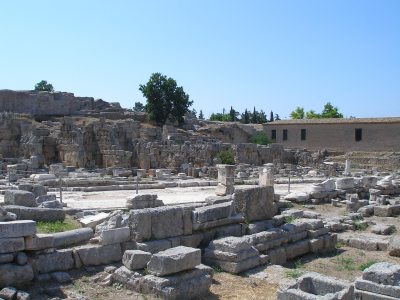
We see Paul introducing a vegetarian. The vegetarian is not someone who wants ethical treatment of animals but someone being super cautious about accidently eating the wrong meat. Most meat was sold in the market at the time of Paul. The markets were usually located directly next to pagan temples. Pagans would sacrifice their animals and then the priests would bring the meat to the market for sale. If you were at a friend’s house for diner, you might pass on the meat because chances were that it was sacrificed to a false God.

market at corinth

This is a picture from my visit to Corinth. Notice the stalls and hill in the background. The temple was on the hill, and the stalls were the shops in which the meat was sold.

Paul calls these people “weak”. Paul is not criticizing vegetarians in general (sadly not the case), but is criticizing Christians who criticize other Christians for what they eat. Paul says “let him who does not eat judge him who eats.” The problem was busybody theologians (notice the judgment “by” vegetarians), not vegetarianism. Paul continues:

Rom 14:15 Yet if your brother is grieved because of your food, you are no longer walking in love. Do not destroy with your food the one for whom Christ died…
Rom 14:17 for the kingdom of God is not eating and drinking, but righteousness and peace and joy in the Holy Spirit.

When Paul talks about the Kingdom of God not being “eating and drinking”, he is not saying we will not eat and drink in the Kingdom. Paul is not making the case that the Kingdom of God is metaphysical. Paul is saying that the point of the Kingdom is righteousness. Food is a side issue. That is the context of this verse.

Rom 14:20 Do not destroy the work of God for the sake of food. All things indeed are pure, but it is evil for the man who eats with offense.
Rom 14:21 It is good neither to eat meat nor drink wine nor do anything by which your brother stumbles or is offended or is made weak.
Rom 14:22 Do you have faith? Have it to yourself before God. Happy is he who does not condemn himself in what he approves.
Rom 14:23 But he who doubts is condemned if he eats, because he does not eat from faith; for whatever is not from faith is sin.

In verse 21, when Paul points out that we should not provoke theological fights over food, this issue is not about “it is a sin to drink alcohol”. The theological issue was “it is a sin to consume wine or meat dedicated to a pagan god”. Stumbling was not “falling off the wagon”, but becoming theologically upset or having a hurt conscience. In no sense is this about “animal cruelty”.

Paul’s advice is to eat and drink whatever you want. The spiritually strong would eat all things, and the weak would abstain due to moral concerns. When you do eat, you should do it in faith (meaning you should not feel guilty). Those are is issues.

This principle should not be exported. Once, a friend of mine was told by a certain Christian: “You should not listen to Skillet [a Christian rock band] because it might make me stumble.” That is not the context. The Jews had traditionally been forbidden to eat meat. Paul introduced something brand new that changed the dietary laws (both about Kosher and about idol sacrifices). The leaders of the church also disagreed with Paul’s message. They commanded the gentiles to abstain from things sacrificed to idols. Paul is not making a greater point to “never do anything in any context that might make someone stumble in any sense of the word.” Paul is saying that the Church has to get used to the changes as to what they are allowed.

A side story on vegetarianism:

My brother in law is an “animal rights” lawyer. He was one day explaining how a pig is smarter than a dog. He then added: “That is why we should not eat pigs. You wouldn’t eat a dog, would you?” To which I responded: “There is nothing wrong with that. I would eat a dog.” With no response, the conversation abruptly ended.

In Timothy, Paul makes the case why Christians should expand their meat menu:

Ti 4:1 Now the Spirit expressly says that in latter times some will depart from the faith, giving heed to deceiving spirits and doctrines of demons,
1Ti 4:3 … commanding to abstain from foods which God created to be received with thanksgiving by those who believe and know the truth.
1Ti 4:4 For every creature of God is good, and nothing is to be refused if it is received with thanksgiving;

Posted in Bible, Greek History, History, Misquoted Verses, Morality, Theology | 1 Comment

cortes – hero for Christianity

Hernan Cortes (16th century Spanish Conquistador and Conqueror of Mexico) has a terrible reputation in the modern culture. He is seen as having bloodlust for gold, but as historian William H Prescott explains, Cortes actually had a bloodlust for God. Hernan Cortes would have gladly died for the salvation of the natives and often times put his entire mission at risk to do so.

Setting the scene of Mexico: Mexico was controlled by the Aztec empire. They introduced human sacrifice to the area centuries before and the practice was widespread at the time Cortes landed. The Aztecs sacrificed 50,000 to 250,000 human beings per year. Sometimes, there would be special occasions in which a great number more would be sacrificed. In 1487, the Aztecs sacrificed 80,400 people in 4 days! Their victims would promptly be cannibalized. The tribute tribes and even the rebel tribes all incorporated this practice into their religious practices. Stopping human sacrifice was a driving motivational force for the Spaniards as they encountered the gruesome scenes. Through the course of Cortes’ campaign, many a Spaniard died at the hands of pagan priests, having their hearts removed while alive and bodies rolled down a pyramid to hungry warriors below. The inside walls of the pagan temples were black goo from the flesh of the victims.

Cortes’ official mission was never to conquer Mexico. Cortes invented this mission himself and snuck a fleet of ships out of Cuba to embark on it. Cortes decided to land 110 sailors, 553 soldiers, and 200 natives into an unexplored nation filled with millions of hostile warriors without having the slightest information on how he would be received. In fact, Cortes’ first landing at the Yucatán Peninsula he fights several intense battles against waves of the natives. To top it all off, he later scuttles his own ships so his 863+ people cannot even escape. Putting this in perspective, the Aztec King Montezuma was said to be able to call upon over 3 million warriors (30 vassals with 100 thousand men each). But Cortes didn’t care: he believed the greater the odds the more God would help him overcome.

Cortes’ primary motive was conversion of the natives to Christianity. Cortes’ first attempt at converting the natives is forthright. While at a pagan temple on an island, the natives inform him that their idols give them the sun and the rain. Cortes is less than impressed and proceeds to roll the idols down the temple stairs. He replaces it with a shrine to Mary. The natives at least feign conversion. Later, upon meeting representatives from the Aztec empire, Cortes enthusiastically tells them about Jesus. But this time it is the natives’ turn to be less than impressed; they quietly leave during the night. This seems to be the common theme throughout Cortes’ journey. Several temples were destroyed in a similar manner and the Aztecs (more than other nations) politely decline Christianity.

After events on the first island, Cortes attempts to gain a foothold on the continent. Cortes valiantly asks for free passage and warns the natives that any blood would be on their heads. When they refuse, a battle ensues. Cortes exposes himself to great danger in hand to hand combat, waste deep in water (Cortes always fought in the thick of the action). The natives single him out, but he repeals their onslaught. After winning the battle, Cortes learns the entire country is in arms. His hard band of explorers is fighting an entire nation (the Tabascans). He decisively defeats them, before relocating his men to Veracruz.

At Veracruz, the Totonacs reach out to Cortes. They had been recently conquered by the Aztecs and were looking for relief from Aztec oppression. At this time, Cortes used his intellect to band together sick and rebellious Castilians, engender moral, and convince his men to follow him despite rumors that Cortes was far exceeding his authority from Spain. After reaching the leader of the Totonacs, Cortes implores them to convert to Christianity and abolish the practice of human sacrifice. The chieftain warns Cortes of the Aztec military might. Undeterred, Cortes declares that one Castilian can defeat a host of warriors.

When Aztec nobles arrive demanding human sacrifices, Cortes has them imprisoned and then released skillfully to mitigate Aztec suspicions. Cortes then put his entire alliance with the Totonacs in jeopardy by destroying their idols. It is at this time Cortes sends treasure to Spain to secure their favor and secretly sinks the rest of his fleet to prevent communication with Cuba. Cortes then resolves all the resulting problems solely through his power of persuasion alone. He calms the Aztecs, the Totonacs and even his rebellious men.

Cortes then sets off for the Aztec capital, planting Christian crosses in receptive cities. When he reached the Tlascalans (a rebel warrior tribe) he weathered several surprise attacks by an opposing force that were over 30 times as numerous. Cortes was heard yelling “If we fail now, the cross of Christ can never be planted in the land.” Cortes, throughout his campaign, gave persuasive and inspirational speeches. Although crippled from fever, Cortes defeats the warrior Tlascalan military (something even the Aztecs could not do). He then enlists them against the Aztecs. After his new allies warn Cortes not to go to the city of Cholula, he resolves that going to Cholula would be his best course of action. There he repeals an Aztec plot against him.

When finally arriving at the Aztec capital of Tenochtitlan, Cortes again preaches Christianity. He devotion to conversion is illustrated by the fact that word has already reached Montezuma that the Castilians preach Christianity wherever they go. The Spaniards reside in Tenochtitlan for about 6 months before having to then fight a superior force of competing Spaniards that land near Veracruz. Cortes defeats them in a surprise night battle, and then enlisted them into his force. This is further evidence that arms alone were not the reason for the Spanish conquest of Mexico.

Returning to Tenochtitlan, he finds the city in arms. One of his captains has led a massacre against the locals. Cortes reprimands him and sets up measures for defense and retreat. This is the low point of his career, as he personally must face the problems caused by a lesser man. He leads his men through a hostile city filled with millions of angry warriors. His casualties are high. About a third of his European force escapes, the rest are killed or sacrificed on the alters of the pagans. Along with high casualties Cortes loses his cannons, muskets, most his horses, and virtually all his crossbows.

The survivors set out towards the nation of the Tlascalans, their only hope. Cortes keeps them in the best of spirits and they weather the elements, hostile natives, starvation, and heat stroke. He rallies this mutinous, weary, and starving force against a vastly superior Aztec force sent to cut them off. Devoid of their superior weapons, the Spanish press into battle. Using his own flare of personal heroics, Cortes finally prevails against this army by thrusting his force deep into the enemy lines and killing the enemy commander. Cortes always fought on the front lines, and by his force of will alone turned the tides of a large number of battles.

Feverous and battle weary, Cortes rests among the Tlascalans. If the Tlascalans turned against him, this would be the end of Cortes’ quest. But the eldest Tlascalan chief persuades his people to ally with the Spanish rather than their ancient enemies, the Aztecs. This was one more of a series of miracles that was Cortes’ campaign.

When Cortes recoups, he leads assaults on various Aztec allies and strongholds, regaining the trust of his previous allies and converting new allies in the process. Cortes was not a vindictive man. He was focused and dedicated to his goals, and all his actions were designed to affect his goals. If a nation surrendered, he was quick to forgive past atrocities. If a nation resisted, it felt his wrath. Cortes always commanded his men to spare women and children, but his native allies felt no such compunction. In this way, Cortes encouraged bloodless submission. But not every tribe submitted.

In a stroke of divine providence, random European ships would show up, bringing extra men and the more invaluable cannons, horses, crossbows, and guns (which had been wiped out in the Aztec capitol). They always seemed to have been diverted by a storm or other chance event. Even Cortes’ Cuban rivals accidently send him supplies. In a stroke of genius, Cortes builds an inland fleet of ships to blockade Tenochtitlan. Then they carry this fleet over the mountains and reassemble on the lake surrounding Tenochtitlan.

When Cortes besieged Tenochtitlan, he had approximately 16 canons, 80,000–200,000 native allies, about 100 cavalry, and about 1,000 Spanish soldiers. This was against the Aztecs which probably had 300,000 warriors inside the capitol, and various tribute states surrounding the lake. Cortes was not leading an invasion force from Europe, but a native, freedom coalition against their oppressors. Cortes even had to dismiss native allies because his force was becoming too cumbersome.

From here Cortes leads his forces around the massive lake, cutting off as many supply routes to Tenochtitlan as possible. He submits various Aztec allies, and cuts off all main entrances to Tenochtitlan. At this point, he leads a three prong assault on the city, using his fleet of ships and canons to press to the gates of the city. Always outnumbered, Cortes successfully cuts off enemy supplies and presses into the city.

Once inside the city, his men can daily hear and see their captured comrades being sacrificed on the pagan alters. But at every turn, Cortes offers to allow the Aztecs a bloodless surrender. But the Aztec will is strong and proud; Cortes cannot gain ground until he literally dismantles every building in the city. The previously oppressed tribes of Mexico eagerly flock to Tenochtitlan with their picks and hoes to rip to shreds the glory of their oppressors.

Even in the end, the Aztecs fight to a man. They were dying of starvation as Cortes conquered the last bit of the city and captured the Aztec king. Cortes offers the survivors peace, and his first act is to rebuild the capitol.

The reputation of Cortes was so great among the natives that intertribal conflicts were appealed directly to Cortes. Cortes sued for peace between ancient enemies and pacified rival tribes. Cortes was consulted on successions of Kings, and was seen as almost a god himself. It may be because of this charisma that that King of Spain ensured Cortes was not allowed to govern Mexico. Instead it fell to less capable hands, which instituted unheard cruelties on the native population. Cortes was left powerless over the nation that he conquered. Cortes did ensure proper (not corrupt) missionaries were established in the land.

Cortes’ legacy is this:

1. Single handedly being responsible for the conquest of Mexico.
2. Converting the people to Christianity.
3. Stopping the mass murder and cannibalism among the native tribes.
4. Unifying Mexico.

Two dark spots remain on Cortes’ character:

1. He asks Spain to institute repartimientos (a form of indentured servitude) when he found out the natives didn’t like hard work (who does?).
2. In a later journey Cortes executes his prisoners (the Aztec king and some Aztec nobles) because of a rumor of a plot (which no one believed).

In total, Cortes should be seen as a soldier of God, whom God personally helped conquer Mexico. He is not the villain that modern apologists for the Aztecs depict. Cortes was a liberator of the oppressed. Cortes saved the lives of countless people who would have been murdered in pagan temples. Cortes was a blessing to humanity. More than anything, Cortes sought the conversion of the natives to Christianity. Cortes is a hero of Christianity.

See also Apologists for the Aztecs

Posted in History, Human Nature | Leave a comment

the butler and lbj

Having now watched The Butler and having found out critical plot elements were complete fabrications (such as the entirety of the butler’s early life and having two sons), it would be good to call attention to the false humanization of Lyndon B Johnson. If there ever was an insidious and evil man, it was LBJ.

In a post by Steve Landsburg, he rightly marginalizes the death of JKF and then pointed out the worst consequence was the elevation to power of LBJ:

Fifty years ago today at 1:30 PM eastern standard time, a minor tragedy took the life of President John F. Kennedy. A little over an hour later, a major tragedy ensued, as Lyndon B. Johnson was sworn in to replace him.

If there is such a thing as evil, it lived in Lyndon Johnson, whose life was one long obsession with the accumulation and exercise of power.

Landsburg’s article does a good job of summarizing the hideous personal nature of LBJ, but another article comes to mind by Lt. Gen. Charles Cooper. He recalls a personal meeting with LBJ in which the military top advisors, men wise with experience, are vulgarly berated by LBJ because LBJ does not care for their advice:

He screamed obscenities, he cursed them personally, he ridiculed them for coming to his office with their “military advice.” Noting that it was he who was carrying the weight of the free world on his shoulders, he called them filthy names-shitheads, dumb shits, pompous assholes-and used “the F-word” as an adjective more freely than a Marine in boot camp would use it. He then accused them of trying to pass the buck for World War III to him. It was unnerving, degrading…

He suggested that each one of them change places with him and assume that five incompetents had just made these “military recommendations.”

With the deaths of so many American’s on LBJ’s hands, the article concludes:

The irony is that it began to end only when President Richard Nixon… did precisely what the Joint Chiefs of Staff had recommended to President Johnson in 1965. Why had Johnson not only dismissed their recommendations, but also ridiculed them? …since he was clearly a bully, maybe what he lacked was courage… But had General Wheeler and the others received a fair hearing, and had their recommendations received serious study, the United States may well have saved the lives of most of its more than 55,000 sons who died in a war that its major architect, Robert Strange McNamara, now considers to have been a tragic mistake.

In the words of Paul: “the Lord repay him according to his works.”

Posted in Goverment, History | Leave a comment

star trek is absurd

I am not a big fan of the Star Trek universe. The plot of the Star Trek always borders on extreme absurdity. One particular episode that I have always thought illustrated this is the episode in which a planet did not use birth control or abortion. As a result the entire surface of the planet was nothing but standing room only people. The episode was criticizing pregnancy and science that extends lifespans! The answer Kirk gives the people is “population control” not “hey, there is a great universe out there will millions of planets… why don’t you move?”

I don’t think I need to say more:

Posted in Abortion, Standard of Living, videos | Leave a comment

headline of the year

From Mike Munger’s blog:

Best headline of 2013: “Ice Breaker Gets Stuck Trying to Rescue Global Warming Scientists Trapped in Antarctic Ice.”

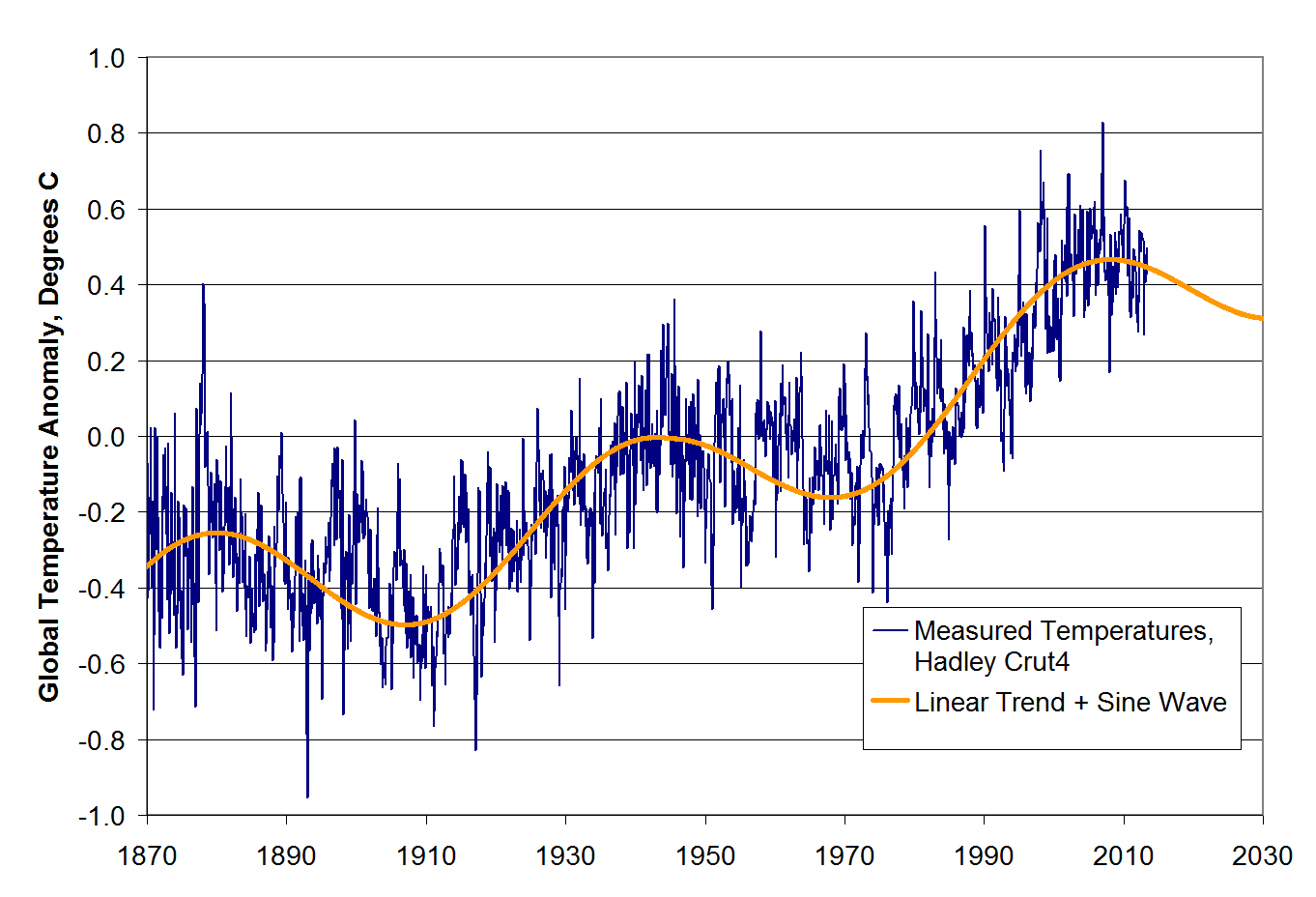
And on Climate Skeptic, an amateur model (which better predicts reality than the professional models), predicts a decrease in temperature over the next decade.

Posted in Science | Leave a comment

dave berry on fiscal problems

From Dave Berry’s year in review:

January

… which begins with a crisis in Washington, a city that — despite having no industries and a workforce consisting almost entirely of former student council presidents — manages to produce 93 percent of the nation’s crises. This particular crisis is a “fiscal cliff” caused by the fact that for years the government has been spending spectacular quantities of money that it does not have, which has resulted in a mess that nobody could possibly have foreseen unless that person had a higher level of financial awareness than a cucumber.

Feburary

If the sequester goes into effect, federal spending will continue to rise, but not quite as fast as it would have risen without the sequester. To a normal human, this means government spending is still increasing, but to Washington, the sequester means “draconian cuts” and is a looming disaster of epic proportions. Panic grips the city, as grim-faced former student council presidents write talking points far into the night.

March

as the federal budget deadline passes without Congress reaching agreement, the devastating, draconian, historically catastrophic sequester goes into effect, causing a mild reduction in the rate of increase in government spending that for some inexplicable reason goes unnoticed by pretty much everybody outside the federal government.

October

the federal government, in an unthinkable development that we cannot even think about, partially shuts down. The result is a catastrophe of near-sequester proportions. Within hours wolves are roaming the streets of major U.S. cities, and bacteria the size of mature salmon are openly cavorting in the nation’s water supply. In the Midwest, thousands of cows, no longer supervised by the Department of Agriculture, spontaneously explode. Yellowstone National Park — ALL of it — is stolen. In some areas gravity stops working altogether, forcing people to tie themselves to trees so they won’t float away. With the nation virtually defenseless, the Bermudan army invades the East Coast, within hours capturing Delaware and most of New Jersey.

Posted in Goverment, Humor | Leave a comment

walmart and the 15 dollar wage

Peter Schiff is receiving his fair share of death threats these days. His crime: he explained why Walmart cannot pay $15 per hour wages. He explains: Walmart’s profit margins are extremely slim as it is (3%). Their customers want low prices and are not willing to pay the cost differential for higher worker pay. Increasing their workers’ pay to $15 per hour would cost them 13 billion dollars per year. The only way to fund this increase would be to raise prices, and not by a insignificant amount. In other words, it would be business suicide. The entire video is worth a watch:

http://finance.yahoo.com/video/peter-schiff-why-wal-mart-200034834.html

Which reminds me of a certain meme:

Here is the original video to which the link refers (the first link is worth watching more):

Posted in Econ 101, Economics, Labor, prices | Leave a comment