buying government toiletpaper

The Blaze posts a recent article about wasteful purchasing by the government. This article covers a single buy of toilet paper for the DOJ. Whoever wrote this article is largely unfamiliar with government contracting, and they chose a fairly bad example to make their case (maybe $400,000 camel statues are too easy). This toilet paper purchase was actually one of the more legitimate purchases in government contracting (the government is required to buy, via bilateral contract, any requirements exceeding $3,000 unless it is applicable to the Service Contract Act or Davis Bacon Act).

The article highlights the buying of AbilityOne toilet paper, although the author is unaware of AbilityOne or the law behind AbilityOne purchases or what would prove to be general popular support of this law. The author assumes this bid will turn out at a high cost to the government, offering no support for this position. The increased cost for this item is attributed vaguely to the Federal Acquisition Regulation (FAR), which then is assumed to have undergone minor changes. If anything, the FAR is much too volatile. The FAR is updated regularly per every scheme of every politician every time a law is passed or an executive order is signed. The FAR also has volatile supplements per each Federal agency, subject to those agencies’ memos. The FAR and the supplements can be seen at the Farsite. The FAR is unstable and ever shifting in an age where the Federal Register is ballooning in size. It is no wonder government contracting specialists in their mid 20s command six figure salaries. The FAR is dynamically complicated stuff.

The article criticizes reverse auctioning, a process which works like ebay except providers bid against each other, offering lower and lower prices. In theory, the vendor who accepts the least amount of profit attains the award. This process does work exceptionally well, that is, as long as a single part number is being bid on. But if the government is bidding out generic requirements this is, by and large, a bad process. Pretend the government needs smartphones. It could spec out processor types, sizes, even a specific OS. But a vendor might respond with a quote for Chinese knockoff phones. Unless that bid can be disqualified, the government has to cancel and re-solicit if it does not want to accept that bid. In short, reverse auctioning is bad for general requirements, but great for specific part numbered items.

In the case of AbilityOne toilet paper, there is only one item. So this purchase will actually be of great value to the government, all factors considered. The single item is signified by the NSN number in the solicitation. Charmin and Whitecloud products cannot be bid. The toilet paper must come from AbilityOne, a manufacturer hiring blind and disabled workers. The AbilityOne requirement is generated by the Javits Wagner O’Day Act which, for good or bad, mandates that the government purchase specific part numbers from vendors who sell items manufactured by those who are blind or disabled. This is a feel-good law that most Americans would endorse (not the best idea to use this as an example of wasteful spending).

The real problem with Fedbid (the reverse auctioning website criticized in the article) is that the government is forcing agencies to use it. Fedbid is a private contractor who convinced the government to start using reverse auctioning. Fedbid is remitted a portion of award values by the companies receiving awards. Because of the nature of Fedbid, it is wholly unfit for the types of solicitations being forced on Fedbid. Additionally, Fedbid was awarded their own master contract under highly dubious circumstances. The Air Force is in the process of debarring Fedbid for illegal and improper activities.

One glaring problem is that the article hypothetically prices the toilet paper at $1.00 per roll, whereas a quick search on GSAAdvantage.gov (the government’s equivalent of Amazon.com) shows a low price of $0.50 per roll. Several commenters were confused and believed the government would actually be paying $1.00 per roll. Most likely, the government will being paying less than half of that price. The Blaze failed to perform basic market research; their readers became misinformed and confused as a result.

Where The Blaze is absolutely correct is that they highlight the absurd number of clauses that vendors must endorse before doing business with the government. Some of the clauses are statements that promise the government that the vendor does not traffic humans or use text messaging while driving. I am quite sure that those things are illegal and a vendor engaged in sex trafficking, nonetheless, would have no problem lying to the government for a contract. The article glances, yet does not elaborate, at the amount of additional red tape, including registering at SAM.gov and accepting the government’s antiquated invoicing system (complete with chronically late payments).

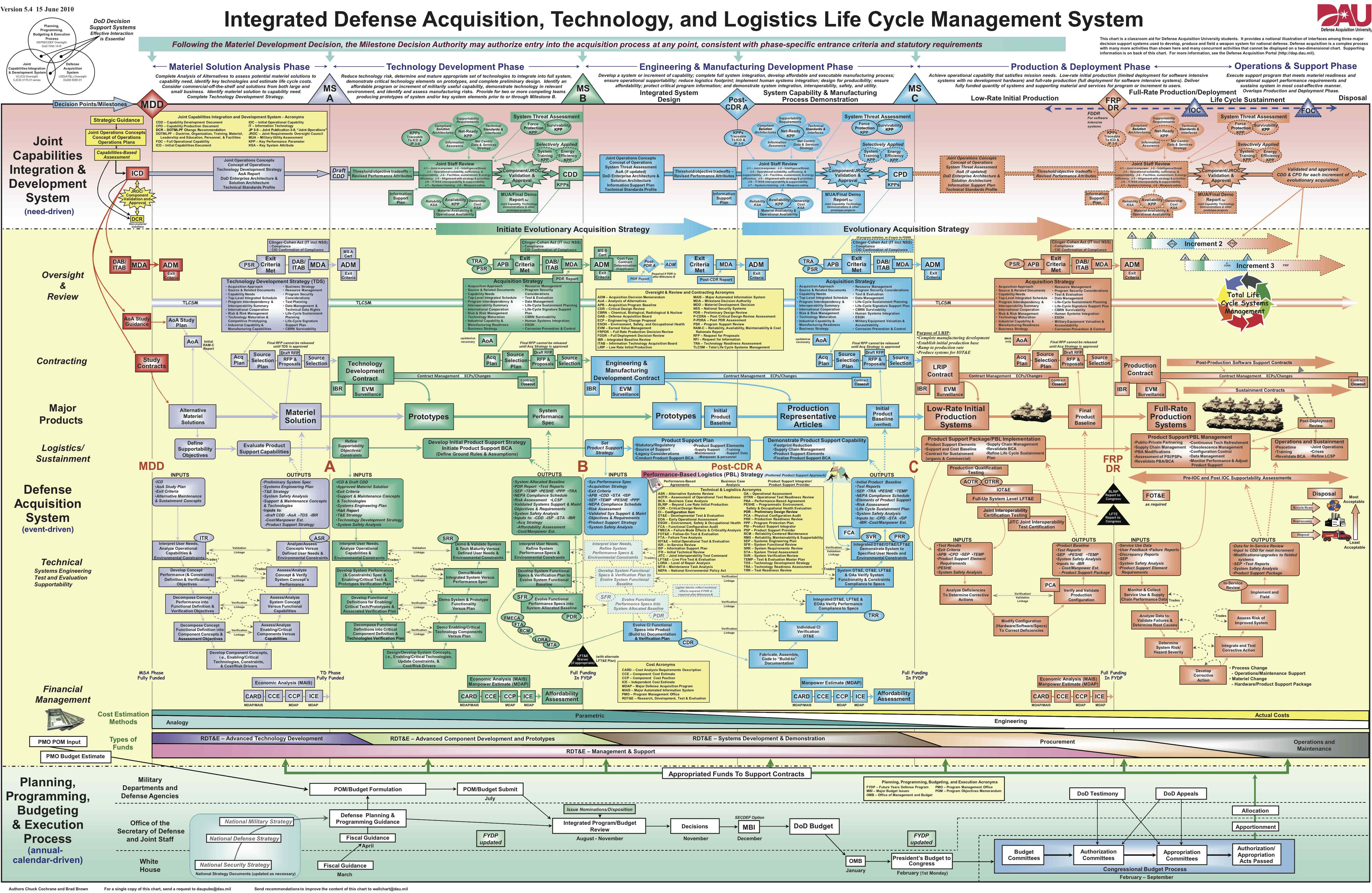
If The Blaze really wanted to point out the bureaucratic processes in government, they would have focused on high level contracts and the processes involved. The below chart should give people an idea of the overhead involved in those purchases:

contracting chart

Posted in Contracting, Goverment | 1 Comment

abortion in early jewish and christian theology

put-on-fleshEarly Jewish and Christian writings are very useful to help enlighten modern audiences about culture and ideas of these ancient civilizations. Whereas modern people have perverse incentives to reinterpret the Bible to fit their ideology, these writings help illustrate double standards in reading comprehension.

One such area is abortion. Some modern people attempt to make the claim that the Bible does not condemn abortion as murder. They willfully misunderstand Exodus 21 to make this claim. In this Exodus text, God gives the death penalty to negligent homicide of the unborn baby:

Exo 21:22 “If men fight, and hurt a woman with child, so that she gives birth prematurely, yet no harm follows, he shall surely be punished accordingly as the woman’s husband imposes on him; and he shall pay as the judges determine.
Exo 21:23 But if any harm follows, then you shall give life for life,

Some individuals claim that the “harm” does not refer to the unborn baby, but that is not genuine to the text. A woman has a premature birth and the text links this to the harm that may or may not follow. The premature birth (there is no evidence this first part is referring to a miscarriage death) causes the assailant to pay restitution. But Exodus adds, if any harm follows (as opposed to “no harm” against the unborn baby), then it is a “life for a life”. The Jews took killing people’s children very seriously.

Conversely, if the woman was not pregnant then presumably no restitution is due. If this text was about the woman and not the baby, then why include the fact that she is pregnant? Why include the premature birth statement? What is the contrast between the premature birth and the later scenario? Aren’t there other texts that deal with unintentional manslaughter? To make this passage dismissive of the life of the baby is a gross injustice to the text.

Interestingly enough, “an eye for an eye” is only found in this text dealing with unborn babies. Killing unborn babies, even accidentally, was a capital crime in the Old Testament.

The Jews were notoriously pro-life. Tacitus (56–117AD) criticizes the Jews on this point:

Still they provide for the increase of their numbers. It is a crime among them to kill any newly-born infant. They hold that the souls of all who perish in battle or by the hands of the executioner are immortal. Hence a passion for propagating their race and a contempt for death. They are wont to bury rather than to burn their dead, following in this the Egyptian custom; they bestow the same care on the dead, and they hold the same belief about the lower world.

In one of the earliest Christian texts, The Didache (50-120AD) this belief is attributed to Christians in general:

thou shalt do no sorcery, thou shalt not murder a child by abortion nor kill them when born,

The “sorcery” mentioned is about potions or poisons. Probably this is referring to chemical abortifacient (with the same meaning being possible in both Gal 5:20 or Rev 9:21). This practice is both mentioned by Minucius Felix and Basil (condemned in both cases). In any case, the text distinguishes between babies aborted in the womb and babies aborted after birth. This is repeated in the The Epistle of Barnabas (c80-120AD):

Thou shalt not murder a child by abortion, nor again shalt thou kill it when it is born.

The text distinguishes between born and unborn babies. Both forms of abortions were prohibited.

No only this, but in the Apocalypse of Peter (c100-150AD) there is a horrifying image. All those women who have had abortions are forced to wallow in excrement/vile/gore up to their eyes. Their unborn babies encircle them, crying endlessly (the image is of their own children, whom they have murdered, piercing their ears with the infant cries they never were able to hear). And from the babies, fire shoots into the eyes of the mothers who aborted them:

26 And hard by that place I saw another strait place wherein the discharge and the stench of them that were in torment ran down, and there was as it were a lake there. And there sat women up to their necks in that liquor, and over against them many children which were born out of due time sat crying: and from them went forth rays of fire and smote the women in the eyes: and these were they that conceived out of wedlock (?) and caused abortion.

Born “out of due time” is referring to in utero abortion. The idea is that the abortion cuts short the pregnancy. It is these babies that are present and taking vengeance.

In a lost fragment of the same text, snakes crawl over the bodies of the mothers and eat their flesh:

But the milk of the mothers, flowing from their breasts and congealing, saith Peter in the Apocalypse, shall engender small beasts (snakes) devouring the flesh, and these running upon them devour them: teaching that the torments come to pass because of the sins (correspond to the sins).

While this lost fragment may be spurious and the previous text limitedly received (the Muratorian fragment accepts it as legitimate), it does show the cultural values of the Christians of that day.

Athenagoras of Athens (c 175-180AD) describes how Early Christians detest abortion (even abortion via chemicals in the womb) as murder:

And when we say that those women who use drugs to bring on abortion commit murder, and will have to give an account to God s for the abortion, on what principle should we commit murder? For it does not belong to the same person to regard the very foetus in the womb as a created being, and therefore an object of God’s care, and when it has passed into life, to kill it; and not to expose an infant, because those who expose them are chargeable with child-murder, and on the other hand, when it has been reared to destroy it.

There is an emphasis on children in the womb.

Both early Jewish and Christian theology was dead set against abortion. The Jewish values clashed against the Roman values. But the early Christians were strongly ingrained by the earliest Church Fathers to oppose abortion. It took Augustine (354–430AD) and the Talmud to shift opinion away from these values.

Posted in Abortion | 2 Comments

when God dwells on earth


10402816_790350641014469_2937347822416183909_nAs I have written before, the temple was at the heart of Jewish theology. To the Jews, the temple was God’s own conduit to Earth. The temple had existed from the time of Moses when God commanded Moses to build Him a sanctuary:


Exo 25:8 And let them make Me a sanctuary, that I may dwell among them.

This first building is a tent. This is particularly useful for a mobile nation. God was thought to have traveled with Israel through their wanderings. Moses even commands that people bury their poop, such that God does not see and/or step in it:

Deu 23:12 “Also you shall have a place outside the camp, where you may go out;
Deu 23:13 and you shall have an implement among your equipment, and when you sit down outside, you shall dig with it and turn and cover your refuse.
Deu 23:14 For the LORD your God walks in the midst of your camp, to deliver you and give your enemies over to you; therefore your camp shall be holy, that He may see no unclean thing among you, and turn away from you.

The people take comfort in having God so close:

Deu 4:7 “For what great nation is there that has God so near to it, as the LORD our God is to us, for whatever reason we may call upon Him?

But at times, God threatens to abandon Israel:

Exo 33:2 And I will send My Angel before you, and I will drive out the Canaanite and the Amorite and the Hittite and the Perizzite and the Hivite and the Jebusite.
Exo 33:3 Go up to a land flowing with milk and honey; for I will not go up in your midst, lest I consume you on the way, for you are a stiff-necked people.”
Exo 33:4 And when the people heard this bad news, they mourned, and no one put on his ornaments.
Exo 33:5 For the LORD had said to Moses, “Say to the children of Israel, ‘You are a stiff-necked people. I could come up into your midst in one moment and consume you. Now therefore, take off your ornaments, that I may know what to do to you.’ ”

Exo 33:14 And He said, “My Presence will go with you, and I will give you rest.”
Exo 33:15 Then he said to Him, “If Your Presence does not go with us, do not bring us up from here.
Exo 33:16 For how then will it be known that Your people and I have found grace in Your sight, except You go with us? So we shall be separate, Your people and I, from all the people who are upon the face of the earth.”
Exo 33:17 So the LORD said to Moses, “I will also do this thing that you have spoken; for you have found grace in My sight, and I know you by name.”

In this passage, God had already pardoned Israel. But God cannot stand Israel. God’s new plan is to send an angel to accompany Israel instead of God. But to this, Moses and the people object. God commands them to show penitence, and from what they show, God will decide how to act. The people comply. Moses engages God again. God grants Moses’ request. The remaining part of Exodus 33 is the infamous scene in which Moses requests to see God.

In Exodus 40, God enters the temple. This is described as visibly looking as if a cloud is descending. The cloud itself is not God, but seems to obscure the vision of God’s glory. This may be because Exodus 33 states that no man can see God’s face and live (Exo 33:20):

Exo 40:34 Then a cloud covered the tent of the congregation, and the glory of the LORD filled the tabernacle.
Exo 40:35 And Moses was not able to enter into the tent of the congregation, because the cloud abode thereon, and the glory of the LORD filled the tabernacle.

The temple remains a tent until the time of David. David proposes to build a more solid structure (paralleled in 1 Chronicles 17):

2Sa 7:5 “Go and tell My servant David, ‘Thus says the LORD: “Would you build a house for Me to dwell in?
2Sa 7:6 For I have not dwelt in a house since the time that I brought the children of Israel up from Egypt, even to this day, but have moved about in a tent and in a tabernacle.
2Sa 7:7 Wherever I have moved about with all the children of Israel, have I ever spoken a word to anyone from the tribes of Israel, whom I commanded to shepherd My people Israel, saying, ‘Why have you not built Me a house of cedar?’ ” ‘

God claims that He dwelt in the tent and traveled around with the tent, from the Exodus until David’s time. God seems satisfied with the tent and wonders why David is intent on a temple. God does not refuse the building, but instead God passes the responsibility to David’s son to build the new temple:

2Sa 7:13 He shall build an house for my name, and I will stablish the throne of his kingdom for ever.

But David starts gathering resources to build God’s house, despite God’s command. God then specifically tells David why David cannot build the house: David has killed too many people. Solomon will have to build the temple.

1Ch 22:8 But the word of the LORD came to me, saying, Thou hast shed blood abundantly, and hast made great wars: thou shalt not build an house unto my name, because thou hast shed much blood upon the earth in my sight.
1Ch 22:9 Behold, a son shall be born to thee, who shall be a man of rest; and I will give him rest from all his enemies round about: for his name shall be Solomon, and I will give peace and quietness unto Israel in his days.
1Ch 22:10 He shall build an house for my name; and he shall be my son, and I will be his father; and I will establish the throne of his kingdom over Israel for ever.

Solomon does build a house for God (this is the First Temple):

2Ch 6:1 Then Solomon spoke: “The LORD said He would dwell in the dark cloud.
2Ch 6:2 I have surely built You an exalted house, And a place for You to dwell in forever.”

God inhabits it:

2Ch 7:1 When Solomon had finished praying, fire came down from heaven and consumed the burnt offering and the sacrifices; and the glory of the LORD filled the temple.
2Ch 7:2 And the priests could not enter the house of the LORD, because the glory of the LORD had filled the LORD’s house.

Absent is the cloud of smoke from Exo 40:34. Instead the transmission of God into the house is either by fire or unrecorded. Again, the glory of God stops individuals from entering the place.

But then God leaves it in Ezekiel:

Eze 10:18 Then the glory of the LORD departed from the threshold of the temple and stood over the cherubim.
Eze 10:19 And the cherubim lifted their wings and mounted up from the earth in my sight. When they went out, the wheels were beside them; and they stood at the door of the east gate of the LORD’s house, and the glory of the God of Israel was above them.

Eze 11:22 So the cherubim lifted up their wings, with the wheels beside them, and the glory of the God of Israel was high above them.
Eze 11:23 And the glory of the LORD went up from the midst of the city and stood on the mountain, which is on the east side of the city.

Ezekiel watches a fiery chariot ascend into the heaven. With the chariot departs God. But Ezekiel gives the reader hope. For one day God would return and inhabit the temple again:

Eze 43:4 And the glory of the LORD came into the temple by way of the gate which faces toward the east.

Eze 43:7 And He said to me, “Son of man, this is the place of My throne and the place of the soles of My feet, where I will dwell in the midst of the children of Israel forever. No more shall the house of Israel defile My holy name, they nor their kings, by their harlotry or with the carcasses of their kings on their high places.
Eze 43:8 When they set their threshold by My threshold, and their doorpost by My doorpost, with a wall between them and Me, they defiled My holy name by the abominations which they committed; therefore I have consumed them in My anger.
Eze 43:9 Now let them put their harlotry and the carcasses of their kings far away from Me, and I will dwell in their midst forever.

When God does inhabit the temple, God would take up rulership. God would protect and judge Israel from His throne. God would stay forever.

The temple is rebuilt. Some 66 years later the construction starts by allowance of Cyrus (Ezr 1:3). Construction is finished under Darius (Ezr 6:14). The prophet Haggai presses the people into action. Haggai claims that God is angry because His house is in ruins.

Hag 1:8 Go up to the mountains and bring wood and build the temple, that I may take pleasure in it and be glorified,” says the LORD.
Hag 1:9 “You looked for much, but indeed it came to little; and when you brought it home, I blew it away. Why?” says the LORD of hosts. “Because of My house that is in ruins, while every one of you runs to his own house.

Haggai then claims that God will reinhabit the temple:

Hag 2:5 ‘According to the word that I covenanted with you when you came out of Egypt, so My Spirit remains among you; do not fear!’

Hag 2:6 “For thus says the LORD of hosts: ‘Once more (it is a little while) I will shake heaven and earth, the sea and dry land;
Hag 2:7 and I will shake all nations, and they shall come to the Desire of All Nations, and I will fill this temple with glory,’ says the LORD of hosts.

But God does not reinhabit this temple, at least not as recorded in the Old Testament. It is probably due to this that apocalyptic literature abounded in 1st Century Judaism. God had left, but had not returned. Instead, Israel was oppressed constantly by foreigners. The Jews were expecting God to return and save them from their oppressors. The Jewish hope was that God would one day return to Earth and then He would stay, ruling the Earth from His holy city.

All the prophets claimed that God would return to the temple or Jerusalem and rule the world (echoing Ezekiel 43):

Hag 2:6 “For thus says the LORD of hosts: ‘Once more (it is a little while) I will shake heaven and earth, the sea and dry land;
Hag 2:7 and I will shake all nations, and they shall come to the Desire of All Nations, and I will fill this temple with glory,’ says the LORD of hosts.

Hag 2:9 ‘The glory of this latter temple shall be greater than the former,’ says the LORD of hosts. ‘And in this place I will give peace,’ says the LORD of hosts.”

Zec 8:3 “Thus says the LORD: ‘I will return to Zion, And dwell in the midst of Jerusalem. Jerusalem shall be called the City of Truth, The Mountain of the LORD of hosts, The Holy Mountain.’

Zec 8:7 “Thus says the LORD of hosts: ‘Behold, I will save My people from the land of the east And from the land of the west;
Zec 8:8 I will bring them back, And they shall dwell in the midst of Jerusalem. They shall be My people And I will be their God, In truth and righteousness.’

Zec 8:23 “Thus says the LORD of hosts: ‘In those days ten men from every language of the nations shall grasp the sleeve of a Jewish man, saying, “Let us go with you, for we have heard that God is with you.” ‘ ”

Zec 14:9 And the LORD shall be King over all the earth. In that day it shall be “The LORD is one,” And His name one.

Zec 14:16 And it shall come to pass that everyone who is left of all the nations which came against Jerusalem shall go up from year to year to worship the King, the LORD of hosts, and to keep the Feast of Tabernacles.

Isa 2:2 Now it shall come to pass in the latter days That the mountain of the LORD’s house Shall be established on the top of the mountains, And shall be exalted above the hills; And all nations shall flow to it.
Isa 2:3 Many people shall come and say, “Come, and let us go up to the mountain of the LORD, To the house of the God of Jacob; He will teach us His ways, And we shall walk in His paths.” For out of Zion shall go forth the law, And the word of the LORD from Jerusalem.
Isa 2:4 He shall judge between the nations, And rebuke many people; They shall beat their swords into plowshares, And their spears into pruning hooks; Nation shall not lift up sword against nation, Neither shall they learn war anymore.

Isa 4:4 When the Lord has washed away the filth of the daughters of Zion, and purged the blood of Jerusalem from her midst, by the spirit of judgment and by the spirit of burning,
Isa 4:5 then the LORD will create above every dwelling place of Mount Zion, and above her assemblies, a cloud and smoke by day and the shining of a flaming fire by night. For over all the glory there will be a covering.
Isa 4:6 And there will be a tabernacle for shade in the daytime from the heat, for a place of refuge, and for a shelter from storm and rain.

Zep 3:15 The LORD has taken away your judgments, He has cast out your enemy. The King of Israel, the LORD, is in your midst; You shall see disaster no more.
Zep 3:16 In that day it shall be said to Jerusalem: “Do not fear; Zion, let not your hands be weak.
Zep 3:17 The LORD your God in your midst, The Mighty One, will save; He will rejoice over you with gladness, He will quiet you with His love, He will rejoice over you with singing.”
Zep 3:18 “I will gather those who sorrow over the appointed assembly, Who are among you, To whom its reproach is a burden.
Zep 3:19 Behold, at that time I will deal with all who afflict you; I will save the lame, And gather those who were driven out; I will appoint them for praise and fame In every land where they were put to shame.
Zep 3:20 At that time I will bring you back, Even at the time I gather you; For I will give you fame and praise Among all the peoples of the earth, When I return your captives before your eyes,” Says the LORD.

This is the theology which John the Baptist teaches. This is the theology that Jesus preaches, the coming Kingdom of God. James, Peter and Paul all await this coming apocalypse. The Bible ends by reaffirming this idea:

Rev 21:2 Then I, John, saw the holy city, New Jerusalem, coming down out of heaven from God, prepared as a bride adorned for her husband.
Rev 21:3 And I heard a loud voice from heaven saying, “Behold, the tabernacle of God is with men, and He will dwell with them, and they shall be His people. God Himself will be with them and be their God.

But for John, because God, Himself, rules the city there will be no more need for a temple. The temple will be obsolete:

Rev 21:22 But I saw no temple in it, for the Lord God Almighty and the Lamb are its temple.

Posted in Theology | 4 Comments

my discussion with one of the little rock nine (or irrationality in politics)

little rock nineAround 2004, I was taking a college class in Discrimination and Law. The purpose of this class was to examine the legal rules and processes behind discrimination lawsuits. The content of this class was very infuriating, describing burdens of proof that are placed on individuals if other individuals have prima facie evidence of discrimination. The entire set of laws is designed such that the state can destroy people’s lives based on unsubstantiated claims. In discrimination law, it is not innocent until proven guilty; it is guilty until you prove yourself innocent.

Around this time, also, I was reading heavily the works of Economist Thomas Sowell. Sowell is a visionary man with a remarkable mind. He also has the distinction of being the only person I ever voted for to be president (as a write-in candidate). He is strong at weaving together historical narratives and statistics, interpreting the data rationally. His book Basic Economics should be the starting point for anyone interested in thinking beyond the superficial.

Concurrently with the class, I started reading Sowell’s Affirmative Action Around the World – An Empirical Study, in which Sowell argues that Affirmative Action has been very destructive, despite the “noble” intents of their authors. This theme is similar to other books he has written including the A Conflict of Visions: Ideological Origins of Political Struggles and The Vision of the Anointed Self-Congratulation as a Basis for Social Policy. When the government tries to fix problems, there are always unforeseen consequences. With the static and politically motivated government at the helm, the cure is almost always worse than the problem (see on the progressives hurting the poor).

At this point in my life, the internet was not widely accessible. I would bring Sowell’s book to class every day so that I could reference his statistics which I had laboriously highlighted during previous readings. Most of my classmates were inclined to believe the state had a legitimate and achievable (two different things which they conflated) role in passing laws about discrimination. I argued that such programs fail, and often escalate the problems they are trying to solve. The free market is, historically, the best mechanism at destroying discrimination. Discrimination quickly becomes expensive. When the state becomes involved, the result is more discrimination because price is removed from the equation (for example, a higher minimum wage allows employers to be more selective as to whom they hire allowing their racism, rather than their wallet, to be the determining factor)

Attempts by the state to end discrimination inevitably creates more discrimination towards the groups they try to help. It increases tension, jealousy, and bitterness between groups. The statistical results also show a failure to achieve the stated goals.

I tried to argue to my unsympathetic class that their policy preferences would lead to failure like they have every time they were tried throughout history. This was not well received. People’s good intentions usually override empirical real life effects when talking about politics. People tend not to care about what has been tried before and how the results have fared.

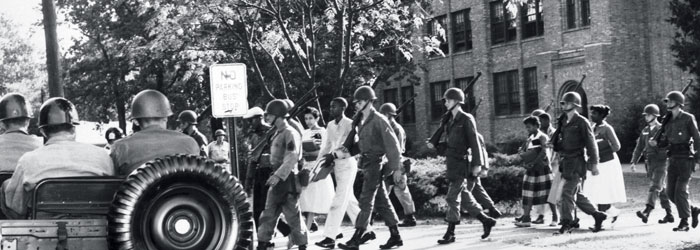
Enter Minnijean Brown-Trickey. Trickey became famous for being a part of the Little Rock Nine. These were the nine students who were forcibly integrated into a school in Little Rock in the 1950s. She was the keynote round table participant for one final project for the Discrimination and Law course. The round table discussion, of course, was on the modern landscape of discrimination legislation. I was looking forward to this discussion because I was very interested in how Trickey would handle various points by Thomas Sowell (who used historical and global data on the issue). She had the life experience to make interesting comments and counter-points. There could have been a meaningful and rational discussion of the issues, but, what resulted shocked everyone.

The other participants were students from the course, myself and others. We each stated our own area of considerations per the topic. A few of us stated we were interested in Affirmative Action. Trickey became visibly upset. When it came to her, she adamantly claimed that there was no such thing as Affirmative Action in the United States. She claimed no one was using Affirmative Action and it was a non-issue. Everyone at the table (and probably in the room) sat stunned. The Supreme Court had just ruled in favor of Affirmative Action (Grutter v. Bollinger), and here is an activist that denies it even exists. Over the course of the discussion, it became clear that Trickey was detached from reality in a strong way. After the event, several students privately circled papers describing her highly unprofessional and irrational rants. The class was unanimous in agreeing with those sentiments (a mostly progressive socialist set of students, nonetheless) although the professor urged us to be more reserved in our criticism.

My real take-away from this event (my life lesson) was that those who are ingrained in politics, who get paid to lobby or legislate, tend to be detached from reality. This summarizes my entire experience with Washington DC federal employees and politicians (I traveled to Washington DC and had met all sorts of famous politicians). The political class is drawn disproportionately from those who are irrational. Worse yet, they have no check on the limit of their irrationality and often command highly paid government jobs subsidizing their irrationality. They tend to have zero concept of the real world and are insulated from the real life effects of their pet policies. To top it off, they actually believe they deserve the money they are getting paid and are ungrateful that they are not getting more. Government jobs tend to attract this sort, as performance is near impossible to gauge, let alone, reward or punish.

The solution to both cultural and economic issues of our day is to advocate organic solutions; solutions not involving the mechanics of the state. The state should be made irrelevant through crowd sourced innovation. We should not empower irrational people to control our lives.

Posted in Goverment, Vanity | Leave a comment

ehrman on a physical kingdom of God

From Bart Ehrman’s Apocalyptic Prophet of the New Millennium:

Moreover, when Jesus refers to this coming Kingdom, in which God will reign, he does not appear to be thinking in purely symbolic terms about God becoming the ruler of your heart. For he often describes the Kingdom with graphically tactile language. Jesus talks about the Kingdom of God “coming in power,” about people “entering into” the Kingdom, about people “eating and drinking in the Kingdom” with the Jewish ancestors, about his disciples serving as “rulers” of the Kingdom, sitting on actual “thrones” in the royal court.

Truly I say to you, in the renewed world, when the Son of Man is sitting on the throne of his glory, you (disciples) also will be seated on twelve thrones, judging the twelve tribes of Israel (Matt. 19:28; cf. Luke 22:30).

And there will be weeping and gnashing of teeth when you see Abraham and Isaac and Jacob and all the prophets in the kingdom, but you are cast out; and people will come from east and west and from north and south and recline at table in the kingdom of God (Q: Luke 13:23—29; cf. Matt. 8:11—12).

Such references are scattered throughout the tradition, and rather than writing them off—for example on the grounds that we ourselves don’t imagine that God will actually, literally, establish a kingdom here on earth—we should take them seriously. Jesus, like other apocalypticists living before him and afterwards, evidently thought that God was going to extend his rule from the heavenly realm where he resides down here to earth. There would be a real, physical kingdom here, a paradisal world in which God himself would rule his faithful people, where there would be eating, drinking, and talking, where there would be human co-regents sitting on thrones and human denizens eating at banquets.

Posted in Bible, Jesus, Theology | Leave a comment

ehrman on the absence of judas in paul

From Bart Ehrman’s Lost Gospel of Judas Iscariot:

For I received from the Lord that which I also handed over to you, that the Lord Jesus, on the night in which he was betrayed, took bread, and after giving thanks, broke it and said, “This is my body given for you.” (1 Cor. 11:23–24) The key phrase for us, of course, is the statement that this took place “on the night in which he was betrayed.” Surely this is a reference to the betrayal of Jesus by Judas Iscariot, so even though the betrayer is not mentioned by name, it is clear that Paul knows all about the incident.

But in fact the matter is not so clear. The problem has to do with the Greek word that Paul uses when he says that Jesus was “betrayed” (Paul, and all the other authors of the New Testament, wrote in Greek). The word is common in the New Testament—Paul himself uses it over fifteen times in his letters, including one other time in the passage I just quoted. When Paul says that the information he is now relating is what he also “handed over” to the Corinthians, it is the same word he uses when he indicates that Jesus was “betrayed.” The Greek word is paradidomi—and it literally means “to give or hand someone or something over to someone else.”

Is Paul referring, then, to Judas Iscariot handing Jesus over to the ruling authorities for trial? Probably not, for in every other instance that Paul uses paradidomi with reference to Jesus, it refers to the act of God, who “handed Jesus over” to death for the sake of others. This can be seen, to choose just one passage, from Romans 8:32:

What then shall we say to these things? If God is for us, who is against us? He who did not spare his own son, but handed him over [paradidomi] for all of us—how will he not give us all things with him?

Since Paul doesn’t specify that he is talking about the betrayal of Jesus by Judas in 1 Corinthians 11:23–24, the translation I gave of the passage may be inaccurate. Probably it would be better to stick with how Paul uses the word in question elsewhere, and translate it as follows:

For I received from the Lord that which I also handed over to you, that the Lord Jesus, on the night in which he was handed over [by God, to face death], took bread, and after giving thanks, broke it and said, “This is my body given for you.” (1 Cor. 11:23–24)

If this translation is correct, then there is no reference in any of Paul’s letters to Judas Iscariot or to his act of betrayal. In fact, there is one passage that might suggest that Paul did not know about Judas and his betrayal. Later in the same book, Paul is discussing the appearances of Jesus to various groups and individuals after his resurrection (1 Cor. 15:3–8), and here he states that “[Christ first] appeared to Cephas, and then to the Twelve.” This clearly refers to Jesus’ twelve disciples, but how could he have appeared to all of them if Judas was no longer among their number? Either Paul is using the term “the Twelve” as a shorthand reference to Jesus’ closest disciples—so he doesn’t really mean there were exactly twelve of them—or he doesn’t know the tradition that one of the Twelve had betrayed his master and departed from the group.

Posted in Bible, Church History, Ehrman | Leave a comment

Jesus would not kick over your coffee bar

Jesus Starbucks

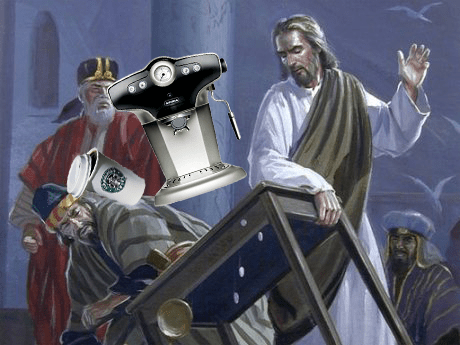
Mick Mooney writes a blog post for the Huffington Post where he describes what a modern day Jesus would do. It is written with all the scholarly Biblical knowledge of a high school student. If he wanted accuracy or honesty, he would do well to have his posts checked by competent non-Christians such as Atheist Bart Ehrman or Muslim Reza Aslan (Ehrman styles Jesus as an apocalyptic prophet and Aslan styles him as a Zealot).

One section, though, deserves comment. This section is widely lauded by counter-commentaries. Mooney describes the would-be Jesus overthrowing Church coffee sales:

Worse still, he had walked into their church the previous Sunday and tore down the book store, overturned the tables and threw the cash register through the window, he then made a whip and chased the pastor out of the building, declaring he was turning God’s house into a den of thieves.

There is a shocking huge difference between the 1st century temple and the modern church. For starters, Jerusalem was the site at which God’s power flowed through to the whole Earth. The Holy of Holies served as God’s connection to this world. Jews would converge upon the temple multiple times a year to offer sacrifices to Yahweh in praise. Only the High Priest could ever enter the Holy of Holies and this was once per year, on the day of atonement. The Jewish Temple did not function in the slightest like modern churches.

Likewise, Jesus never roughed up any other Jewish synagogue that is recorded. Jesus only became enraged once he visited the temple in Jerusalem. This is because the transactions happening at the Jerusalem temple were specific to the temple for a very specific purpose. Per Aslan:

The money changers play a vital role in the Temple. For a fee , they will exchange your foul foreign coins for the Hebrew shekel, the only currency permitted by the Temple authorities. The money changers will also collect the half-shekel Temple tax that all adult males must pay to preserve the pomp and spectacle of all you see around you: the mountains of burning incense and the ceaseless sacrifices, the wine libations and the first-fruits offering, the Levite choir belting out psalms of praise and the accompanying orchestra thrumming lyres and banging cymbals. Someone must pay for these necessities. Someone must bear the cost of the burnt offerings that so please the Lord.

With the new currency in hand, you are now free to peruse the pens lining the periphery walls to purchase your sacrifice: a pigeon, a sheep —it depends on the depth of your purse , or the depth of your sins. If the latter transcends the former, do not despair. The money changers are happy to offer the credit you need to enhance your sacrifice. There is a strict legal code regulating the animals that can be purchased for the blessed occasion. They must be free of blemish . Domesticated , not wild. They cannot be beasts of burden. Whether ox or bull or ram or sheep, they must have been reared for this purpose alone. They are not cheap. Why should they be? The sacrifice is the Temple’s primary purpose. It is the very reason for the Temple’s being. The songs, the prayers, the readings— every ritual that takes place here arose in service of this singular and most vital ritual . The blood libation not only wipes away your sins, it cleanses the earth . It feeds the earth, renewing and sustaining it, protecting us all from drought or famine or worse. The cycle of life and death that the Lord in his omnificence has decreed is wholly dependent upon your sacrifice. This is not the time for thrift.

So people were converting images of Caesar into Hebrew coin. They were using this converted money to exchange into token offerings, with little personal effort or sacrifice. Live animals were butchered and burned 24 hours a day, 7 days a week. All the while, the merchants received premium profits and the priests got their opulent cut. This was all in the name of giving God sacrifices. The entire ritual of animal sacrifice (a sacrifice meaning to atone for sins and please God) was corrupt from the bottom to the top. This all was taking place in God’s actual house.

We can understand Jesus when he cries out:

Joh 2:16 And He said to those who sold doves, “Take these things away! Do not make My Father’s house a house of merchandise!”

When Jesus cried out “Do not make My Father’s house a house of merchandise”. He was being serious. God had a house (1 Ki 8:13), this was a house in which God was said to dwell in some sort of visible form (1Ki 8:11, Exo 40:35). And the place where God dwelt was being overrun by rampant corruption.

Jesus would not bat an eye at coffee sales in a church. No one is exchanging money to sacrifice to God and atone for sins. There is no pagan currency with the title that the president is god which then needs to be converted to neutral money. God does not dwell in churches. There is no cloud of glory obscuring people’s vision during church. There is no Holy of Holies where God convenes with man once per year. There are no ritual animal sacrifices. Instead, the church is structure with four normal walls. It is a place to hang out. Coffee is refreshment.

Posted in Bible, Bible Critics, God, History, Jewish History | 1 Comment

the jewish temple is violated

When Pompey subdued Jerusalem (63BC), one of his first acts was to enter into the Jew’s most sacred place. It is here that the historian Tacitus (56-117 AD) says that Pompey discovered that the Jewish mysteries were empty:

[5.9] Gnaeus Pompeius was the first of our countrymen to subdue the Jews. Availing himself of the right of conquest, he entered the temple. Thus it became commonly known that the place stood empty with no similitude of gods within, and that the shrine [mysteries] had nothing to reveal [were a sham].

The Jewish religion became, in Tacitus’ eyes and in the eye’s of his contemporaries, a laughingstock. The Jews had an empty secret inner temple. Pompey and the other Greeks were looking for a revelation in the secret inner chamber, as with the other mystery cults of the time. Their mistake was thinking that the Jews were just another mystery cult. But the Jews thought that God inhabited the temple. The temple was the conduit by which God communed with man. Aslan explains:

The entire liturgy is performed in front of the Temple’s innermost court, the Holy of Holies— a gold-plated, columnar sanctuary at the very heart of the Temple complex. The Holy of Holies is the highest point in all Jerusalem. Its doors are draped in purple and scarlet tapestries embroidered with a zodiac wheel and a panorama of the heavens. This is where the glory of God physically dwells. It is the meeting point between the earthly and heavenly realms, the center of all creation… It is a vast, empty space that serves as a conduit for the presence of God, channeling his divine spirit from the heavens, flowing it out in concentric waves across the Temple’s chambers, through the Court of Priests and the Court of Israelites, the Court of Women and the Court of Gentiles, over the Temple’s porticoed walls and down into the city of Jerusalem, across the Judean countryside to Samaria and Idumea, Peraea and Galilee, through the boundless empire of mighty Rome and on to the rest of the world, to all peoples and nations, all of them— Jew and gentile alike— nourished and sustained by the spirit of the Lord of Creation, a spirit that has one sole source and no other: the inner sanctuary, the Holy of Holies, tucked within the Temple, in the sacred city of Jerusalem.

God had physically abandoned the temple in Ezekiel 10:18:

Eze 10:18 Then the glory of the LORD departed from the threshold of the temple and stood over the cherubim.
Eze 10:19 And the cherubim lifted their wings and mounted up from the earth in my sight. When they went out, the wheels were beside them; and they stood at the door of the east gate of the LORD’s house, and the glory of the God of Israel was above them.

Eze 11:22 So the cherubim lifted up their wings, with the wheels beside them, and the glory of the God of Israel was high above them.
Eze 11:23 And the glory of the LORD went up from the midst of the city and stood on the mountain, which is on the east side of the city.

The Jews still used the temple as their conduit to God, but God did not dwell in the temple. Instead, the Jews were under the understanding that God would return one day (Eze 43), bringing judgement and a new rule. At that time, God would again dwell with mankind:

Rev 21:2 Then I, John, saw the holy city, New Jerusalem, coming down out of heaven from God, prepared as a bride adorned for her husband.
Rev 21:3 And I heard a loud voice from heaven saying, “Behold, the tabernacle of God is with men, and He will dwell with them, and they shall be His people. God Himself will be with them and be their God.

But all of this was lost on Tacitus and Pompey, they saw the Jewish religion as silly and sub-par to the Greek mysteries.

The Greek mysteries were religious cults centered around various Greek gods. The purpose of these cults were to give their adherents an introspective and self-enlightened experience. What might Pompey have expected? Hippolytus (170–235 AD) claims that the highest innitiates of the Eleusian mysteries experienced a solitary ear of corn.

And after the Phrygians, the Athenians, while initiating people into the Eleusinian rites, likewise display to those who are being admitted to the highest grade at these mysteries, the mighty, and marvellous, and most perfect secret suitable for one initiated into the highest mystic truths: (I allude to) an ear of corn in silence reaped. But this ear of corn is also (considered) among the Athenians to constitute the perfect enormous illumination (that has descended) from the unportrayable one…

Although a Christian apologist speaking of the most secretive rites of a pagan cult are to be taken with a grain of salt, it is not unreasonable that the inner chambers of the mystery religions held such mundane focus items. The purpose of the mystery cults were largely some sort of self enlightened ascension. The focus item would possibly be simple (profound) to heighten this experience.

Posted in Bible, God, History, Jewish History, Mystery Cults | Leave a comment

hatch on the differences between the Bible and greek thinking

From Edwin Hatch’s “The influence of Greek ideas and usages upon the Christian church“:

It is impossible for any one, whether he be a student of history or no, to fail to notice a difference of both form and content between the Sermon on the Mount and the Nicene Creed. The Sermon on the Mount is the promulgation of a new law of conduct ; it assumes beliefs rather than formulates them ; the theological conceptions which underlie it belong to the ethical rather than the speculative side of theology; metaphysics are wholly absent. The Nicene Creed is a statement partly of historical facts and partly of dogmatic inferences ; the meta-physical terms which it contains would probably have been unintelligible to the first disciples ; ethics have no place in it. The one belongs to a world of Syrian peasants, the other to a world of Greek philosophers.

Posted in Bible | Leave a comment

mao was worse than hitler and stalin

democide

Source

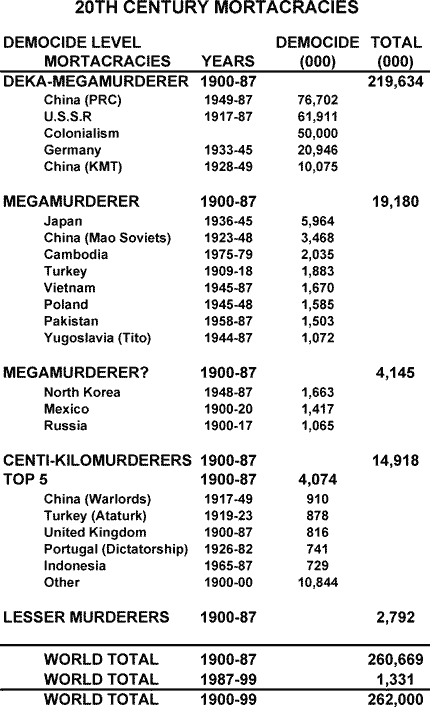
Hitler is often cited as the example of the most evil person in existence. I suspect this is due to leftist’s love of communism and their attempts to whitewash history. FDR’s beloved “Uncle Joe” killed three times as many people as Hitler, 62 million compared to Hitler’s 21 million. These are human beings, not numbers. 62 million people with families and lives and dreams, all killed for communism, and no one remembers or cares.

But one communist killed even more than Stalin. This was Mao of the People’s Republic of China. Some scholars do not attribute famine deaths to Mao (putting Mao’s numbers far under Stalin’s). But this is a mistake, as explained on this blog post.

From the biography of Mao, which I trust (for those who might question it, look at the hundreds of interviews Chang and Halliday conducted with communist cadre and former high officials, and the extensive bibliography) I can now say that yes, Mao’s policies caused the famine. He knew about it from the beginning. He didn’t care! Literally.

Indeed, wanted to take even more food from the mouths of his starving people in order to increase his export of food. It was all he had to export and he was after power. He was dead set on becoming the head of the international communist movement, and in making China a superpower. He thought he could rule the world. In order to do so, he exported vast quantities of food to the Soviet Union, Eastern Europe, and Third World countries that he was trying to control. Ironically, some communist rulers knew about his famine and thus declined his food, since hey had more to feed their people than he did. With the Soviet Union, he was using food as a quid pro quo for weapons and weapon factories.

Those in the top circle of the CCP tried to alleviate the famine. They were arrested, some tortured, some executed or allowed to die horribly. Even in 1961, he wanted to INCREASE the amount of food taken from the people. But, at great risk to himself, Liu Shao-ch’i (President of the PRC and second in power) ambushed Mao at a CCP conference of 7,000, which agreed with Liu to alleviate the famine. Mao could not forgive Liu and the others, and because he believed he was thus losing control of the CCP, he launched a purge in 1965 called the Cultural Revolution to overthrow the CCP and replace it with the military. About 100,000,000 people were persecuted, and around 3,000,000 were murdered.

So, the famine was intentional. What was its human cost? I had estimated that 27,000,000 Chinese starved to death or died from associated diseases. Others estimated the toll to be as high as 40,000,000. Chang and Halliday put it at 38,000,000, and given their sources, I will accept that.

Now, I have to change all the world democide totals that populate my websites, blogs, and publications. The total for the communist democide before and after Mao took over the mainland is thus 3,446,000 + 35,226,000 + 38,000,000 = 76,692,000, or to round off, 77,000,000 murdered.

This exceeds the 61,911,000 murdered by the Soviet Union 1917-1987, with Hitler far behind at 20,946,000 wiped out 1933-1945.

Communism is evil.

Posted in Goverment, History | 3 Comments