elisha helps kill the king

In 2 Kings, there is an interesting story in which the prophet Elisha aids in another case of divine assassination. He provokes Hazael to kill the king of Syria by telling him that Hazael would be the next king. To top this all off, Elisha tells Hazael to lie to the current king:

2Ki 8:7 Then Elisha went to Damascus, and Ben-Hadad king of Syria was sick; and it was told him, saying, “The man of God has come here.”
2Ki 8:8 And the king said to Hazael, “Take a present in your hand, and go to meet the man of God, and inquire of the LORD by him, saying, ‘Shall I recover from this disease?’ ”
2Ki 8:9 So Hazael went to meet him and took a present with him, of every good thing of Damascus, forty camel-loads; and he came and stood before him, and said, “Your son Ben-Hadad king of Syria has sent me to you, saying, ‘Shall I recover from this disease?’ ”
2Ki 8:10 And Elisha said to him, “Go, say to him, ‘You shall certainly recover.’ However the LORD has shown me that he will really die.”
2Ki 8:11 Then he set his countenance in a stare until he was ashamed; and the man of God wept.
2Ki 8:12 And Hazael said, “Why is my lord weeping?” He answered, “Because I know the evil that you will do to the children of Israel: Their strongholds you will set on fire, and their young men you will kill with the sword; and you will dash their children, and rip open their women with child.”
2Ki 8:13 So Hazael said, “But what is your servant—a dog, that he should do this gross thing?” And Elisha answered, “The LORD has shown me that you will become king over Syria.”
2Ki 8:14 Then he departed from Elisha, and came to his master, who said to him, “What did Elisha say to you?” And he answered, “He told me you would surely recover.”
2Ki 8:15 But it happened on the next day that he took a thick cloth and dipped it in water, and spread it over his face so that he died; and Hazael reigned in his place.

So the king sends gifts to Elisha. Elisha tells the messenger to lie to the king. The messenger returns, lies to the king, then smothers him in the king’s sleep. And this was all by God’s design. It seems that God wanted to use Hazael to punish Israel. The text later reads:

2Ki 10:30 And the LORD said to Jehu, “Because you have done well in doing what is right in My sight, and have done to the house of Ahab all that was in My heart, your sons shall sit on the throne of Israel to the fourth generation.”
2Ki 10:31 But Jehu took no heed to walk in the law of the LORD God of Israel with all his heart; for he did not depart from the sins of Jeroboam, who had made Israel sin.
2Ki 10:32 In those days the LORD began to cut off parts of Israel; and Hazael conquered them in all the territory of Israel

The text states that “the LORD” began to cut off Israel. His method: Hazael conquered them. This is the same Hazael who rose to power based on the prophet Elisha’s lie and was to be anointed by God in 1 Kings 19:15. This is one example of God using lying prophets, assassination, and evil people to do his work.

Posted in Bible, God, Theology | Leave a comment

neglected verses Eze 14 9

Eze 14:9 And if the prophet be deceived when he hath spoken a thing, I the LORD have deceived that prophet, and I will stretch out my hand upon him, and will destroy him from the midst of my people Israel.

A little commentary on this neglected verse: we have a real example of this in the case of Jehoshaphat the king of Judah. He summons 400 prophets to tell him what to do. When he gets a real prophet of God (Micaiah), that prophet begins by sarcastically saying the same thing that the false prophets were saying:

1Ki 22:15 So he came to the king. And the king said unto him, Micaiah, shall we go against Ramothgilead to battle, or shall we forbear? And he answered him, Go, and prosper: for the LORD shall deliver it into the hand of the king.

But after the King presses Micaiah, Micaiah tells him the truth. God has sent lying spirits into the 400 prophets in order to kill Ahab. Ahab, less than impressed, proceeds to ignore Micaiah and get himself killed, fulfilling God’s intent in deceiving the 400 prophets.

Posted in Bible, God, Neglected Verses | 3 Comments

I AM is the relational name of God

By Craig Fisher

It is well to have specifically holy places, and things, and days, for, without these focal points or reminders, the belief that all is holy and “big with God” will soon dwindle into a mere sentiment. But if these holy places, things, and days cease to remind us, if they obliterate our awareness that all ground is holy and every bush (could we but perceive it) a Burning Bush, then the hallows begin to do harm.
― C.S. Lewis, Letters to Malcolm: Chiefly on Prayer

CS Lewis, in this quote, is making the claim that all ground is holy. In essence, he is equating common bushes found in any front lawn with the extraordinary event described in Exodus 3. Moses, in Exodus 3, literally had a face to face conversation with God. When CS Lewis calls all bushes “holy” be belittles God’s revelation and obscures the intent of the Exodus event. Although the mysticism expressed by CS Lewis may be very seductive, he creates pantheism out of all ground and all bushes. And despite the claims of CS Lewis, the theophany (an appearance of God) in Exodus 3 occupies a specific time and place which hallows the ground. The ground is made holy by this event. It is this event in which God’s introduction to Moses at the burning bush critically identifies God’s character as one whom we should worship. God is personal and relational rather than transcendental and omnipresent.

A Contextual Understanding of Exodus 3

Exodus 3 begins with Moses in tending the sheep of his father-in-law next to Mount Horeb (afterwards called the Mountain of God). Moses sees a burning bush in the mountain and turns aside to investigate. Unexplainably, the bush continues to burn and is not consumed by the fire.

God calls to Moses from the burning bush, and Moses answers with the famous “Here am I.” This reply recurs thematically throughout scripture as a reply to the prophetic call from God. It is the answer of Samuel to God in his bedchamber and the answer of Isaiah to God in the temple. God appears to each of these prophets, and they answer, “Here I am.”

As in all introductions, the parties exchange names. God knows Moses, but Moses does not know God. God introduces himself, “I am the God of your father—the God of Abraham, the God of Isaac, and the God of Jacob.” Why does God here identify himself in relation to the patriarchs of Genesis? He has many names, such as Lord of Hosts (Head of Armies). But here, the personal God identifies himself by his relationships with individuals from the past, specific people with whom he has had close relationships. The reader should note that God is connecting with his creation rather than transcending it. He is identifying himself by his relationships to his creation. If you somehow were to lose contact with your grandchildren and then meet them in the future, how would you introduce yourself? Naturally, you would perhaps give them your surname and your personal name. But more importantly you would say I am your grandfather, the father of Rachel or Chris, your mother or father. You would connect personally with them. God is reconnecting with Israel and communicating his relational nature.

Jesus, in the gospel of Matthew, explains the significance of “I AM” in Genesis verse 6. In his confrontation with the Sadducees, they attempted to make the resurrection look ridiculous by creating a hypothetical situation where seven brothers married the same woman. They asked the “gotcha” question: after the resurrection, which brother will be married to her? Of course people do not remain married after the resurrection, but Jesus added positive evidence of the resurrection: have you not read what was spoken to you by God, saying:

Mat 22:32 ‘I AM THE GOD OF ABRAHAM, THE GOD OF ISAAC, AND THE GOD OF JACOB’ ? God is not the God of the dead, but of the living.”

What is strange is that the verb for “I am”, εγω ειμι, is not in the Hebrew (Exo 36). The Hebrew, read literally, says, “I, God of Abraham, God of Isaac…” The “I AM” of this verse simply links God to personal relationships.

Apparently Moses understood who God is from this historical context or at least he had some prior knowledge about God. After making this introduction, God then tells Moses to confront the most powerful empire on earth (Egypt) to free God’s chosen people. Moses, understandably concerned about his role as a messenger, specifically asks God “What is your name?” Here, Moses was probably looking for power or assistance in God’s name.

The names of gods symbolize power. The name “Thor” depicts a hammer-wielding god associated with thunder, lightning, storms, oak trees, and strength: a name that would inspire terror enemies. The name “Zeus” depicts a lightning wielding god associated with the downfall of the Titans. Moses was seeking some sort of power in God’s name. Instead God frustrates him further.

God, perhaps himself irritated at Moses’ desire for a more useful name, says “I AM WHO I AM.” (אֶֽהְיֶ֖ה אֲשֶׁ֣ר אֶֽהְיֶ֑ה) To understand this statement, it helps to understand how others have used it in scripture. Paul, after explaining his own unworthiness, uses the same words in Greek to explain to the Corinthians his apostleship:

1Co 15:10 But by the grace of God I am what I am

Paul is saying he knows that he is not worthy of this apostleship. In his checkered past, he has persecuted Christians, but God transformed him into an apostle, preaching the good news to all who would receive him. When Paul says “I am who I am”, he means “what you see is what you get”, nothing more or less. Paul is not claiming to be an immutable, simple and incorruptible god, a claim made by leading Calvinists.

Additionally, in Exodus 3:14, the two verbs for “be” are in the imperfect tense in Hebrew. The imperfect tense is sometimes used for the present tense, making this statement “I am who I am.” Sometimes in Hebrew the imperfect tense will be used for events that are frequented or of general occurrence that are independent of time. In these instances the English present could be used. However, the imperfect tense is usually translated in the future tense. The better translation is “I will be who I will be.” Regardless, the other translation “I am who I am” could be used to convey the same meaning. In the context, this appears to be a defense to Moses on the use of God’s name. Moses wants a better name, but God is saying this is my name and “I will be who I will be.”

Remember, God has already identified himself by connecting himself with the patriarchs Abraham, Isaac and Jacob. When God replies to Moses, “I will be who I will be,” he is referring to that relationship. This is the same usage as Paul’s statement, “I am who I am”, referring to Paul’s history. This statement is a historical identification. It emphasizes that this is a fixed and permanent history, and this emphasis is carried on in the following verses.

God takes on the name, “I AM” to tell the nation of Isreal: ‘I AM has sent me to you.’” (Exodus 3:14) What does this “I AM” mean? God reiterates:

Exo 3:15 Moreover God said to Moses, “Thus you shall say to the children of Israel: ‘The LORD God of your fathers, the God of Abraham, the God of Isaac, and the God of Jacob, has sent me to you. This is My name forever, and this is My memorial to all generations.’

It is clear from the context that “I AM” is the short form for this longer identity. He says “I AM” the God of your fathers. “I AM” is explicitly a historical identity of a personal relationship with his creation.

“I AM” is the personal name for God; Yahweh יְהוָ֞ה. Exodus Chapter 3 introduces God’s name in the Scriptures. Strong’s concordance lists 6,220 occurrences of this word in the Old Testament. It would be cumbersome to use the long form of his name, “The God of Abraham, the God of Jacob…” Rather, Yahweh is used. Those who know God also know of this passage where “Yahweh” is defined in detail. God is the God of history, the God of continuing relationships with the fathers, and the God who continues to relate to his people to this day.

Posted in Bible, Craig Fisher, God, Open Theism, Textual Criticism, Theology | 1 Comment

walter brueggemann on how the old testament defines God

From Walter Brueggemann’s Theology of the Old Testament:

Israel’s characteristic adjectival vocabulary about Yahweh is completely lacking in terms that have dominated classical theology, such as omnipotent, omniscient, omnipresent. This sharp contrast suggested that classical theology, insofar as it is dominated by such interpretive categories and such concerns, is engaged in issues that are not crucial for Israel’s testimony about Yahweh and are in fact quite remote from Israel’s primary utterance…

The Old Testament, in its discernment of Yahweh, is relentlessly committed to the recognition that all of reality, including the reality of Yahweh, is relational, relative to the life and destiny of Israel. And the God of Israel has no propensity to be otherwise than related to Israel.

Posted in Bible, Calvinism, God, Open Theism, Theology | Leave a comment

God is bad at punishment

I was talking to a Christian today about Calvinists and letters to newspapers. Once in a while, in any major newspaper there will be some letter to the editor claiming that all the hurricanes and mass murders are God’s judgment against America. The letters claim that America is becoming more and more wicked, and thus we see this judgment. I am not going to make any claims on America’s current moral state, but if America was getting more wicked and God is punishing America with hurricanes and mass shootings, then God is not doing a very good job at punishing us.

Not only are gun homicides going down, but also mass shootings and the number of people killed in mass shootings.

The second graph needs to be understood in light of the population boom over the same years. The number of shootings has been flat, the number of victims has been flat, the US population has increased about 50%. This represents a massive decrease in mass shootings.

In the same vein, see the Reason.com takes on the myth of increasingly severe tornadoes:

Similarly, the United Nations’ Intergovernmental Panel on Climate Change’s 2012 report on trends on weather extremes concludes that there is no evidence for either an increase or a decrease in tornado frequency or intensity.

While the number of strong tornadoes has stayed steady, the rate of deaths from tornados has fallen about 90 percent in the last 90 years, from just under 2 per million in the 1920s to 0.2 per million recently.

And tornado damage, Reason.com references a study that normalizes the data to conclude:

Under several methods, there has been a sharp decline in tornado damage. This decline corresponds with a decline in the reported frequency of the most intense (and thus most damaging) tornadoes since 1950.

If God is judging America with shootings and tornadoes, he just is not doing a good job.

Posted in Calvinism, God, Science, Statistics, Theology | Leave a comment

good students and good teachers

In a recent post by Bryan Caplan he lays out the characteristics of a good student:

First, good students genuinely want to learn. They don’t study material merely because they see it on the syllabus or expect it on the test.

Second, good students fight the natural human tendency to forget material right after the final exam. Unlike most students, they consciously choose to try to remember what they learn.

Third, good students strive for what educational psychologists call Transfer of Learning. They earnestly try to apply what they’ve learned outside the classroom.

Fourth, and perhaps most importantly, good students put Truth first. They aren’t afraid to entertain and embrace socially unacceptable ideas.

It is one of my priorities as a father to impart to my children the values of being a good student. First and foremost: that they seek the truth above all else. The truth is often not popular, and someone who genuinely seeks the truth will not win any popularity contests.

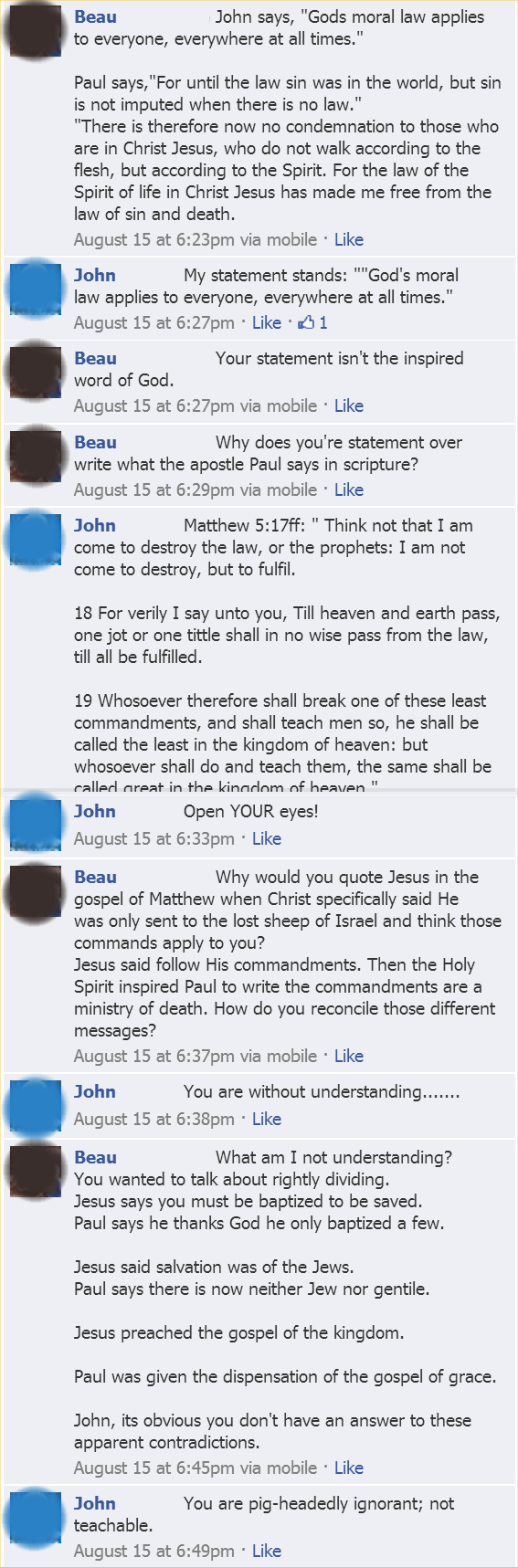
I like Caplan’s definition of a good student, because there is so much false authority in the modern world. Take for example this Facebook debate I captured:

not teachable

In it “John” seems to just expect “Beau” to take his word as gospel. Beau uses several verses and arguments to counter what John states. John does not address anything Beau states directly. John concludes in a fit of anger that Beau is “unteachable”. John does not seem to have understood, or cared to understand Beau’s arguments, yet Beau is “unteachable” for not rolling over, discounting all his previous knowledge and just accepting John without question.

This resonates with me because it has happened on several occasions in my life. In fact, it just happened last week during an “inspection” at work. The “inspector” just assumed that her word was gospel because she had 20 years’ experience. She did not even care to address my counter arguments. When people want you to believe them based on their own authority, they are very dangerous people. The best teachers in life are themselves good students. As stated before, look to see if the teacher holds unpopular beliefs and has ever changed their mind on something of consequence.

If my children just believe every doctrine I tell them without question, I have failed as a father.

Posted in Education, Human Nature | Leave a comment

how paul defines works of the law

The apostle Paul is well known for his teachings against the law. To the Galatians he writes that the law is a curse. To the Romans he writes that no flesh will be justified by the law. But what does he mean by “the law”. This is a contentious point among Christians. To those who preach salvation by faith plus works, “the law” is interpreted as the symbolic ordinances. To them, Paul is teaching primarily against circumcision but still requires Christians to follow the moral laws.

To those who preach salvation by faith alone, “the law” is interpreted as all law (symbolic and moral). To them, Paul is teaching that no matter what sin a Christian commits, they are still saved.

Perhaps the best way to figure out if Paul is referring to symbolic or moral law is to examine the context. Not only will the particular ways he uses “the law” give insight to his meaning, but also the immediate listed examples will help define the phrase. If Paul references symbolic law (like circumcision) but does not reference moral law (like thievery), then he might be talking about only symbolic law. If he talks about murder, thievery, and other moral sins, he probably is referring to moral law (and symbolic law). It is also important to note that Paul may sometimes be using one usage and later using the other. This possibility should not be ignored.

In Galatians (widely considered Paul’s earliest existent writing) Paul talks heavily about the law and about works. In Galatians he counters what are modernly known as “judaizers”, those who taught circumcision and a separation between Jews and Gentiles. While the tone of Galatians is primarily concerning circumcision, Paul lets the reader understand his point is more widespread than just that. Paul writes:

Gal 5:13 For you, brethren, have been called to liberty; only do not use liberty as an opportunity for the flesh, but through love serve one another.
Gal 5:14 For all the law is fulfilled in one word, even in this: “YOU SHALL LOVE YOUR NEIGHBOR AS YOURSELF.”…

If Paul was only speaking about symbolic law, it is hard to see how the law of circumcision is fulfilled by loving your neighbor. It is hard to see how liberty from the law would allow “opportunity of the flesh” if the moral law was still required. In fact, Paul goes on to expound on the “works of the flesh”:

Gal 5:18 But if you are led by the Spirit, you are not under the law.
Gal 5:19 Now the works of the flesh are evident, which are: adultery, fornication, uncleanness, lewdness,
Gal 5:20 idolatry, sorcery, hatred, contentions, jealousies, outbursts of wrath, selfish ambitions, dissensions, heresies,
Gal 5:21 envy, murders, drunkenness, revelries, and the like; of which I tell you beforehand, just as I also told you in time past, that those who practice such things will not inherit the kingdom of God.

Here Paul lists some of the works of the flesh. The general categories are moral laws, not symbolic laws. Galatians 5:21 ends with an interesting phrase: “those who practice such things will not inherit the kingdom of God.” Is Paul teaching, contrary to how the text was reading before this verse, that Christians must follow the moral laws? The key to Paul’s thinking is the next couple of verses:

Gal 5:22 But the fruit of the Spirit is love, joy, peace, longsuffering, kindness, goodness, faithfulness,
Gal 5:23 gentleness, self-control. Against such there is no law.

Paul ends these verses about good works with “against such there is no law”. Apparently, he is contrasting this list of good works (against which there is no law) against the list of works of the flesh (against which there is law). Note that Galatians 5:18-23 form a block. Galatians 5:18 starts with talking about the Spirit and the law. Galatians 5:22-23 concludes the paragraph about the Spirit and the law. Galatians 5:18 states people are not under the law, then lists categories covered by the law. Then Galatians 5:22-23 contrast areas not covered by the law. This is all started by the statement: “you are not under the law”.

His point is that there are laws against the works of the flesh, but not against good works. He begins by stating we are not under the law. And because we are not under the law, we should not have to worry about being cut off from salvation for bad works. He contrasts this to good works, against which there is no law. Although we do not have to worry about moral law because we are not under the law, we should still do good works, because the state of “not being under the law” does not affect good works. We should not ignore good works with the same logic we ignore the works of the flesh. Good works are not covered by the law.

Then what is Paul’s meaning of “that those who practice such things will not inherit the kingdom of God”? Probably the best reading is that Paul is talking about people under the law. Paul is saying that “people judged by the law who do such things will not inherit the Kingdom of God.” Additional evidence for this is that the introductory verse talks about “those being led by the spirit”, which might be contrasted with those “not led by the spirit”.

There is a parallel passage in 1 Corinthians, that gives the reader more insight into the law and Paul’s meaning.

1Co 6:9 Do you not know that the unrighteous will not inherit the kingdom of God? Do not be deceived. Neither fornicators, nor idolaters, nor adulterers, nor homosexuals, nor sodomites,
1Co 6:10 nor thieves, nor covetous, nor drunkards, nor revilers, nor extortioners will inherit the kingdom of God.
1Co 6:11 And such were some of you. But you were washed, but you were sanctified, but you were justified in the name of the Lord Jesus and by the Spirit of our God.
1Co 6:12 All things are lawful for me, but all things are not helpful. All things are lawful for me, but I will not be brought under the power of any.

Here Paul sets up the mechanism by which sinners can inherit the Kingdom of God. They are washed of their sins, justified. He then concludes this statement with “all things are lawful to me”. He is saying even if he again commits one of these things, it is not unlawful. He is not under the law. He then cites examples of both symbolic and moral law to make his point:

1Co 6:13 Foods for the stomach and the stomach for foods, but God will destroy both it and them. Now the body is not for sexual immorality but for the Lord, and the Lord for the body.

In this passage, Paul is extra clear that the law (which we are not under) includes moral laws. This includes the long list of moral crimes, due to which unbelievers will not inherit the Kingdom of God.

All things considered, When Paul states believers are not under the “law” that this includes moral laws (such as murder, drunkenness, and idolatry). Sins will not cause a loss of salvation.

Posted in Bible, Dispensationalism, Morality, Theology | 5 Comments

names in the book of life

It is an often touted Calvinist point to claim that people, individuals, have had their names written in the Book of Life before even the world began. It is comforting for some Christians to see themselves as eternally chosen, elect. To steal phrasing from NT Wright, it is kind of a wonderful, rhetorical flourish. But the fact is that it is just not true. The Book of Life just doesn’t work the way that the Calvinists claim.

Calvinists hinge their claim on this verse:

Rev 13:8 All who dwell on the earth will worship him, whose names have not been written in the Book of Life of the Lamb slain from the foundation of the world.

Calvinists, while they are not using the verse to argue that Jesus was slain from the foundation of the world, claim that individuals have had their names written in the book before the world began. A few things of note:

First, this verse is talking about unbelievers whose names “have not been written in the Book of Life since the foundation of the world.” Of course unbelievers would never have their names written in the Book of Life. This in no sense means that believers must have had their names written since before the foundation of the world.

Secondly, “from the foundation of the world” could, and does, mean the timeframe between the creation of the world and the future time. This would be like saying “all those who have not grabbed an umbrella since we opened the storage locker will get wet”. The actions are not limited to taking place before the founding event in question. In fact, the natural reading is that the actions take place between the founding event and the future event.

The Calvinist chooses to see the Book of Life as some sort of global prediction list. But the list just does not work that way. Individuals have their names added and removed. If the names were written before the foundation of the world, why would their names have to be removed?

Rev 3:5 He who overcomes shall be clothed in white garments, and I will not blot out his name from the Book of Life; but I will confess his name before My Father and before His angels.

Rev 22:19 and if anyone takes away from the words of the book of this prophecy, God shall take away his part from the Book of Life, from the holy city, and from the things which are written in this book.

Jesus would not mention blotting out names unless it was a possibility. And the last verses of Revelation mention God “taking away” from the book of life. People can get blotted out of the Book of Life.

If the Book of Life represented an eternal list of names, stating who would go to heaven and who would go to hell, why would people have their names added just to be blotted out? If this was an eternal list, why would God wait for the event to happen to blot out a name? Why would he add that name in the first place? God operates in real time, not some “eternal now”. Revelation describes the Book of Life being updated as events occur. The Book of Life is further evidence against Calvinism.

Posted in Bible, Calvinism, Open Theism, Theology | 3 Comments

understanding galatians chapter 1 – part 1

The books of the New Testament are letters. This might be a hard concept for some Christians to digest. The books of the New Testament were not as much theological treatises as they were personal letters (Romans being the exception). The books themselves were written for a specific purpose, at a specific time, and to a specific people. In Colossians, Paul’s thrust is to counter Platonism. In 1 Corinthians it is to counter division. In Philippians, it is to say thanks.

Galatians reads distinctly more hostile than all these other books. In Reading Through Galatians, the author notes: “The personality of the author blazes out of every sentence” and that the tone is “rebuking rather than teaching”. Paul was very angry about something, and every sentence seems directed and focused towards a specific problem. In short, Christians from Judea were preaching to Paul’s converts that they had to circumcise to be saved. Bart Ehrman sums up the events as such in his book Peter, Paul, and Mary Magdalene:

Paul eventually… moved on from Galatia to take his message elsewhere. As often happened, other Christians arrived on the scene, proclaiming a different message. It is not completely clear what these other “apostles” told the Galatians, but they evidently insisted that when God gave the law to the Jews it was an eternal provision for his chosen people. It was never meant simply as a temporary or limited set of optional requirements… These other apostles also pointed out that the disciples of Jesus, who were the original heads of the church and who continued to lead the church in Jerusalem, agreed with them on this issue. They concluded that if Paul taught a different message, he had corrupted the original teaching of Jesus and his followers.

When Paul got word of the conflict in Galatia, he hit the roof and wrote a response. Unlike most of his other letters, this is not a friendly bit of correspondence written out of a warm regard for his good friends. This is a letter dashed off in white-hot anger.

There is something about Galatians that bewitches those who study the Bible. Of all the books of the New Testament, Galatians is the first book to which critical historians point to show an authentic writing. The clear appeal of Galatians to the Biblical critic is that it shows a major conflict in early Christianity between Paul and the twelve disciples. Most Christians are either unaware that this is present or try to explain it away. But the text is clear: Paul is confronting teachings from Jerusalem.

This is not just an isolated event. Galatians itself details two past events that were similar, but the reason Paul was writing the letter was a third instance. In this letter alone, we learn of three instances in which Paul’s ministry is being subverted in the region of Galatia. This is a continuing pain for Paul, and one he wishes to put down for good. This is the reason he writes to Galatia. We do not have the final outcome of his struggle with the Galatians, but we do know that eventually Christians stopped following the symbolic law. The modern world is testament to Paul’s victory.

A careful reader of Galatians will be able to pick up Paul building his case. Each sentence seems to counter some unspoken argument by his critics. He starts at the core of his ministry: that he has a special authority (dispensation) from God. His authority was not from men (especially the twelve disciples). Paul begins the letter by saying just this:

Gal 1:1 Paul, an apostle (not from men nor through man, but through Jesus Christ and God the Father who raised Him from the dead),

Before the rebuke begins, Paul needs to establish that he has the authority to rebuke. With this one sentence, he is telling his readers two main points: his authority is from God and his authority is not from man. Why is he emphasizing that his authority is not through men? If it were through men, which men would it be? Christians universally recognized the authority of the 12 apostles (by extension, James). If Paul did gain authority through men, it would be through the Twelve Disciples. If Bart Ehrman was correct when he said that the Christians from Judea taught that “Paul was a corrupted version of the apostles gospel”, then this sentence make much more sense. The first sentence Paul writes is to refute the notion that his authority was subject to the Twelve. This theme echoes throughout Galatians.

As further evidence that Paul is emphasizing his authority did not come from the Twelve (“men”), compare Galatians 1:1 to Paul’s other introductions:

Rom 1:1 Paul, a bondservant of Jesus Christ, called to be an apostle, separated to the gospel of God

1Co 1:1 Paul, called to be an apostle of Jesus Christ through the will of God, and Sosthenes our brother,

2Co 1:1 Paul, an apostle of Jesus Christ by the will of God, and Timothy our brother, To the church of God which is at Corinth, with all the saints who are in all Achaia:

Eph 1:1 Paul, an apostle of Jesus Christ by the will of God, To the saints who are in Ephesus, and faithful in Christ Jesus:

Php 1:1 Paul and Timothy, bondservants of Jesus Christ, To all the saints in Christ Jesus who are in Philippi, with the bishops and deacons:

Col 1:1 Paul, an apostle of Jesus Christ by the will of God, and Timothy our brother,

1Th 1:1 Paul, Silvanus, and Timothy, To the church of the Thessalonians in God the Father and the Lord Jesus Christ: Grace to you and peace from God our Father and the Lord Jesus Christ.

2Th 1:1 Paul, Silvanus, and Timothy, To the church of the Thessalonians in God our Father and the Lord Jesus Christ:

1Ti 1:1 Paul, an apostle of Jesus Christ, by the commandment of God our Savior and the Lord Jesus Christ, our hope,

2Ti 1:1 Paul, an apostle of Jesus Christ by the will of God, according to the promise of life which is in Christ Jesus,

Tit 1:1 Paul, a bondservant of God and an apostle of Jesus Christ, according to the faith of God’s elect and the acknowledgment of the truth which accords with godliness,

Phm 1:1 Paul, a prisoner of Christ Jesus, and Timothy our brother, To Philemon our beloved friend and fellow laborer,

Galatians is Paul’s only introduction to emphasize that his authority is not coming from men. This is a critical clue to the events that Galatians was written to counter.

Gal 1:2 and all the brethren who are with me, To the churches of Galatia:

We have on record that Paul visited several regions in Galatia, including Pisidia and Lycaonia. Antioch, Iconium, Derbe and Lystra are four cities named that were visited (“cities” is not to be confused with “regions”). The region is interesting to note, because Acts 15 describes events in which men from another region (“men from Judea”) come preaching circumcision. There was a regional hierarchy, either real or imagined to the Galatians. Acts describes Paul being sent back to Judea to get affirmation of his preaching. The evidence suggested that the events in Acts are the same described in Galatians 1 and 2.

With this being the case, Galatians records three instances of false preaching: 1. An event leading to the writing of the letter (indirectly inferred). 2. The event in Antioch with “false apostles”. 3. The later event in Antioch with Peter and men from James. This is not to mention the “believers” teaching the same thing as mentioned in Acts 15:5. This seems to have been a common event.

Paul continues:

Gal 1:3 Grace to you and peace from God the Father and our Lord Jesus Christ,
Gal 1:4 who gave Himself for our sins, that He might deliver us from this present evil age, according to the will of our God and Father,
Gal 1:5 to whom be glory forever and ever. Amen.

This choice of wording appears to be a very common blessing in Paul’s letters with the exception of talking about delivering Christians from the “evil age”. Perhaps Paul emphasizes “evil age” because he is mad at those preaching against his gospel. In fact, the next verses address this very point:

Gal 1:6 I marvel that you are turning away so soon from Him who called you in the grace of Christ, to a different gospel,
Gal 1:7 which is not another; but there are some who trouble you and want to pervert the gospel of Christ.

The Galatians had been converted by Paul, but they were turning away. “So soon” might refer to quickly after their initial conversion or just quickly in general (i.e. it did not take much preaching to convert them away from Paul’s gospel). In any case, we see Paul’s anger take shape against those converting away from the “gospel of Christ”. Paul uses the word “pervert”, which in English connotes modification to the worse (accurate of the Greek word as well). Notice that Paul’s converts are being “troubled” by “a different gospel which is not another”.

Much has been made of this phrase “which is not another”. Acts 2 Dispensationalists tend to translate this to mean “this is not even a gospel”. Acts 9 Dispensationalists point out that “different” and “another” are two separate Greek words and “another” more accurately is translated as “not another of the different type”. Acts 9 Dispensationalists argue the text is better rendered “I marvel you turn to another gospel which is not really even a different gospel (it is the same!)”. Acts 2 and Acts 9 Dispensationalists can argue, but context is key to figuring out the real meaning.

“Perverting” the gospel, or altering the gospel, does that make it a new gospel or a gospel of another type? Were the men who were troubling Paul’s converts preaching a “gospel”? Did Paul consider it a “gospel”? As Galatians proceeds, the reader gains more context clues:

Gal 1:8 But even if we, or an angel from heaven, preach any other gospel to you than what we have preached to you, let him be accursed.
Gal 1:9 As we have said before, so now I say again, if anyone preaches any other gospel to you than what you have received, let him be accursed.

So Paul begins this segment by saying that even if he (the one who originally converted these people) were to return and preach something else, then those people should reject Paul. Paul doubles down on his point and says even angels are not to be believed when they preach something else. Both these concepts fit into Paul’s overall message that his authority is not from man but from God. Paul is setting up his reader to reject man’s authority, even if it came from the Twelve Apostles. If they are instructed to reject Paul (and any other preacher included in his collective “we”) and angels, who can they accept who preaches a different gospel? Paul is eliminating all other options. In essence, this is Paul saying “it does not matter who teaches something else, they are wrong.” The very next verses echo the same theme:

Gal 1:10 For do I now persuade men, or God? Or do I seek to please men? For if I still pleased men, I would not be a bondservant of Christ.
Gal 1:11 But I make known to you, brethren, that the gospel which was preached by me is not according to man.
Gal 1:12 For I neither received it from man, nor was I taught it, but it came through the revelation of Jesus Christ.

To be continued…

Posted in Bible, Bible Critics, Dispensationalism, Ehrman, History, People, Theology | 3 Comments

men and women are different

An oft heard statistic is that for every dollar a man makes, a woman makes .77 cents. The factoid itself is a sharp lesson in bad statistics. It is calculated by taking the “median” female income (not even the average!) and comparing it to the median male income. This would be like taking the middle value of income for people over age 40 and comparing it to the middle value of income for people under 20. People under 20 have less experience, engage in entry level jobs, and generally value different things (maybe value leisure time more). Statistically it is a fallacy to straight compare one group of individuals to another, especially when the defining characteristics are also predictors of different value sets.

The “pay gap” advocates understand this, but they pretend it does not exist. It would not help their bottom line if they quote: “An unmarried, educated, childless, career orientate women makes more than a male of the same demographic”. Women, when controlling for relevant factors, actually make more than men (up to 20%)! A career orientated woman is a valuable employee.

One primary reason, besides childbirth, that women on average (and median) make less than men is because the two groups have wildly different value sets. Reason.com reports about a University of Texas study:

“The participant pool was composed entirely of 72 female students at the University of Texas at Austin, because researchers were unable to find male participants who played computer games for less than two hours a [week].”

Yes, that’s right. They could not find any college-aged men who barely played video games.

Why the differential? See also Huffington Post on a computer hacker’s convention:

Unfortunately, women were underrepresented at DEF CON — at least as badly as the ongoing disparity in the fields of science, technology, engineering and math. While organizers don’t keep records to track demographics (remember the registration process?), it’s glaringly obvious in the convention halls and even bathroom lines. Given the price, the event could be used as cost-effective stepping stone for women who want to get involved in STEM.

The convention is cheap, voluntary, technological, and devoid of women. The same could be said about Comic-Com or any anime convention:

There is a reason that walking around in any major city will reveal that men make up the vast majority of homeless people. Women don’t generally tolerate living in squalor. Men, however, can tolerate living like slobs or sleeping on streets. On the lower end of the spectrum, men make up the vast majority of lazy people. Homeless statistics are skewed by the fact that families living in buildings (like hotels or motels) are still counted as “homeless”. But statistics still show the discrepancy.

Men and women have wildly divergent value sets. Pretending that they are the same is dishonest. Reality is challenging to those who think gender discrimination is real. Remember: the free market destroys real discrimination. Bureaucrats attempting solutions cause it.

Posted in Econ 101, Economics, Human Nature, Leftists, Statistics, Women | Leave a comment