
do not vote for laws you will not kill over

From Yale Professor Stephen L. Carter:

On the opening day of law school, I always counsel my first-year students never to support a law they are not willing to kill to enforce. Usually they greet this advice with something between skepticism and puzzlement, until I remind them that the police go armed to enforce the will of the state, and if you resist, they might kill you.

The problem is actually broader. It’s not just cigarette tax laws that can lead to the death of those the police seek to arrest. It’s every law. Libertarians argue that we have far too many laws, and the Garner case offers evidence that they’re right. I often tell my students that there will never be a perfect technology of law enforcement, and therefore it is unavoidable that there will be situations where police err on the side of too much violence rather than too little. Better training won’t lead to perfection. But fewer laws would mean fewer opportunities for official violence to get out of hand.

Posted in Goverment | Leave a comment

Origen’s Neo-Platonism

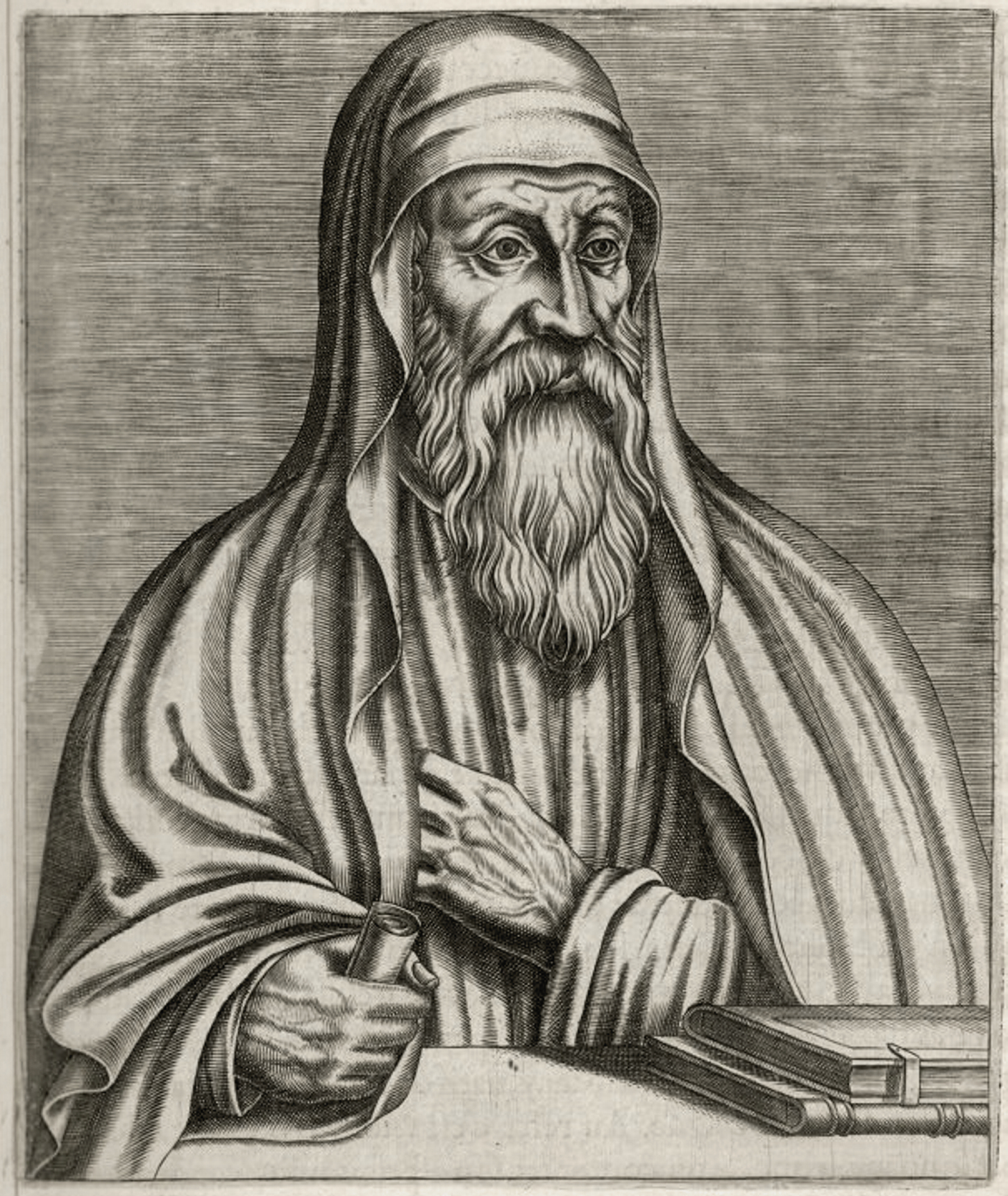
OrigenOrigen was an early merger of Neo-Platonism and Christian theology. In his writings, he represents creation as a departion from God. God is immutable and changeless.

God, therefore, is not to be thought of as being either a body or as existing in a body, but as an uncompounded intellectual nature, admitting within Himself no addition of any kind; so that He cannot be believed to have within him a greater and a less, but is such that He is in all parts Monas, and, so to speak, Enas, and is the mind and source from which all intellectual nature or mind takes its beginning. But mind, for its movements or operations, needs no physical space, nor sensible magnitude, nor bodily shape, nor colour, nor any other of those adjuncts which are the properties of body or matter. Wherefore that simple and wholly intellectual nature can admit of no delay or hesitation in its movements or operations, lest the simplicity of the divine nature should appear to be circumscribed or in some degree hampered by such adjuncts, and lest that which is the beginning of all things should be found composite and differing, and that which ought to be free from all bodily intermixture, in virtue of being the one sole species of Deity, so to speak, should prove, instead of being one, to consist of many things.

In a sense, God is omnipotent, but since gaining power is impossible for an immutable being, this necessitates that everything has always existed (later Origen represents cycles of Earths, the universe is in constant ebb and flow):

As no one can be a father without having a son, nor a master without possessing a servant, so even God cannot be called omnipotent unless there exist those over whom He may exercise His power; and therefore, that God may be shown to be almighty, it is necessary that all things should exist. For if any one would have some ages or portions of time, or whatever else he likes to call them, to have passed away, while those things which were afterwards made did not yet exist, he would undoubtedly show that during those ages or periods God was not omnipotent, but became so afterwards, viz., from the time that He began to have persons over whom to exercise power; and in this way He will appear to have received a certain increase, and to have risen from a lower to a higher condition; since there can be no doubt that it is better for Him to be omnipotent than not to be so.

God created homogeneously good beings (the Intellects). And these beings were responsible for creating evil on Earth. Because God did not directly create the evil (the evil was created by these Intellects per their free will) then God is not to blame for evil:

He created all whom He made equal and alike, because there was in Himself no reason for producing variety and diversity. But since those rational creatures themselves, as we have frequently shown, and will yet show in the proper place, were endowed with the power of free-will, this freedom of will incited each one either to progress by imitation of God, or reduced him to failure through negligence. And this, as we have already stated, is the cause of the diversity among rational creatures, deriving its origin not from the will or judgment of the Creator, but from the freedom of the individual will.

Because of free will, all that departs from God was created by the Intellects:

For the Creator gave, as an indulgence to the understandings created by Him, the power of free and voluntary action, by which the good that was in them might become their own, being preserved by the exertion of their own will; but slothfulness, and a dislike of labour in preserving what is good, and an aversion to and a neglect of better things, furnished the beginning of a departure from goodness. But to depart from good is nothing else than to be made bad. For it is certain that to want goodness is to be wicked. Whence it happens that, in proportion as one falls away from goodness, in the same proportion does he become involved in wickedness. In which condition, according to its actions, each understanding, neglecting goodness either to a greater or more limited extent, was dragged into the opposite of good, which undoubtedly is evil. From which it appears that the Creator of all things admitted certain seeds and causes of variety and diversity, that He might create variety and diversity in proportion to the diversity of understandings, i.e., of rational creatures, which diversity they must be supposed to have conceived from that cause which we have mentioned above. And what we mean by variety and diversity is what we now wish to explain.

So God creates the world (“admitted certain seeds and causes of variety and diversity”) in proportion to the fallen Intellegences. The Intellegences, then, freely chose to fall away and creation was built around their fall. The goal, then, of all reality is to return to perfection:

Whence also the working of the Father, which confers existence upon all things, is found to be more glorious and magnificent, while each one, by participation in Christ, as being wisdom, and knowledge, and sanctification, makes progress, and advances to higher degrees of perfection; and seeing it is by partaking of the Holy Spirit that any one is made purer and holier, he obtains, when he is made worthy, the grace of wisdom and knowledge, in order that, after all stains of pollution and ignorance are cleansed and taken away, he may make so great an advance in holiness and purity, that the nature which he received from God may become such as is worthy of Him who gave it to be pure and perfect, so that the being which exists may be as worthy as He who called it into existence. For, in this way, he who is such as his Creator wished him to be, will receive from God power always to exist, and to abide for ever. That this may be the case, and that those whom He has created may be unceasingly and inseparably present with HIM, WHO IS, it is the business of wisdom to instruct and train them, and to bring them to perfection by confirmation of His Holy Spirit and unceasing sanctification, by which alone are they capable of receiving God.

Everything had to undergo cycles of purification and perfection. This would lead them to ultimately joining with God. The substance would merge to immutable and simple perfection. But the world is fallen, and needs to become pure. The Intellects pushed away from God and thus created the world. Included in this fall was the creation of the Soul. To Origen, the Soul was the lifeblood of creatures. All animals had Souls:

Now, that there are souls in all living things, even in those which live in the waters, is, I suppose, doubted by no one. For the general opinion of all men maintains this; and confirmation from the authority of holy Scripture is added, when it is said that “God made great whales, and every living creature that moveth which the waters brought forth after their kind.”

From this, Origen defines the Soul as anything that moves. When Origin uses the word “Soul” it is not with the modern Christian meaning. To Origen, the “Soul” was the lifeblood of all living things. This Soul was part of the fallen creation (all creation except for the Intellegence is evil).

If, then, those things which are holy are named fire, and light, and fervent, while those which are of an opposite nature are said to be cold; and if the love of many is said to wax cold; we have to inquire whether perhaps the name soul, which in Greek is termed yukh, be so termed from growing cold out of a better and more divine condition, and be thence derived, because it seems to have cooled from that natural and divine warmth, and therefore has been placed in its present position, and called by its present name. Finally, see if you can easily find a place in holy Scripture where the soul is properly mentioned in terms of praise: it frequently occurs, on the contrary, accompanied with expressions of censure, as in the passage, “An evil soul ruins him who possesses it;” and, “The soul which sinneth, it shall die.” For after it has been said, “All souls are Mine; as the soul of the father, so also the soul of the son is Mine,” it seemed to follow that He would say, “The soul that doeth righteousness, it shall be saved,” and “The soul which sinneth, it shall die.” But now we see that He has associated with the soul what is censurable, and has been silent as to that which was deserving of praise. We have therefore to see if, perchance, as we have said is declared by the name itself, it was called yukh, i.e., anima, because it has waxed cold from the fervour of just things, and from participation in the divine fire, and yet has not lost the power of restoring itself to that condition of fervour in which it was at the beginning. Whence the prophet also appears to point out some such state of things by the words, “Return, O my soul, unto thy rest.” From all which this appears to be made out, that the understanding, falling away from its status and dignity, was made or named soul; and that, if repaired and corrected, it returns to the condition of the understanding.

So to Origen, the Soul was a fallen aspect of creation. This Soul would have to remerge with what it once was in order to become once again perfected. It would have to be “repaired and corrected”. Once the Soul did this, to Origen, it was no longer a Soul:

If the soul neither prays nor sings with the spirit, how shall it hope for salvation? or when it attains to blessedness, shall it be no longer called a soul?s Let us see if perhaps an answer may be given in this way, that as the Saviour came to save what was lost, that which formerly was said to be lost is not lost when it is saved; so also, perhaps, this which is saved is called a soul, and when it has been placed in a state of salvation will receive a name from the Word that denotes its more perfect condition.

In order to become one again with the substance (the Intellect) from which it fell, each Soul would have to be animated by “the Spirit”:

For if the animal man receive not the things of the Spirit of God, and because he is animal, is unable to admit the understanding of a better, i.e., of a divine nature, it is for this reason perhaps that Paul, wishing to teach us more plainly what that is by means of which we are able to comprehend those things which are of the Spirit, i.e., spiritual things, conjoins and associates with the Holy Spirit an understanding rather than a soul. For this, I think, he indicates when he says, “I will pray with the spirit, I will pray with the understanding also; I will sing with the spirit, I will sing with the understanding also.’ And he does not say that “I will pray with the soul,” but with the spirit and the understanding. Nor does he say, “I will sing with the soul,” but with the spirit and the understanding.

But not all Souls could be animated. Origen represents a type of man that is more an animal than a man. These men walked and talked like human beings, but had the inability to understand the Spiritual:

Paul indeed intimates that there is a kind of animal-man who, he says, cannot receive the things of the Spirit of God, but declares that the doctrine of the Holy Spirit seems to him foolish, and that he cannot understand what is to be spiritually discerned.

This animal-man was Totally Depraved. He held no spark of the divine and was completely animal. These individuals Origen said were “altogether incapable of instruction”:

Now, if this be the case, it seems to me that this very decay and falling away of the understanding is not the same in all, but that this conversion into a soul is carried to a greater or less degree in different instances, and that certain understandings retain something even of their former vigour, and others again either nothing or a very small amount. Whence some are found from the very commencement of their lives to be of more active intellect, others again of a slower habit of mind, and some are born wholly obtuse, and altogether incapable of instruction.

This is Origen’s version of Total Depravity. These individuals should be avoided and not evangelized (quote from Homilies on Leviticus):

Therefore, these teachers of the Church, in procreating such generations, sometimes use the binding of the thighs and abstain from begetting, since they find such hearers in whom they know they could not have fruit. Finally, also in the Acts of the Apostles, it is related concerning some of these that ‘we could not speak the word of God in Asia’ (Cf. Acts 16:6). That is, they had put on the thigh covering and preserved themselves that they not beget sons, for certainly these were such hearers in whom both the seed would die and could not have offspring. Thus therefore, the priests of the Church, when they see incapable ears or when they encounter counterfeit and hypocritical hearers,

But Jesus also had a Soul. Jesus, Origen states, is the “Soul” of God, as God does not have an actual Soul:

“How then is there said to be also a soul of God?” To which we answer as follows: That as with respect to everything corporeal which is spoken of God, such as fingers, or hands, or arms, or eyes, or feet, or mouth, we say that these are not to be understood as human members, but that certain of His powers are indicated by these names of members of the body; so also we are to suppose that it is something else which is pointed out by this title–soul of God. And if it is allowable for us to venture to say anything more on such a subject, the soul of God may perhaps be understood to mean the only-begotten Son of God. For as the soul, when implanted in the body, moves all things in it, and exerts its force over everything on which it operates; so also the only-begotten Son of God, who is His Word and Wisdom, stretches and extends to every power of God, being implanted in it; and perhaps to indicate this mystery is God either called Or described in Scripture as a body. We must, indeed, take into consideration whether it is not perhaps on this account that the soul of God may be understood to mean His only-begotten Son, because He Himself came into this world of affliction, and descended into this valley of tears, and into this place of our humiliation; as He says in the Psalm, “Because Thou hast humiliated us in the place of affliction.”

But this soul was not an ordinary Soul. To Origen, Jesus had an immutable Soul (which allowed Jesus to transcend the problem of a Soul being evil):

5. Now, if our having shown above that Christ possessed a rational soul should cause a difficulty to any one, seeing we have frequently proved throughout all our discussions that the nature of souls is capable both of good and evil, the difficulty will be explained in the following way. That the nature, indeed, of His soul was the same as that of all others cannot be doubted otherwise it could not be called a soul were it not truly one. But since the power of choosing good and evil is within the reach of all, this soul which belonged to Christ elected to love righteousness, so that in proportion to the immensity of its love it clung to it unchangeably and inseparably, so that firmness of purpose, and immensity of affection, and an inextinguishable warmth of love, destroyed all susceptibility (sensum) for alteration and change; and that which formerly depended upon the will was changed by the power of long custom into nature; and so we must believe that there existed in Christ a human and rational soul, without supposing that it had any feeling or possibility of sin.

The function of Jesus was an intermediator, to bring the fallen back into communion with the perfect:

because human frailty can neither see all things with the bodily eye nor comprehend them by reason, seeing we men are weaker and frailer than any other rational beings (for those which are in heaven, or are supposed to exist above the heaven, are superior), it remains that we seek a being intermediate between all created things and God, i.e., a Mediator, whom the Apostle Paul styles the “first-born of every creature.”

This intermediator would lead individuals to God. The Holy Spirit would give them knowledge (those capable of receiving the knowledge):

And as there are many ways of apprehending Christ, who, although He is wisdom, does not act the part or possess the power of wisdom in all men, but only in those who give themselves to the study of wisdom in Him; and who, although called a physician, does not act as one towards all, but only towards those who understand their feeble and sickly condition, and flee to His compassion that they may obtain health; so also I think is it with the Holy Spirit, in whom is contained every kind of gifts, For on some is bestowed by the Spirit the word of wisdom, on others the word of knowledge, on others faith; and so to each individual of those who are capable of receiving Him, is the Spirit Himself made to be that quality, or understood to be that which is needed by the individual who has deserved to participate.

But some followers of Jesus just will not understand the nature of reality. When they die, they will be given special classes, teaching them that the physical world is not the endgame, and to strive for a return to the One, the essence of God. In this manner, these Christians can purify themselves for eventual inclusion with the One:

We are therefore to suppose that the saints will remain there until they recognise the twofold mode of government in those things which are performed in the air. And when I say “twofold mode,” I mean this: When we were upon earth, we saw either animals or trees, and beheld the differences among them, and also the very great diversity among men; but although we saw these things, we did not understand the reason of them; and this only was suggested to us from the visible diversity, that we should examine and inquire upon what principle these things were either created or diversely arranged. And a zeal or desire for knowledge of this kind being conceived by us on earth, the full understanding and comprehension of it will be granted after death, if indeed the result should follow according to our expectations. When, therefore, we shall have fury comprehended its nature, we shall understand in a twofold manner what we saw on earth. Some such view, then, must we hold regarding this abode in the air. I think, therefore, that all the saints who depart from this life will remain in some place situated on the earth, which holy Scripture calls paradise, as in some place of instruction, and, so to speak, class-room or school of souls, in which they are to be instructed regarding all the things which they had seen on earth, and are to receive also some information respecting things that are to follow in the future, as even when in this life they had obtained in some degree indications of future events, although “through a glass darkly,” all of which are revealed more clearly and distinctly to the saints in their proper time and place. If any one indeed be pure in heart, and holy in mind, and more practised in perception, he will, by making more rapid progress, quickly ascend to a place in the air, and reach the kingdom of heaven, through those mansions, so to speak, in the various places which the Greeks have termed spheres, i.e., globes, but which holy Scripture has called heavens; in each of which he will first see clearly what is done there, and in the second place, will discover the reason why things are so done: and thus he will in order pass through all gradations, following Him who hath passed into the heavens, Jesus the Son of God, who said, “I will that where I am, these may be also.”

Posted in Church Fathers, History, Platonism | 1 Comment

The Biblical Standard of Marriage

marriage

In the book of Matthew, Jesus is approached by the Pharisees. The Pharisees present Jesus with one of the contentious issues of the day: divorce. Jesus questions their fundamental understanding of marriage. To Jesus, when people are joined, they are joined by God and there is no return:

Mat 19:4 He answered, “Have you not read that he who created them from the beginning made them male and female,
Mat 19:5 and said, ‘Therefore a man shall leave his father and his mother and hold fast to his wife, and the two shall become one flesh’?
Mat 19:6 So they are no longer two but one flesh. What therefore God has joined together, let not man separate.”

One thing to note is that God joined the individuals. It is “man” that is separating what God joined. In Jesus’ theology, is this possible? Or is this Jesus’ way of saying that man cannot undo what God has done even if they do so socially (it would be a rhetorical point)? Jesus states, later in the same passage, that remarriage after divorce is still adultery. In the theology of Jesus, divorce is a man-made concept (not recognized by God).

Jesus states that the only real divorceable offense is adultery:

Mat 19:9 And I say to you: whoever divorces his wife, except for sexual immorality, and marries another, commits adultery.”

Jesus’ logic flows from sex being the uniting act. Once a woman is joined to a man then that bond is sealed eternally. If a man or woman forms that bond with another person, the unique bond is no longer unique; it has become common and vulgarized. Divorce for adultery does not lead to adultery because once adultery is committed, the bond is already broken.

This was a two way street. Both men and women could break the covenant. In Jesus’s understanding, activities like polygamy were a violation of marriage. Because marriage was a bond between two people, any deviation was suspect. Notice the parallel passage in Mark:

Mar 10:11 So He said to them, “Whoever divorces his wife and marries another commits adultery against her.
Mar 10:12 And if a woman divorces her husband and marries another, she commits adultery.”

In this scenario, adultery occurs after the divorce is finalized (the idea is that a social divorce may be state recognized but is not recognized by God). The adultery occurs, then, once the divorced individuals remarry. Theoretically, if the individuals do not remarry (have sex with other individuals), no adultery occurs.

In the mindset of Jesus, marriage centered around the act of sex. Sexual union constituted spiritual union. Once the circle has been expanded from husband and wife, that circle is broken. There are no marital bonds left in an adulterous marriage.

When Jesus’ quotes the Old Testament, this quote is coming directly from Genesis:

Gen 2:24 Therefore a man shall leave his father and his mother and hold fast to his wife, and they shall become one flesh.

Jesus’ concept of sex uniting body and soul is a fundamental aspect of God’s original creation. God creates Adam to be the perfect being, and for Adam he develops a helper (Eve). The two engage in sexual relations, and the two become one. The marriage act (sex) is a merging of two individuals.

This is God’s intended standard. There is no adultery, or polygamy, or multiple sexual partners. Instead, there are two individuals united in marriage. This was the intended creation, although this is not how society eventually functioned (as seen through the laws of ancient Israel).

In keeping with this understanding of marriage, Jesus uses some very interesting terminology in Matthew 5:

Mat 5:32 But I say to you that whoever divorces his wife for any reason except sexual immorality causes her to commit adultery; and whoever marries a woman who is divorced commits adultery.

Jesus states that the act of divorce “causes” a woman to commit adultery. Jesus is not blaming the woman for being an adulterer. In this view, her remarriage was only the logical (and acceptable) choice. But because of the logistics as to how marriage works, this act (although acceptable), is adultery nonetheless. The blame is being placed on the man, who is culpable of making his wife an adulterer.

Paul held identical beliefs about the function of sex and marriage. Paul reinforces this concept in his works. In Corinthians, Paul criticizes Christians who use prostitutes. In doing so, he explains how prostitutes vulgarize the bond of marriage:

1Co 6:15 Do you not know that your bodies are members of Christ? Shall I then take the members of Christ and make them members of a prostitute? Never!
1Co 6:16 Or do you not know that he who is joined to a prostitute becomes one body with her? For, as it is written, “The two will become one flesh.”

Notice, much like the implication from Jesus and from Genesis, Paul is equating the sexual copulation with “becoming one”. In the theology of Paul, the sex act unites individuals. Paul’s argument is that by having sex with prostitutes, Christians are forming a marriage covenant with those same prostitutes. This in turn makes prostitutes (which the text considers dirty) part of the church (body of Christ).

Sex constitutes the foundation of marriage.

The Ideal

In Jewish theology, God has established an ideal plan for the world. God has His views on how the world should operate and how individuals should act. Deviation from this ideal distanced individuals from God.

In God’s perfect world, individuals would not die, individuals would marry as virgins, individuals would not suffer deformity, there would be no disease. Man was to live perfect and healthy lives. As such, God sought to use the priestly caste, the caste closest to Himself, to mimic this perfection. He imposed upon the priests special rules and commands that applied only to themselves.

The High Priest was not allowed to scar his body or even have natural deformities. He could not be maimed in battle, but had to have physical perfection. The High Priest could not attend funerals (or be in contact with death). The High Priest was not allowed tattoos, and his daughters could not be prostitutes (under penalty of death). He could not be born of a forbidden union (most likely of adultery or whoredom). If any priest came in contact with disease, they were unclean. If his daughter was married to a non-priest, then she was no longer considered family and could not eat the Holy food (note that this dispossession of a daughter in marriage affirms the Genesis description in which the married couple merges).

But very interestingly, the priests were also imposed a standard of virginity in marriage:

Lev 21:13 And he shall take a wife in her virginity.
Lev 21:14 A widow, or a divorced woman, or a woman who has been defiled, or a prostitute, these he shall not marry. But he shall take as his wife a virgin of his own people,
Lev 21:15 that he may not profane his offspring among his people, for I am the LORD who sanctifies him.

Any woman who had ever had sex, even in the bounds of marriage, was off-limits to marrying the priestly class. This makes sense in the context in which sex equals an eternal bond. If ever a woman had sex, she was joined to her partner, and marrying another constituted an unideal arrangement (a deviation from God’s standard). This concept was re-enforced such that even if a priest’s sister died, the priest could not attend her funeral unless she was a virgin (although allowances were made for widows to reintergrate into the family, possibly for reasons of practicality). This image of marriage was God’s standard.

Deviations

While God’s standard is one man, one woman, one marriage, there were many deviations from this standard. Most of these deviations were instituted for practical reasons.

Normal Israelites (not of the priest class) were allowed to marry impure women (widows, prostitutes, and promiscuous women). Remarriage of a woman after her husband’s death was encouraged and sometimes mandated. The penalty for a brother not furthering the lineage of a deceased sibling was that his house would forever be labeled “The house of him who had his sandal pulled off”:

Deu 25:5 “If brothers dwell together, and one of them dies and has no son, the wife of the dead man shall not be married outside the family to a stranger. Her husband’s brother shall go in to her and take her as his wife and perform the duty of a husband’s brother to her.
Deu 25:6 And the first son whom she bears shall succeed to the name of his dead brother, that his name may not be blotted out of Israel.
Deu 25:7 And if the man does not wish to take his brother’s wife, then his brother’s wife shall go up to the gate to the elders and say, ‘My husband’s brother refuses to perpetuate his brother’s name in Israel; he will not perform the duty of a husband’s brother to me.’
Deu 25:8 Then the elders of his city shall call him and speak to him, and if he persists, saying, ‘I do not wish to take her,’
Deu 25:9 then his brother’s wife shall go up to him in the presence of the elders and pull his sandal off his foot and spit in his face. And she shall answer and say, ‘So shall it be done to the man who does not build up his brother’s house.’
Deu 25:10 And the name of his house shall be called in Israel, ‘The house of him who had his sandal pulled off.’

In this text, a brother (without children) dies. The duty is passed to the second brother to give children to the wife who had none. If he refuses this duty, he is publically mocked and scorned. For his lack of concern for his brother’s lineage, a curse was placed on his house such that he too is cut off from having children.

In God’s perfect plan, brothers have children and do not die. But because God’s plans are not realized on Earth, sometimes brothers die childless. The circumstances may demand odd actions to rectify the situation. In God’s standard, per the logic of the priestly code, the widowed woman has already formed her bond. She was off limits for further sex with other individuals. But per lineage concerns, she married within the family. She was also free to pursue alternative marriages if a brother refused to fulfill his duties.

Marriage after the death of a spouse was common. One of the most famous examples is that of Ruth, who then becomes included in the lineage of Jesus (much like another odd figure, the prostitute, Rehab). Normal Israelites would marry divorcees, promiscuous women, and sometimes even prostitutes (such as in the case of Hosea). Such were shameful things, and a high price was placed on virginity.

Polygamy was also legal, although a deviation from the ideal. Michael Heiser writes:

So, does the Old Testament “approve” of polygamy? Yes, in the sense that (a) it was part of the culture at the time God chose to call Abraham and create a people through him and his wife Sarah and (b) God didn’t care to outlaw the culture of the time. But it would be misguided to think that God promoted polygamy or held it out as the most desirable option. The Old Testament holds monogamy as an ideal, and makes no effort to argue that polygamy was a desirable situation for men in general. Polygamy just “was” and God didn’t care about the culture in which he initiated the next phase of his salvation plan. Polygamy had no vital theological place in that plan and would ultimately become even culturally irrelevant when Israel was replaced as the circumcision-neutral Church as the people of God. 1 It just wasn’t an issue.

Polygamy was allowed, and there is at least one example of polygamy even among the priest caste: Elkanah, father of Samuel (although the circumstances of his polygamy are not explored in the text).

Paul shows his disdain for polygamy through his qualifications for being an elder of the church:

1Ti 3:2 Therefore an overseer must be above reproach, the husband of one wife, sober-minded, self-controlled, respectable, hospitable, able to teach,

There has been discussion about what Paul means here. He may be saying: Elders have to be married, or elders cannot have divorced, or even elders cannot be polygamous. If Paul is saying elders cannot have been divorced and remarried, this would also seem to cover polygamous relationships. Paul’s point would be an affirmation of Jesus’ concept of how marriage works, and this would be consistent to his own treatment of the marital relationship.

Although Paul does not outlaw polygamous and/or remarried elders within the church ranks, it is not allowed to infiltrate the ranks of church leadership. It is tolerated but disdained. Much like the priests, the elders of the church were held to a higher standard, and had to lead more perfect lives (setting the standard by which others must follow).

Criminalized Activity

While certain sexual activities were not criminalized (such as polygamy, prostitution, and general promiscuity) plenty of sex acts incurred very extreme punishment. Death was given to rapists, adulterers (even those who have sex with engaged/betrothed women), those who have sex with both mother and daughter, those who have sex with their close relatives (following the idea that sex bonds, death was given for having sex with both blood relatives and relatives by marriage), homosexuality, bestiality, those who have sex with menstruating women, and even prostitutes who are the daughters of priests (per the priestly purity laws).

To opine that the Bible is not a thorough book and cannot cover all sex scenarios (thus does not cover prostitution or polygamy or promiscuity) is not a very good argument. How common is prostitution compared to men who have sex with menstruating women? Compared to bestiality? Compared to sex with a both a daughter and mother? Would not a prohibition against sex with multiple people cover sex with both a mother and daughter? Why would the author not save some time and just illegalize all extra-marital sex? The fact is that American morality seems to diverge from Israelite morality.

The modern American might not think twice about some of these sexual relations that God condemns with death. It is near impossible to figure out which men are having sex with menstruating women, and Americans would be hard pressed to even hold a discussion the issue. But, in the Bible, God overthrows nations for this very act:

Lev 18:19 “You shall not approach a woman to uncover her nakedness while she is in her menstrual uncleanness.

Lev 18:24 ‘Do not defile yourselves with any of these things; for by all these the nations are defiled, which I am casting out before you.
Lev 18:25 For the land is defiled; therefore I visit the punishment of its iniquity upon it, and the land vomits out its inhabitants.

Eze 18:5 But if a man is just And does what is lawful and right;
Eze 18:6 if he does not eat upon the mountains or lift up his eyes to the idols of the house of Israel, does not defile his neighbor’s wife or approach a woman in her time of menstrual impurity,

Eze 18:9 If he has walked in My statutes— And kept My judgments faithfully— He is just; He shall surely live!” Says the Lord GOD.

Eze 22:9 There are men in you who slander to shed blood, and people in you who eat on the mountains; they commit lewdness in your midst.
Eze 22:10 In you men uncover their fathers’ nakedness; in you they violate women who are unclean in their menstrual impurity.
Eze 22:11 One commits abomination with his neighbor’s wife; another lewdly defiles his daughter-in-law; another in you violates his sister, his father’s daughter.

Eze 22:15 I will scatter you among the nations and disperse you through the countries, and I will consume your uncleanness out of you.

In God’s law, having sex with menstruating women was a capital offense, one which led to the overthrow of nations, even Gentile nations. Prostitution, polygamy, promiscuity… not so much. While it may be shocking to modern Americans, plenty of activities were not criminalized in ancient Israel. And unlike having sex with menstruating women, God shows no strong disdain for these acts:

Women becoming prostitutes (there was a prohibition against cult prostitutes and against the daughters of priests becoming prostitutes).
Polygamy.
Premarital sex.
General promiscuity.
Divorce.

At best, these activities were scorned upon but tolerated (they were deviations from the ideal). At worst, these activities were not considered wrong (although in the case of prostitution there are plenty of New Testament texts claiming it is a sin). Jesus claims divorce was allowed for reasons of practicality. It could be the case that these other activities were also so widespread as to not allow general criminalization. But this still becomes a question of scale: homosexuality is wrong and a capital offense. Are there circumstances which God decriminalizes a large segment of homosexual acts on the grounds of practicality?

An intellectually honest Christian must understand that, by level of importance, God is willing to overthrow Israel for sex with menstruating women while similar attention is not shown to other activities. Equating adultery to polygamy is not a Biblical position. Although they might be technically equal, per Jesus’ understanding of the marriage bond, they were not the social or criminal equivalent (they have not even been consistently judged as equal in God’s economy). The care and attention shown each activity (activities that have always been widespread in human culture) is just not even on the same scale of the criminalized activities.

In the case of premarital sex, Paul’s advice is to marry:

1Co 7:2 But because of the temptation to sexual immorality, each man should have his own wife and each woman her own husband.

1Co 7:8 To the unmarried and the widows I say that it is good for them to remain single as I am.
1Co 7:9 But if they cannot exercise self-control, they should marry. For it is better to marry than to burn with passion.

This is in keeping with Old Testament laws on pre-marital sex, in which the “punishment” was that the two individuals should marry (but this could be overridden by the father).

Commonly misunderstood verses

Mat 5:28 But I say to you that everyone who looks at a woman with lustful intent has already committed adultery with her in his heart.

In this verse, Jesus is warning his audience (primarily married men) that if they look on married women with lust, they commit adultery in their heart. This is not a verse directed to or about unmarried men and women. The Greek word for woman is the same as for a married woman. Adultery cannot occur between people who do not have a sexual bond already formed. In this sense, Jesus affirmed what he is quoting:

Mat 5:27 “You have heard that it was said, ‘You shall not commit adultery.’

Not only should people not have sex with married women, they should not even lust after a married woman. Jason Staples expounds on this verse:

So it is clear that the grammar is reflecting purpose: “anyone who looks at a woman in order to covet her.” (“Covet” is preferable here in part because “covet” better reflects the intentionality reflected in the passage.) This is a critically important point; Jesus is not suggesting that any sexual thought or inclination towards a woman is sinful. Nor is he suggesting that such thoughts or attractions being triggered by a look are sinful. The look is not the problem (nor is the presence of a beautiful woman, which some of that day tended to blame as the real problem); no, these are assumed. What is remarkable (given the popular misinterpretation) is that Jesus likewise assumes the presence of sexual desire in the man as a given, and that sexual desire isn’t seen as the problem. Instead, Jesus addresses the matter of intent, of volition, the purpose of the look. The issue is not the appetite itself but how a man directs this natural appetite and inclination. (I’m reminded here of the old saying: If you’re a young man on a beach and a beautiful woman in a bikini walks past and you don’t feel any sort of excitement or attraction, it’s not because you’re spiritual, it’s because you’re dead.)

So Jesus’ statement was one which forbids man from looking upon a married woman with intent to covet. This is not about unmarried teenagers finding young, unmarried women attractive.

1Co 6:9 Or do you not know that the unrighteous will not inherit the kingdom of God? Do not be deceived: neither the sexually immoral, nor idolaters, nor adulterers, nor men who practice homosexuality,
1Co 6:10 nor thieves, nor the greedy, nor drunkards, nor revilers, nor swindlers will inherit the kingdom of God.

Often in the New Testament, sexual immorality is equated by modern Christians with modern notions of sexual immorality. Some equating is correct. Jesus considered sex as the marital act and bond, thus discounting the legitimacy of promiscuity, polygamy and prostitution. But Israel was still Israel, and inherited ancient Israelite notions of sexual immorality. Likely this phrase covers “having sex with menstruating women” or even “prostitution” (considering Paul’s treatment of prostitution elsewhere) or even the situation covered in 1 Corinthians in which a son is having sex with his mother-in-law (1Co 5:1). This would be a form of incest. Paul’s term “sexual immorality” might not cover normal or infrequent sexual promiscuity, and if it does, it is probably not on the same level as the sins that Paul describes.

Some further readings by an anti-Christian and anti-Jewish author:
Jews, Adultery and Prostitution in the Jewish Bible
Polygamy in the Jewish Bible

Posted in Bible, Morality, Theology | 1 Comment

omnipotence in platonism and in thomism

From Plotinus by Lloyd P Gerson:

Where a creation metaphysics such as that of Aquinas differs from Plotinian metaphysics is in its claim that the [ἀρχή] of all is the sole cause not of the existence but of the being of everything else, hence of existence and[i] essence. Accordingly, Aquinas must say that God is not just virtually all things but eminently all things as well. That is, every predicate that belongs to complexes belongs to their simple cause in a higher mode of being. In short, [οὐσία] cannot be a real [ἀρχή] for him. Were it so, this would compromise the omnipotence of God. By contrast, Plotinus is less concerned with preserving omnipotence than he is with preserving the unqualified simplicity of the first [ἀρχή]. One way to express the differences between the two in the matter of omnipotence is to say that although they agree that the [ἀρχή] of all of logical possibility is grounded in the second [ἀρχή], Intellect, whereas Aquinas will want to say that logical possibility and impossibility are ultimately to be accounted for by the first principle, God…

Plotinus certainly emphasizes the idea of supreme power in his characterizations of the One. What precisely is this power supposed to be? How is power to be analyzed? First, as the text in V.3.15.33-6 indicates, Plotinus takes over Aristotle’s distinction between a passive and an active power, identifying the latter with the One (see Metaphysics 9.1.1046a19ff.). Second, the power of the One is indicated by its results, namely, the existence of everything that can exist. But since the existence of everything that exists is not identical with the One, the One’s power is evidently that in virtue of which everything else exists. But this power is in no way really distinguishable from anything else in the One, else its perfect simplicity would be destroyed. The One is virtually everything else, including Intellect. Since, however, the One does not confer existence on a waiting recipient (since the recipient would then already[i] exist), the power of the One is not the power to bring about a substantial change like generation. It is something even more radical than this. It is the power to cause to exist everything that can exist, including eternal Intellect and Forms. With the causal power of the One even eternal truths would not exist.

The [i]’s denote italicized words in the original.

Posted in Platonism | 2 Comments

an overview of the book of job


Main characters:

God (Yahweh) – In this text, Yahweh rules from His court in heaven. The angles approach Him and report on their activities. God is styled as considering what His court attendants bring to His attention. God is propositioned by Satan to see if Job is inherently righteous or if his righteousness is bought by God’s blessings. God entertains this. God acts as an unseen witness during Job’s discussions, ultimately confronting Job to reverse Job’s suit against God.

Satan – Satan acts as a member of God’s court. In this chapter, Satan is tasked with roaming the earth and exposing wickedness. Satan’s job is to punish the wicked. As part of his official duties, Satan questions the loyalties of Job. Perhaps Job only worships God because God blesses Job. God gives permission to Satan to find out the truth.

Job – Job is the most righteous man alive. Job has done nothing deserving of harm, yet God afflicts him. Job’s position is that he is innocent and will die clinging to his integrity. Job laments that there is no justice in this wpovertyorld. Job blames God for not enforcing a system of retributive justice; something that Job wrongly believes is God’s duty. God corrects Job by saying that if Job is not in a position to suggest how the world should operate; if Job wants morality enforced, then Job can do it himself. Otherwise, Job has no standing to question what God should and should not do.

Job’s wife – Job’s wife succumbs to Satan’s afflictions. She serves as the example of someone failing the test. Her advice is for Job to curse God and die. Job ignores this advice.

Eliphaz – Eliphaz is one of Job’s three friends. Eliphaz takes the stance that Job is not truly wicked, but suffering a temporary set-back due to some non-systematic or non-characteristic sin. Eliphaz maintains that Job will die in old age, and not as part of the wicked. Eliphaz operates under the impression that the sin is punished and the wicked are killed.

Bildad – Bildad takes the stance that Job may or may not be wicked. Job’s children were wicked, as evidenced in their deaths. Job has sinned, but may not have committed a sin worthy of death. Bildad says to commit Job’s case to God.

Zophar – Zophar takes the stance that Job is truly wicked, the punishment is evidence and is revealing some hidden sin of Job’s. Zophar maintains that Job is getting his just due, and will be killed as one of the wicked. Zophar operates under the impression that the sin is punished and the wicked are killed.

Elihu – Elihu serves as the last character in the story. Elihu is an interloper. He is not named except in the texts in which he speaks. As such, scholars often claim that his speeches were a later addition to the text. His speech is not explicitly condemned or endorsed or addressed, and he vanishes as quickly as he is introduced. His speeches serve as a bridge to God’s speech, acting as a profane foil to God. Many of his themes approximate those of his friends. Elihu, like the others, believes in divine punishment of the wicked. But Elihu adds that Job’s punishment could be a divine warning from God in anticipation of future sins. Like the others, Elihu is wrong.

Plot:

The book of Job describes a group of angels reporting to God. One such angel, who is tasked with roaming the world and seeking out hidden wickedness, presents a conundrum to God. Perhaps the righteous are only righteous because God prospers them. God then allows the most righteous man on Earth (Job) to be tested to understand his motives. The angel destroys all that Job loves, but Job holds fast to his integrity.

The angel approaches God again, arguing that a direct threat to Job’s life is what it will take to expose Job. Annoyed at Satan for previously unnecessary suffering, God then allows this final test. Job, although bitter at God and surrounded by false witnesses, endures in his integrity. Job calls for God to judge him, as his friends surround him in judgment.

God appears, silencing Job. Job is not God. In fact, Job does not understand the world as God does. Job is in no position to proffer a new system of justice for the world. As such, Job is operating under misguided presumptions and does not even have a case to present to God. Justice is not God’s job. Justice is not a property of this world or any world. Job is not entitled to recompense. The universe is filled with random chaos. God can intervene or watch or act in whatever way He wishes.

God rewards Job and punishes Job’s accusers. God, then, restores Job to good fortune. The story ends.

Posted in Bible, Morality, Theology | 2 Comments

on an american insurgency

On Popehat, a new contributor (Marc Randazza) posts an ungracious and inflammatory post claiming that having small arms to subvert government tyranny is not a valid reason for gun ownership. As evidence, he offers a hypothetical in which all insurgents cluster into a single city and then the American government is willing to carpet bomb the city. The leaps of logic, the outright nonsense, and the lack of historical understanding are well below par for a Popehat post.

Granting Randazza’s hypothetical triggering situation (the president abolishing the presidency, instituting Islam, and granting the government the rights to have sex with people’s wives), what would an American insurgency look like?

People and Weaponry

America is a nation of 317 million people. Presumably, the hypothetical could at least arouse 1% of the population to rebel (between the people rebelling against Islam, the people rebelling against a change in government, and the people rebelling against gun confiscation, this number would not be hard to hit). This would be 3.1 million people in itself. These insurgents would not be localized in a particular city, but distributed loosely throughout America (probably disproportionately among Military and Police ranks as those populations naturally house more aggressive individuals). The insurgents would have access to the over 357 million guns in circulation; being supplemented by off-grid milling and 3d printing. On a side note: the more progress made in 3d printing, the less realistic any gun control measures.

In order to control this, the government would have to quickly implement a police state with door-to-door confiscation (causing even more ill-will). It is hard to imagine, in Randazza’s hypothetical, that the government would have the intellectual support of the population in their crackdown (people tend not to like forced religion and government officials having sex with their wives). How many guns are unregistered and how can the government begin to manage any sort of confiscation? Imagine the mobilization that would have to occur to police hundreds of thousands of households? Who is confiscating, and are they loyal to the government?

In addition to the limitless small arms available to all insurgents, the insurgents in the military would have access to planes, tanks, and missiles. The problem with insurgents is that they are hard to identify beforehand. Maybe an F16 operator goes rogue? It only takes one (maybe his wife or sister is raped per the new government dictates). Maybe a nuclear silo is captured (maybe the security forces team does not like Islam being the new state religion)? Maybe a fuel contractor places explosives in a fuel truck (maybe the contractor longs for free elections)? This all assumes there is not a military coup in response to the change in government.

Insurgency is asymmetric warfare. Although small arms would definitely play a large role in the insurgency (especially for the common citizen insurgent), they would be supplemented by military and enthusiast tech. The citizen insurgent contingent will inspire the government insurgent contingent. The government is going to have to handle all threats simultaneously and indefinitely. In doing so, they are going to alienate their own supporters with the far-reaching and broad brush strokes needed to accomplish this (how many loyal Soviets were mistakenly executed or sent to gulags?).

Warfare

Despite Randazza’s hypothetical rebellion, the insurgents probably would not take a town and barricade that town. One: they will probably not be as reckless as to present a military bombing target (unless they were sure the military would not just bomb it). Two: most people in any society are not the types to take up arms over anything (notice the lack of vigilantes in American society). Will an entire town rebel? Probably not, at least not overtly.

One further point: imagine a random town in Montana decided to rebel even without any hypothetical tyranny. Would the current administration even consider carpet bombing? In the real world, governments operate under constraints: financial, material, moral, legal, and political. The cost of carpet bombing is not just money and bombs, but also hearts and minds (local and foreign, civilian and military). Imagine what would happen if the government did carpet bomb and entire town. The entire country would come undone with rage, indignation, and seek to oust those in charge. The government might be able to get by with bombing a Waco compound or two (where those bombed can be dismissed as weirdoes), but not an entire Waco city (where outsiders can identify with those being bombed). More realistically, the government would just cut off trade until the city caves.

With decentralized locations, the insurgents would probably not operate in any unified way. If a leadership develops, it would probably operate in a very decentralized manner (providing agendas and letting insurgency cells operate independently). Attacks would probably be uncoordinated, random, and anonymous (much like other insurgencies around the globe). Insurgents probably would not even know eachother.

Government officials, and their collaborators, would probably be the subject of assassination attempts, carried out by disgruntled loners who don’t care about consequences. How can the government control this? They couldn’t even fight organized assassinations in Pablo Escobar’s Columbia where they knew who was directing them. Decentralized assassinations will be that much harder.

crushed-police-carsWe see modern American examples in the man who flew his plane into an IRS building and the man who smashed police trucks with his tractor. These events are unpredictable and can hardly be guarded against. A widespread insurgency will legitimize use of small arms in the minds of the disgruntled. The body count will demoralize government agents.

The people who care about consequences will operate anonymously. They will set fires, set bombs, operate sniper rifles from vans, smuggle handguns into locations with government loyalists. We see modern American examples in the terrorists who operated a sniper rifle from their van, the individual who shot police sitting in their cars, the individual who shot a few police officers and fled into the woods (they about shut down an entire state to catch the guy). Modern technology, although helpful, could not swiftly prevent or even capture these individuals. It does not take more than a single individual to unnerve an entire city, county, or state.

Supply lines would be hit. The military and police agencies rely on many private companies to exist. Fuel, food, electricity, water, clothing, technology… all become targets. A complicated supply chain leads to untold vulnerabilities and plenty of opportunity for insurgent objectives. With insider threats, this cannot all be defended and will be very costly to manage (just look at what normal services and supplies cost in Iraq).

Literally, the insurgency can continue on indefinitely (and there is no withdraw like in Iraq). To stop an embedded and anonymous insurgency requires heavy public support, a massive surveillance state, massive prisons, and a lot of other resources. This will not be like Iraq, in which the insurgents are a foreign population hiring other foreigners to fight against a unified American military. The insurgency will be Steve (the neighborhood hockey coach) augmented by unidentifiable sleeper agents embedded throughout the government. The current government has problems killing even current people who are in need of killing, now they are going to wage war on their own population. Unlikely.

Morale

The population probably would identify with the rebels. Forced religion, a subverted government, and having your wife raped would probably be enough, but if the government is engaging in the type of carpet bombing that Randazza imagines then this lack of government support would surely increase. Some commenters on Randazza’s post hypothesized that the government would use foreign mercenaries. This is also a bad policy for local support. Having foreign nationals kill citizens is likely to be seen as a foreign occupation and will increase rebel sympathies.

Government officials and loyalists would probably live in fear of assassination. The local population who has nothing to do with the insurgency would live in fear of both the insurgents (for being executed as loyalists) and the government (for being accidently branded as having insurgent sympathies). Top government officials may even attempt a second coup to stabilize the government (such as what happened in Chile).

Even if the population does not identify with the rebels, people quickly tire of war. Even if the insurgency is not generally supported, how long does support for prolonged warfare last? How would a well-armed insurgency affect long term popular opinion about prolonged war? Surely, the prospect of a sniper behind every bush is more threatening than a disarmed insurgency. People do not want to live in a world of uncertain violence (especially middle class Americans).

Insurgency without Guns

black panthersOf course, the point of Randazza’s original post is that deterring the government is not a
good reason for having guns. It should go unsaid (but sadly needs to be said) that it is irrational to assume that deterrence takes the form of a city rebelling and starting a new government, rather than historical deterrence (black panthers carrying shotguns to deter police abuse or farmer militias stopping federal enforcers from taking land). It is interesting that modern drug raids are carried out by heavily armed and armored police, suggesting that guns really do impose real and tangible threats to the government. Armed police often accompany Child Services when taking people’s children. When police and government officials are scared of being killed randomly, one might take this as evidence that guns do deter government action.

So, what if the government took all guns, and then somehow was able to control milling and 3d printing? The insurgency probably would take a major hit. In Communist Russia, Socialist Germany, and Communist China, and unarmed population was easily subdued (what heavily armed population was ever oppressed by their government?). Granted, the American fighting spirit would probably be greater than in these countries, with our long history of independent spirits. But not having a gun in every hand would definitely give the government a large starting advantage.

Conclusion

This is just a thought experiment on how an American insurgency would play out. Washington agencies are well area of these things, as they are tasked with mapping out various contingency situations. No doubt they have gone through scenarios looking at this exact thing, and have built contingency response plans. But how does one fight a well-armed local insurgency? It is near impossible.

If America were pushed to an insurgency, even an insurgency of 1% of the population, small arms would play a major role (as they do in Iraq, Afghanistan, gang activity, current anti-government violence). Small arms and asymmetric warfare can inflict untold damage on the government. If current gun ownership plays a major role in how the government currently acts and behaves, how much more when a large segment of the population is provoked?

Posted in Goverment | Leave a comment

popehat builds a gun strawman

On Popehat, a new blogger, Marc Randazza, posts an unusually dull and misinformed piece on guns. The name of the article is “You Are Not Going to Resist the Government With Your Guns”. In this article, the blogger imagines the government becomes tyrannical. Guns owners decide to resist by barricading a city but then the government just bombs them to oblivion. Randazza’s point is that gun owners should drop arguments of government deterrence in their list of reasons for gun ownership.

In the comments, Randazza is utterly destroyed for his silly straw man argument. Some of the best comments:

Brad writes:

Marc makes the common mistake of assuming that in any violent conflict between the American people and the American Government that the military will not only fall in line but also be employed to maximum effect. Both assumptions are ridiculously simplistic and therefore false.

TMLutas writes:

The stupid, it burns. First of all, government tyranny comes in all shapes and sizes and we have well upwards of 80k governments in this country, each of them having the potential to pick our pockets or break our legs. The utility of the 2nd amendment’s resistance to tyranny isn’t about how well it works on the most well armed of these governments but how well it works in making the yahoos in the other 80k governments rethink any dumb ideas they might have to behave like little tyrants.

Second, I believe the most recent successful sagebrush rebellion in this country was in 2014. That is slightly more relevant to the evaluation of the 2nd amendment as a 21st century brake on tyranny than the 1700s example of Shays rebellion. In what legal backwater is ancient example of real world practice more relevant than contemporary practice within living memory? The tyranny claims in the Bundy case are actually more interesting to boot. Shays Rebellion was about claims the government could not lay a particular tax. But in the Bundy case we have the BLM explicitly and flagrantly violating federal law in its wild horse policies (it won’t sell to people who will slaughter horses) which means all that land has too many horses because BLM can’t store all the horses needed to keep the land up so they’ve been pushing out the cattle ranchers for decades. Only a crazy man would stand in their way. Enter Mr. Bundy who fits the bill of too resourceful and ornery to give in to the pressure and crazy enough to grab for any theory to hand.

Caleb says

As others have pointed out, the purpose of of an armed domestic insurgency isn’t to stand toe-to-toe with the regular armed forces. It’s purpose is to wage distributed asymmetric warfare across wide swaths of territory, thereby raising the costs of effective occupation to prohibitive levels. See: any US (or Russian) attempted occupation of hostile territory since Vietnam.

Moreover, the current value of an armed domestic population isn’t in the actual use of the arms for these ends. It’s in their potential use for these ends. Any potential hostile occupier can look at the numbers of civilian firearms owned, plus the numbers of potential civilian combatants, plus the sheer size of US territory, and know that any attempted hostile occupation of the US will be an absolute nightmare. Best to seek power by other means.

Dylan says:

What last stand? When I was in Mosul the insurgents didn’t group up with AKs and attack people. Or declare a people’s republic in some warehouse and dare us to come kill them.

They packed 2000+ lbs of homemade explosives in dumptrucks and blew them up near US and Iraqi government compounds. Or they walked up to two Iraqi soldiers standing watch in a market, shot them in the head with pistols, and walked off into the crowd, never to be heard from again and no one saw anything. Or they dropped pipe bombs with a remote trigger in a trash bag on a street and blew them up the next time a police officer walked by. Or they set up a car with 80 lbs of home made explosive in a neighborhood and when it was found early by the Iraqis they blew it up and then three minutes later shot at the responders with their AKs for 20 seconds before vanishing into the night. The helicopter that had been overhead when it blew up didn’t help at all to identify or track the shooters.

That’s about half of the incidents I personally dealt with. That was in early 2009 when the security situation was the best it had ever been and they were ready to remove all US forces from Iraqi cities. You may heard a bit of how Mosul developed last year.

And in the few months I was there they killed lots of Iraqi soldiers and police and a few of the US soldiers in my company. My battalion killed zero of them, but we did kill some innocent civilians while shooting at teenagers throwing grenades. I had 20 men with body armor and real military small arms and four armored vehicles and .50 machine guns and sometimes I had helicopters with rockets and chain guns working for me to look for threats and ready to kill any they saw. It didn’t matter to the things I actually had to deal with.

The big problem with insurgency in urban environments is intelligence and knowing who to target. If you’re smart and can rely on enough people to help you or can terrorize people enough not to identify you the drones and aircraft don’t do any good at all unless you just want to kill everyone. Unless your opinion of liberals (or whoever) is that they won’t endorse burning away entire neighborhoods of Iraqi women and children but will in Oklahoma City I’m not sure why you think any of that shit matters.

Tom writes:

Many commentators have already pointed the inaccuracy of this post out, but I’ll jump in too. As author (and admitted gun nut) Larry Correia so aptly put it:

“You ever note in every discussion about the topic of the 2nd Amendment being powerless against a modern government, it is always the peacenick afraid of guns with zero understanding of fighting, combat, logistics, or tactics arguing about how easy national confiscation would be against the trigger pullers, veterans, and people with a clue?”

Now, granted, this is not exactly a polite or non confrontational way to phrase it, but the statement is nevertheless accurate. I note that the author of this piece, at least according to Wikipedia and his posted bios, does not have any type of military or law enforcement background. He is also not an accomplished scholar in military history or a related field. So why is it that he is so confident in this opinion? If the author happens to read this comment, I’m not trying to be belittling or insulting; I’m simply pointing out that you have no real grounding in the relevant subject matter. Did you, then, consult with subject matter experts?

As a military veteran and current private contractor for the Federal government with extensive experience overseas, I not only have relevant personal experience, training and education (including a Master’s degree focusing on a related subject) but have also spent the last ten-plus years in daily contact with the undeniable subject matter experts on insurrection and irregular warfare. Members of the JSOC and USSOCOM, the 75th Ranger Regiment, Army Special Forces and the supporting Civil Affairs and Psychological Operations Command , NSW, MARSOC and the Marine Corps’ Reconnaissance battalions, and the Intelligence Community. My experience, and that of the vast majority of the professionals mentioned above, indicates that the author’s point is nothing short of laughable and that a population armed with light personal weapons is more than capable of effectively resisting a government they refuse to accept.

I do not expect my claim to be taken at face value, but I do raise the question. Has the author consulted with subject matter experts, and what do they say? If not….why not, and why would you expect your opinion to be taken seriously when you are speaking on a subject you have no expertise in?

Hasdrubal says:

Why are we even having this discussion?

About 32,000 people a year die from guns, but most of those are accidents and suicides. Let’s not talk about that because I don’t think anyone is talking about banning assault weapons to prevent suicides.

About 11,000 a year die from homicides. Roughly 2% of those are committed by “long guns”: shotguns, rifles, assault weapons.

AND, the trend is down. The murder rate is roughly 60% of what it was 20 years ago.

So, why are we even discussing “military grade rifles and machine guns?” Why are we even getting into Constitutional territory over something that, even if it works perfectly, will get lost in the statistical noise? There’s a tremendous amount of political capital being spent, and a tremendous amount of antagonism being generated, over something with at best a tiny real world impact. Is it worth it? President Obama probably increased Republican turnout by at least a couple percent last night, was that worth it for something with a theoretical maximum of 2% improvement on the murder rate?

Or, is the fear of “military grade rifles and machine guns” specifically due to mass shootings? Again, is it worth it? Is limiting access/banning a (very nebulous) class of guns the best way of preventing these attacks? Is it even in the top 5 most effective courses of action to prevent these? Do you have solid data, or even a testable theory, on why banning semi automatic rifles would prevent mass killings? Or does it simply seem obvious that making scary guns harder to get means fewer people will kill school kids? Are you arguing from emotion? Do you want to get into Constitutional territory with an argument based on your gut feeling?

Posted in Guns | Leave a comment

jesus’ knowledge in the gospel of john – part 1

I was recently challenged on the concept of Jesus in the gospel of John. The challenger stated that Jesus is depicted as omniscient or semi-omniscient. Jesus, throughout the gospel of John, seems to have access to God’s knowledge (and power) and utilized it on a regular basis.

The first thing to note about the writing style of John is that it is more ethereal and cryptic than the other gospels. John introduces about 90% new material, and uses that material in such a way that it presents Jesus as more divine than the other gospels. Much more of Jesus’ statements are contextless and not very concrete. There is a lot of confusion for the listeners and the readers. The text sometimes, but not always, follows up with clarifications.

The book also tends to divorce Jesus from his Jewish apocalyptic primary message depicted in the other gospels. This suggests a late date of writing, when the followers of Christianity began to expect the imminent end was not so imminent and the Gentile mission was larger. The book seems to be written to later Greek converts (having to define terms such as “Rabbi” and “Messiah”). The cryptic nature probably appealed more to the Greek sense of mystery than the Jewish sense of apocalypticism.

Jesus shows clairvoyance

Jesus is depicted as having access to much of God’s knowledge. There is a very early scene in which Jesus recalls having seen someone in a place where Jesus was not present:

Joh 1:47 Jesus saw Nathanael coming toward him and said of him, “Behold, an Israelite indeed, in whom there is no deceit!”
Joh 1:48 Nathanael said to him, “How do you know me?” Jesus answered him, “Before Philip called you, when you were under the fig tree, I saw you.”
Joh 1:49 Nathanael answered him, “Rabbi, you are the Son of God! You are the King of Israel!”

Jesus’ knowledge of the character of Nathanael is based on seeing Nathanael earlier. Something about this scene gave Jesus the indication that Nathanael was doing something under the fig tree that spoke to his character. Perhaps Nathanael was in prayer. Jesus’ claim would be that God showed him Nathanael’s prayer.

Jesus knows the character of man

In the second chapter, Jesus is said to know the character of his new converts. He knows not to trust them, because he understands “man”:

Joh 2:23 Now when he was in Jerusalem at the Passover Feast, many believed in his name when they saw the signs that he was doing.
Joh 2:24 But Jesus on his part did not entrust himself to them, because he knew all people
Joh 2:25 and needed no one to bear witness about man, for he himself knew what was in man.

How this is worded seems to say that Jesus knew the general character of man, especially the people who are claiming to be his disciples. This instance seems to be referenced in a much later context:

Joh 6:60 When many of his disciples heard it, they said, “This is a hard saying; who can listen to it?”
Joh 6:61 But Jesus, knowing in himself that his disciples were grumbling about this, said to them, “Do you take offense at this?

Joh 6:64 But there are some of you who do not believe.” (For Jesus knew from the beginning who those were who did not believe, and who it was who would betray him.)

If John 6:64 is a reference to John 2:25, it would appear that Jesus knew who would betray him because he knew the character of the people with which he was dealing. Unlike the John 1:48 instance, Jesus is not tapping into divine knowledge for this event.

Jesus acquires new information

John 4 begins with Jesus learning about the actions of the Pharisees. In this case, Jesus did not have foreknowledge or clairvoyance (assumedly) about something that happens.

Joh 4:1 Now when Jesus learned that the Pharisees had heard that Jesus was making and baptizing more disciples than John
Joh 4:2 (although Jesus himself did not baptize, but only his disciples),
Joh 4:3 he left Judea and departed again for Galilee.

Jesus is operating in a manner in which he learns something, after it happens, and then Jesus responds accordingly.

Jesus knows a woman’s past

John 4 cuts to Jesus interacting with a woman at a well. In this interaction, Jesus is able to recall events from this woman’s life with accuracy:

Joh 4:17 The woman answered him, “I have no husband.” Jesus said to her, “You are right in saying, ‘I have no husband’;
Joh 4:18 for you have had five husbands, and the one you now have is not your husband. What you have said is true.”
Joh 4:19 The woman said to him, “Sir, I perceive that you are a prophet.

To this woman, that Jesus could recount her past put Jesus in the role of a prophet, someone who communicates with and for God. The woman’s normal interpretation of these events is not to bestow omniscience on Jesus, but to understand Jesus as operating through the power of God.

This passage reveals several idiomatic expressions, hyperboles. The woman says that Jesus “told me all that I ever did” and she says that Christ would “tell us all things.” These normal idiomatic expressions are very important, because within John, the disciples tell Jesus that Jesus knows “all things”:

Joh 16:30 Now we know that you know all things and do not need anyone to question you; this is why we believe that you came from God.”

The phrase “all things” most naturally is limited to a hyperbolic expression that needs to be taken in context. It would be a mistake to assume some sort of literal and metaphysical sense to these words unless the context is explicit.

Jesus changes the future

Jesus’ ministry is entirely in the context of saving people from things that can happen. One does not see in Jesus a sense of fatalism. Jesus warns people that their actions will be responsible for future contingencies. Jesus attempts to avert the worst with warnings.

In John 5, Jesus warns someone he has just healed that he needs to refrain from sinning to avert judgment:

Joh 5:14 Afterward Jesus found him in the temple and said to him, “See, you are well! Sin no more, that nothing worse may happen to you.”

Jesus attempts to save people:

Joh 5:34 Not that the testimony that I receive is from man, but I say these things so that you may be saved.

Jesus uses the power of God

Consistent with the events of Nathanael and the woman at the well, Jesus makes the claim that his power is through God.

Joh 5:19 So Jesus said to them, “Truly, truly, I say to you, the Son can do nothing of his own accord, but only what he sees the Father doing. For whatever the Father does, that the Son does likewise.

And:

Joh 5:30 “I can do nothing on my own. As I hear, I judge, and my judgment is just, because I seek not my own will but the will of him who sent me.

Jesus tests the disciples

Although Jesus generally knows people’s hearts, sometimes Jesus tests them in specific ways to learn what they will do:

Joh 6:5 Lifting up his eyes, then, and seeing that a large crowd was coming toward him, Jesus said to Philip, “Where are we to buy bread, so that these people may eat?”
Joh 6:6 He said this to test him, for he himself knew what he would do.

Jesus planned on performing a miracle, but wanted to see if the disciples would put their faith in Jesus’ power. The disciples are thinking of the non-miraculous, and seem to fail the test.

Jesus knows that Judas will betray him

Later in John 6, Jesus has a falling out with many of his disciples. These are probably many of the same disciples that Jesus did not trust in John 2:25. Jesus calls them out and then a bunch leave. The text then states that Jesus knew they were not true converts, adding in that Jesus knows who would betray him:

Joh 6:64 But there are some of you who do not believe.” (For Jesus knew from the beginning who those were who did not believe, and who it was who would betray him.)

The text then identifies that individual, by name:

Joh 6:68 Simon Peter answered him, “Lord, to whom shall we go? You have the words of eternal life,
Joh 6:69 and we have believed, and have come to know, that you are the Holy One of God.”
Joh 6:70 Jesus answered them, “Did I not choose you, the Twelve? And yet one of you is a devil.”
Joh 6:71 He spoke of Judas the son of Simon Iscariot, for he, one of the Twelve, was going to betray him.

How does Jesus know Judas would betray him? The knowledge about the other disciples was per their character. Would it not be safe to assume Jesus knew the character of Judas? There are no hints of divine information sharing in this text.

Jesus avoids dangerous situations

After this, Jesus decides to avoid Judea because there would be a chance he would die:

Joh 7:1 After this Jesus went about in Galilee. He would not go about in Judea, because the Jews were seeking to kill him.

Jesus, here, is not operating with exhaustive future omniscience, but is minimizing risks of future occurrences by avoiding dangerous situations. Someone with exhaustive future omniscience could easily inject themselves into dangerous situations and overcome. Someone operating within the bounds of human activity, with some divine help, needs to take precautions.

Jesus eventually does go to Judea, but is careful not to let that information out:

Joh 7:10 But after his brothers had gone up to the feast, then he also went up, not publicly but in private.

Jesus’ divine protection

In John 7, Jesus gives a speech that incites the authorities. They attempt to arrest him, but Jesus escapes. The stated reason is that “his hour has not come”:

Joh 7:30 So they were seeking to arrest him, but no one laid a hand on him, because his hour had not yet come.

Perhaps this is because Jesus was given divine protection. If this is the case, divine protection thwarts what would have been. The future is being changed through divine action. The Jews are thwarted at the end of chapter 8 where they attempt to stone Jesus:

Joh 8:59 So they picked up stones to throw at him, but Jesus hid himself and went out of the temple.

Jesus runs away. This is reoccurring:

Joh 10:39 Again they sought to arrest him, but he escaped from their hands.

Jesus learns about a man

In chapter 9, Jesus heals a blind man. The Jewish authorities expel the man from the synagogue for declaring Jesus as the Messiah. Jesus learns about this and then seeks out the man:

Joh 9:35 Jesus heard that they had cast him out, and having found him he said, “Do you believe in the Son of Man?”

Part 1 conclusion:

The text presents Jesus as knowledgeable, with the ability to tap into God’s power. Jesus is not depicted as omniscient. And the future is portrayed as flexible and indefinite.

Posted in Bible, Calvinism, Figures of Speech, God, Jesus, Omniscience, Open Theism, Theology | 1 Comment

the greek origin of omniscience

The concept of omniscience in rooted in the idea of God’s “perfection”. In platonism, the perfect cannot change. Thus, if god changed (such as learning new information) then god would not be perfect. Omniscience, then, is an extension of platonistic musings on perfection. Christianity, early in its infancy, adopted these notions of perfection and with it an idea of Omniscience in which God’s knowledge does not change. This is why there is such great objection to Open Theists who want to redefine omniscience to mean knowing “all things current”. Redefining omniscience to allow God’s knowledge to change divorces Omniscience from its roots in platonistic perfection.

Modern Christians often say the following:

Even reason teaches us that no change is possible in God, since a change is either for better or for worse. But in God, as the absolute Perfection, improvement and deterioration are both equally impossible.

This is from the most popular systematic theology book today: Systematic Theology by Louis Berkhof. This reasoning is ubiquitous in Christianity, everywhere from gotquestions.org to “refutations” of Open Theism.

This line of reasoning comes straight from Plato, and is nowhere found in the pages of the Bible. To Plato, god was immutable because any change would be for the worse:

But surely God and the things of God are in every way perfect? Of course they are. Then he can hardly be compelled by external influence to take many shapes?… If he change at all he can only change for the worse, for we cannot suppose him to be deficient either in virtue or beauty… Then it is impossible that God should ever be willing to change; being, as is supposed, the fairest and best that is conceivable, every god remains absolutely and for ever in his own form.

But, plenty of perfect things change. A perfect baby changes. A perfect river changes. A perfect clock changes. But this is not quite what this maxim was designed to describe. Instead, this maxim was meant to describe Plato’s theory of forms, that the material and changeable is corrupt, and that somewhere in an eternal heaven is a perfect form of those things, never changing. The doctrine of perfection is a doctrine of platonistic dualism in which change (the material world) is corrupt and immutability (the heavenly realm) is perfection.

Plato writes:

First then, in my judgment, we must make a distinction and ask, What is that which always is and has no becoming; and what is that which is always becoming and never is? That which is apprehended by intelligence and reason is always in the same state; but that which is conceived by opinion with the help of sensation and without reason, is always in a process of becoming and perishing and never really is. Now everything that becomes or is created must of necessity be created by some cause, for without a cause nothing can be created. The work of the creator, whenever he looks to the unchangeable and fashions the form and nature of his work after an unchangeable pattern, must necessarily be made fair and perfect; but when he looks to the created only, and uses a created pattern, it is not fair or perfect.

In Plato’s mindset, “the perfect” was abstract and “the corrupt” was the material world. Change implied imperfection. Change is a feature of imperfection. But because god is perfect, god does not inhabit change. Instead, god falls within the changeless realm:

Now the nature of the ideal being [the Platonistic god] was everlasting, but to bestow this attribute in its fullness upon a creature was impossible. Wherefore he resolved to have a moving image of eternity, and when he set in order the heaven, he made this image eternal but moving according to number, while eternity itself rests in unity; and this image we call time. For there were no days and nights and months and years before the heaven was created, but when he constructed the heaven he created them also. They are all parts of time, and the past and future are created species of time, which we unconsciously but wrongly transfer to the eternal essence; for we say that he “was,” he “is,” he “will be,” but the truth is that “is” alone is properly attributed to him, and that “was” and “will be” only to be spoken of becoming in time, for they are motions, but that which is immovably the same cannot become older or younger by time, nor ever did or has become, or hereafter will be, older or younger, nor is subject at all to any of those states which affect moving and sensible things and of which generation is the cause. These are the forms of time, which imitates eternity and revolves according to a law of number. Moreover, when we say that what has become is become and what becomes is becoming, and that what will become is about to become and that the non-existent is non-existent-all these are inaccurate modes of expression.

In Platonism, this concept was very important. This is why god cannot become jealous, this is why god cannot have parts, and this is why god cannot learn something new. For God to learn something new, this implies change in god. But change is impossible.

Very early in Christianity, these Platonic concepts were adopted. God’s entire being was centered around this idea of changeless perfection. Philo of Alexandria, a platonistic Jew in the time of Jesus, says the following on God’s repentance in Genesis 6:

Perhaps some very wicked persons will suspect that the lawgiver is here speaking enigmatically, when he says that the Creator repented of having created man, when he beheld their wickedness; on which account he determined to destroy the whole race. But let those who adopt such opinions as these know, that they are making light of and extenuating the offences of these men of old time, by reason of their own excessive impiety; (22) for what can be a greater act of wickedness than to think that the unchangeable God can be changed? And this, too, while some persons think that even those who are really men do never hesitate in their opinions, for that those, who have studied philosophy in a sincere and pure spirit, have derived as the greatest good arising from their knowledge, the absence of any inclination to change with the changes of affairs, and the disposition, with all immovable firmness and sure stability, to labour at every thing that it becomes them to pursue.

Philo denounces, in strong terms, those who think that God can repent. The issue at stake is not God’s knowledge. This issue is not that God is learning something new. The issue is that repentance implies change. God foreknew the wickedness in man, not because God has “all knowledge”. But God foreknew the wickedness in man because any new information would be a change that would destroy the godhead.

Augustine, similarly states in his writings on the Trinity:

But other things that are called essences or substances admit of accidents, whereby a change, whether great or small, is produced in them. But there can be no accident of this kind in respect to God; and therefore He who is God is the only unchangeable substance or essence, to whom certainly being itself, whence comes the name of essence, most especially and most truly belongs. For that which is changed does not retain its own being; and that which can be changed, although it be not actually changed, is able not to be that which it had been; and hence that which not only is not changed, but also cannot at all be changed, alone falls most truly, without difficulty or hesitation, under the category of being.

Changes, even the slightest change, would destroy God. This is why God’s knowledge of the future is set. From Augustine’s writings on the Pelagians:

For the ordering of His future works in His foreknowledge, which cannot be deceived and changed, is absolute, and is nothing but, predestination.

The early Platonized Christians were obsessed with immutability. This was the core attribute of God. The quotes can be multiplied indefinitely. All else flowed from God’s unchangeableness, even God’s omniscience. Omniscience is not a Biblical concept. The concept of Omniscience is rooted in “perfect being” theology. Omniscience is a quality of immutability, and has little to do with God’s knowledge. For this reason, redefining Omniscience into a concept that does not involve immutability, is destined for failure.

Posted in Augustine, Bible, God, Greek History, Immutablility, Plato, Theology | 5 Comments

satan as an agent in the court of God

There is a scene in Job in which Satan approaches God. God asks Satan where he has been. Satan claims he has been running “to and fro” on the Earth. This leads God into a question as to if Satan has considered Job. Here is the text:

Job 1:7 The LORD said to Satan, “From where have you come?” Satan answered the LORD and said, “From going to and fro on the earth, and from walking up and down on it.”
Job 1:8 And the LORD said to Satan, “Have you considered my servant Job, that there is none like him on the earth, a blameless and upright man, who fears God and turns away from evil?”

This series of events happen twice: once in Job 1 and once in Job 2. This is odd, considering the conversation is casual and at least on face value, the conversation seems genuine. Satan is running to and fro on the Earth, and Satan is “considering” people. Something interesting is happening which is perhaps missed by most people:

Satan is acting as an agent of God. Satan has been tasked with searching the Earth on behalf of God and evaluating human beings. In this capacity, Satan is acting as one of the “eyes of the Lord”, a group of angels who watch over human activity (punishing and blessing people according to their works). This concept is consistent with Satan’s overall role in the Old Testament and the terminology used in Job.

One key concept that most people miss is that Satan is not a proper noun in Job. Satan is called “the satan”, as if he is someone fulfilling a role. “The satan” (the adversary) is just one of the “sons of God” who has been assigned a particular task. There are other satans throughout the Bible, some angelic and some human.

While the satan in Job is paired with an article, other times in the Bible Satan could be a proper noun. We see the term “Satan” being used in 1 Chronicles 21. In this case, also, Satan acts as an agent of God:

1Ch 21:1 Then Satan stood against Israel and incited David to number Israel.

The parallel text replaces Satan with Yahweh, God’s proper name:

2Sa 24:1 Again the anger of the LORD was kindled against Israel, and he incited David against them, saying, “Go, number Israel and Judah.”

At least one of these authors, and probably both, considered Satan as doing Yahweh’s will. Yahweh is the one inciting David, but Satan is the agent carrying out the action. This is one of three divine references to Satan without an article. Another is in Psalms:

Psa 109:6 Appoint a wicked man against him; let an accuser stand at his right hand.
Psa 109:7 When he is tried, let him come forth guilty; let his prayer be counted as sin!

In these verses, King David is asking God to set wicked (perhaps “brutal” would be a better conseptual translation) rulers over the wicked people who are his enemies. Satan would act as an advisor to this king in order to council the king’s judgment. With both a brutal ruler to punish and Satan to accuse, David is assured that his enemies would be killed. Satan’s role, in this case, is one of prosecutor to a king.

Satan appears again with Balaam, enforcing the will of God:

Num 22:22 But God’s anger was kindled because he went, and the angel of the LORD took his stand in the way as his adversary. Now he was riding on the donkey, and his two servants were with him.

In this case, an angel (an adversary or “satan”) opposes Balaam. This satan is “the angel of Yahweh”. In the text of Numbers, the satan’s job is to act on behalf of God’s wrath. God is angry with Balaam, and this angel opposes Balaam to stop Balaam.

Other than these verses, all other references to “satan” without the article are in reference to human beings (1 Sam 29:4; 2 Sam 19:23; 1 Kings 5:18; 1 Kings 11:14; 1Ki 11:23). The term, “satan”, in these verses, are just people who generally oppose others, or people raised up by God for specific acts of opposition.

With the article, the angelic satan is seen elsewhere in the Bible. In Zecheriah 3, a satan is standing at the right hand of God. This position suggests affiliation and membership with the court of God. In this text, the satan is rebuked by God:

Zec 3:1 Then he showed me Joshua the high priest standing before the angel of the LORD, and Satan standing at his right hand to accuse him.
Zec 3:2 And the LORD said to Satan, “The LORD rebuke you, O Satan! The LORD who has chosen Jerusalem rebuke you! Is not this a brand plucked from the fire?”

Satan seems to have been accusing Jerusalem (rightly). God was in the process of punishing Israel, but never entirely. Jerusalem (Israel) was a firebrand, burning but never consumed. God silences Satan before Satan can speak. The high priest appears, in this text, and is purified by God. The image is the equivalent of God washing away one’s sins. Satan wanted those sins punished. God wanted them forgiven.

Satan is not being accused or silenced due to evil intent. Satan, instead, wants God to exercise righteous judgment in place of mercy. Satan is acting as a divine councilor in a heavenly court. His role is to advocate justice.

This fits the scene in Job. In Job, God asks the satan if he has “considered” Job. This considering would have been a normal part of satan’s duties as Satan wanders the Earth. The wandering, itself, is interesting. The satan has been going “to and fro”, language associated heavily with God’s angels, who judge the wicked. These angels are known as the “eyes of the Lord”.

The “eyes of the Lord” function much like “the satan” in Job (and possibly are one and the same). In 2 Chronicles, the eyes of the Lord (like the satan in Job) run “to and fro” over the Earth. In this case, they support the righteous:

2Ch 16:9 For the eyes of the LORD run to and fro throughout the whole earth, to give strong support to those whose heart is blameless toward him. You have done foolishly in this, for from now on you will have wars.”

The same running “to and fro” are attributed to other eyes in Zechariah:

Zec 4:10 … For these seven rejoice to see The plumb line in the hand of Zerubbabel. They are the eyes of the LORD, Which scan to and fro throughout the whole earth.” [This is the NKJV because the ESV substitutes “scan to and fro” with “range”]

The “plumb line” was a measuring device, a symbol for judgment. The “eyes of the Lord” are functioning as that tool of judgment. There are seven, and these seven seem to be assigned to Israel:

Zec 3:9 For behold, on the stone that I have set before Joshua, on a single stone with seven eyes, I will engrave its inscription, declares the LORD of hosts, and I will remove the iniquity of this land in a single day.

In Revelation 5:6, there seems to be a reference to these two verses in Zechariah. These seven “eyes” are spirits which God sent into world (Revelation is a book of judgment). These eyes seem to be fulfilling the role of prosecutor. The “eyes of the Lord”, in these verses, are functioning as agents of judgment.

In Jeremiah 5, God’s eyes run to and fro throughout Jerusalem, exposing lies:

Jer 5:1 Run to and fro through the streets of Jerusalem, look and take note! Search her squares to see if you can find a man, one who does justice and seeks truth, that I may pardon her.
Jer 5:2 Though they say, “As the LORD lives,” yet they swear falsely.
Jer 5:3 O LORD, do not your eyes look for truth?…

This fits one of the Proverbs:

Pro 22:12 The eyes of the LORD keep watch over knowledge, but he overthrows the words of the traitor.

Throughout the Bible, the “eyes of the LORD” watch everyone:

Pro 5:21 For a man’s ways are before the eyes of the LORD, and he ponders all his paths.

Pro 15:3 The eyes of the LORD are in every place, keeping watch on the evil and the good.

Isa 49:5 And now the LORD says, he who formed me from the womb to be his servant, to bring Jacob back to him; and that Israel might be gathered to him— for I am honored in the eyes of the LORD, and my God has become my strength—

The “eyes of the Lord” find all sorts of people both righteous and unrighteous:

Amo 9:8 Behold, the eyes of the Lord GOD are upon the sinful kingdom, and I will destroy it from the surface of the ground, except that I will not utterly destroy the house of Jacob,” declares the LORD.

Righteous: Noah (Gen 6:8). Zadok (2Sa 15:25), David (1Ki 15:5). Asa (1Ki 15:11, 2Ch 14:2 ). Jehoash (2Ki 12:2). Amaziah (2Ki 14:3, 2Ch 25:2 [but not with a whole heart]). Azariah (2Ki 15:3). Pekah (2Ki 15:34). Hezekiah (2Ki 18:3, 2Ch 29:2). Josiah (2Ki 22:2, 2Ch 34:2). Joash (2Ch 24:2). Uzziah (2Ch 26:4). Jotham (2Ch 27:2).
Unrighteous: Ahaz (2Ki 16:2, 2Ch 28:1).

The “eyes of the Lord” also watch the land. The eyes are assigned to a land, and if Israel moves to that land, Israel will gain increased scrutiny by these eyes:

Deu 11:12 a land that the LORD your God cares for. The eyes of the LORD your God are always upon it, from the beginning of the year to the end of the year.

With all these passages in mind, the satan found in Job can be best understood as an agent of God. This satan is tasked with evaluating human kind. The wager between God and satan is part of satan’s duties, to expose corruption. The satan fails.

None of this requires that New Testament references to Satan have to be the same courtly position. Michael Hiesner suggests that the term morphed into one concerning those who were critical of God. Through this morphology, the label became affixed to “the Devil”:

Basically, “the satan” in Job is an officer of the divine council (sort of like a prosecutor). His job is to “run to and fro throughout the earth” to see who is and who is not obeying Yahweh. When he finds someone who isn’t and is therefore under Yahweh’s wrath, he “accuses” that person. This is what we see in Job — and it actually has a distinct New Testament flavor. (We also see it in Zechariah 3). But the point here is that this satan is not evil; he’s doing his job. Over time (specifically the idea of “being an adversary in the heavenly council” was applied intellectually to the enemy of God — the nachash (typically rendered “serpent”) in Eden, the one who asserted his own will against Yahweh’s designs. That entity eventually becomes labeled “Satan” and so the adversarial role gets personified and stuck to God’s great enemy (also called the Devil). This is a good example of how an idea in Israelite religion plays out and is applied in different ways during the progress of revelation.

God could have an adversary named “the Devil”, but the satans of the Old Testament are probably not him.

Also see:

Posted in Bible, Theology | 4 Comments