the epistle of barnabas

The Epistle of Barnabas (not to be confused with the Gospel of Barnabas) was an early 1st century (80-120 A.D.) Christian document which was widely attributed to the apostle Barnabas. The Epistle of Barnabas was written to Gentile Christians and argues that Christians hold the true covenant with God (as opposed to the Jews of the time). This document is important because it reflects the views of the first generation of Christians after the apostles were no longer alive. We see in the writings of Eusebius that this document was widely accepted by the Christian church. This means that even if it was a forgery/false/gnostic document it still reflected the views of many early Christians.

As a side note, one really great thing about these types of documents is that no Christian has an unwaiverable dedication to forcing meaning out of the text. In other words, it would be much easier to convince a Christian of the plain meaning of the Epistle of Barnabas than anything in the Bible. In fact, it might benefit to have a discussion with someone about the meaning of example texts like this to then apply the same concepts to Biblical interpretation.

When I read early church documents the prime things I look for are “how do they believe one is saved”, “how do they treat Biblical interpretation”, and, most importantly, “what was their views about God.”

In regards to salvation, salvation to the author was salvation to the Kingdom of God. This salvation was contingent on not sinning. The Epistle of Barnabas seems to be immersed in the idea that sins separate individuals from salvation. A Christian who begins to sin is not saved:

Barnabas 4:6
Ye ought therefore to understand. Moreover I ask you this one thing besides, as being one of yourselves and loving you all in particular more than my own soul, to give heed to yourselves now, and not to liken yourselves to certain persons who pile up sin upon sin, saying that our covenant remains to them also.

Barnabas 4:12
The Lord judgeth the world without respect of persons; each man shall receive according to his deeds. If he be good, his righteousness shall go before him in the way; if he be evil, the recompense of his evil-doing is before him; lest perchance,

Barnabas 4:13
if we relax as men that are called, we should slumber over our sins, and the prince of evil receive power against us and thrust us out from the kingdom of the Lord.

Barnabas 5:1
For to this end the Lord endured to deliver His flesh unto corruption, that by the remission of sins we might be cleansed, which cleansing is through the blood of His sprinkling.

In the author’s understanding: people gave up sins, were washed by the blood of Jesus, but then could dirty themselves again if they fell away.

As to interpretation, the Epistle of Barnabas is entirely absurd when recounting the meaning of Old Testament texts:

Barnabas 9:7
For the scripture saith; And Abraham circumcised of his household eighteen males and three hundred. What then was the knowledge given unto him? Understand ye that He saith the eighteen first, and then after an interval three hundred In the eighteen ‘I’ stands for ten, ‘H’ for eight. Here thou hast JESUS (IHSOYS). And because the cross in the ‘T’ was to have grace, He saith also three hundred. So He revealeth Jesus in the two letters, and in the remaining one the cross.

In this passage, the author tries to draw an allusion to Jesus by the number of people circumcised. What is really awful about this is that the Old Testament was written in Hebrew, not Greek.

The Epistle of Barnabas heavily allegorizes the Old Testament texts, deciphering wholly boggling meanings. The author presumes that it is not a parallel or a lesson being drawn for modern audiences, but intended in the original writing of the text.

As to the author’s understanding of God, the text is fairly vague, which is a shame. The author does not seem to be gnostic, but might be a Platonist or disciple of Philo (as evidenced by his method of interpreting scriptures). The author does not exhibit a sense that mankind does not have free will or that God is outside of time. When the author talks about the future, it seems as if it would be like friends talking about future plans (not as time travel or prophecy):

Barnabas 5:3
We ought therefore to be very thankful unto the Lord, for that He both revealed unto us the past, and made us wise in the present, and as regards the future we are not without understanding.

When God is said to be eternal, it is in the context of time (not outside of time):

Barnabas 18:1
But let us pass on to another lesson and teaching. There are two ways of teaching and of power, the one of light and the other of darkness; and there is a great difference between the two ways. For on the one are stationed the light giving angels of God, on the other the angels of Satan.

Barnabas 18:2
And the one is the Lord from all eternity and unto all eternity, whereas the other is Lord of the season of iniquity that now is.

The author of the Epistle of Barnabas is not overtly Platonistic, although he might be.

One last note on the Epistle of Barnabas, it appeals that Christians should not practice abortion (this can be contrasted to Augustine’s moral acceptance of abortion):

Barnabas 19:5
Thou shalt not doubt whether a thing shall be or not be. Thou shalt not take the name of the Lord in vain. Thou shalt love thy neighbor more than thine own soul. Thou shalt not murder a child by abortion, nor again shalt thou kill it when it is born. Thou shalt not withhold thy hand from thy son or daughter, but from their youth thou shalt teach them the fear of God.
Posted in Bible, Church History, God, History, Textual Criticism, Theology | 1 Comment

Christianity – platonism for the people

Friedrich Nietzsche famously stated that “Christianity is Platonism for the masses” in his introduction to Beyond Good and Evil. His reason for giving Christianity this label was because of Christian obsession with the supreme Good talked about in Plato. This was Augustine’s summum bonum.

Nietzsche rejected Plato and other introspection orientated philosophy. It was in this context he made his famous remark:

Let us not be ungrateful to it, although it must certainly be confessed that the worst, the most tiresome, and the most dangerous of errors hitherto has been a dogmatist error–namely, Plato’s invention of Pure Spirit and the Good in Itself. But now when it has been surmounted, when Europe, rid of this nightmare, can again draw breath freely and at least enjoy a healthier–sleep, we, WHOSE DUTY IS WAKEFULNESS ITSELF, are the heirs of all the strength which the struggle against this error has fostered. It amounted to the very inversion of truth, and the denial of the PERSPECTIVE–the fundamental condition–of life, to speak of Spirit and the Good as Plato spoke of them… But the struggle against Plato, or–to speak plainer, and for the “people”–the struggle against the ecclesiastical oppression of millenniums of Christianity (FOR CHRISITIANITY IS PLATONISM FOR THE “PEOPLE”), produced in Europe a magnificent tension of soul, such as had not existed anywhere previously; with such a tensely strained bow one can now aim at the furthest goals.

Although Nietzsche was a nihilist, he correctly saw modern Christianity as an infantile version of Platonism.

Posted in Bible, Bible Critics, Calvinism, History, Theology | 8 Comments

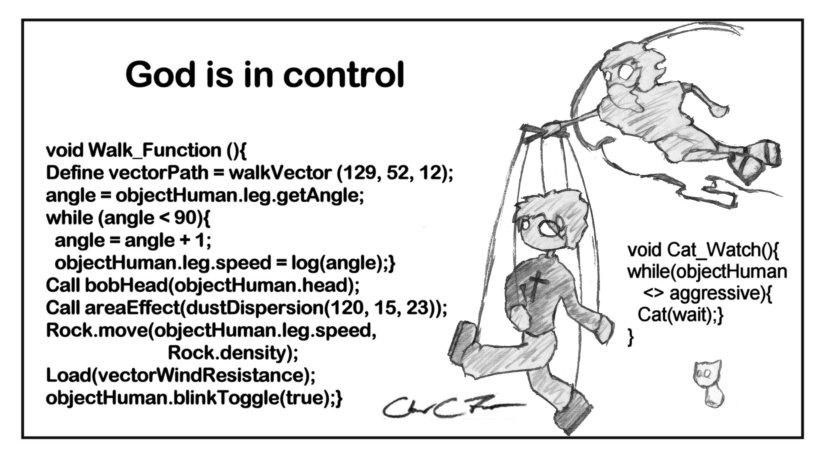
God is in control

Here is a little cartoon I drew in college.

Posted in Calvinism, Humor, Theology, Vanity | Leave a comment

facts are stubborn things

The one great thing about Obamacare is that it is a beautiful illustration of economics in action. With most things in this world, it is very hard to discern cause and effect from just what is visible. I am reminded of William Easterly’s The Elusive Quest for Growth in which he recounts an instance in which he correctly predicted a decrease in growth of “the Gang of Four”, not based on policies, but because that was where growth was highest and was thus bound to decrease.

But Obamacare is a different animal. It is a wide-sweeping piece of legislation that affects all health care in an economy of 300 million people. It institutes a host of policies that economists have claimed as being harmful: mandatory coverage, limits on deducible, no limits on preexisting conditions. In fact, Obamacare takes the “insurance” out of “health insurance”. The effects of Obamacare were predictable and widely predicted.

Regular insurance works by people who are subject to risk paying a fraction of the price of covering loses incurred during an unpredictable event. I will use “flooding” as an example. Not everyone will have their houses flooded. But although the risk is small, the damages can be massive. People might be willing to pay a sum of money per month (the premium) to cover their house. This premium will be priced based on risk. Their house may or may not flood, but their premium is pooled and will cover any house that does flood in the same insurance pool. Insurance only works if enough people are willing to pay a slight cost to cover the risk of an event, the total sum of which covers the people that actually have to pay the full cost of that event when it occurs. The premium must also cover administrative costs.

There is no such thing as insurance for a predictable event. If a house flooded every year, either no insurance would be offered or the cost to the individual over the course of a year would necessarily be greater than the yearly cost of the damage. When Obamacare mandates age triggered screenings, birth control, or regular check-ups, this cost must necessarily be born directly by the contributors. They are no longer paying for risk, but paying for certainty. In other words, they are handing their money to a third party to hand to a doctor. They are procuring a paying agent, not insurance.

If insurance prices are not allowed to be priced based on risk, all incentives to minimize costs fly directly out the window. No one would have incentives to use their own time and money to prevent flooding. They would also issue claims over the most minor water damage because there would be no individual repercussions for issuing such claims. In other words, without price signaling, no one is incentivized to economize and everyone is incentivized to consume. Naturally, as the costs rise due to overconsumption, people with low risk will begin to see that the costs of insurance do not cover the risk of the event. They will drop out of the market.

Politicians have invented a mechanism to force consumers to still buy insurance and cover exuberant consumption. In Obamacare, this is called the individual mandate. People who drop out of the insurance pool are fined. But if the fine is too low comparative to the premium cost, people will opt for the fine over insurance.

Obamacare incentivizes taking this fine because Obamacare mandates that coverage must cover pre-existing conditions. This means that the yearly pool not only has to cover the chance that individuals in the pool have a disaster, it also has to cover people who have not even contributed. These people have paid nothing but show up only after their house floods. This cost must be priced into the premiums paid by the prior insurance contributors. This cost will not be negligible, because all these new entrants will be entering the insurance pool with guaranteed and massive costs. There is no good way for an insurance company to predict what costs they have to price in existing insurance in order to cover these unexpected guaranteed costs. Expect health care firms to compete over how unappealing they can be to new entrants, as every company will want another company to take the new guaranteed costs.

The only real way that Obamacare could reduce premiums is if it coerced enough people to pay more into insurance plans than they ever expect to use. This would be like people who live in Death Valley, California being forced to pay for flood insurance. They will pay into the system, but never withdraw. But with Obamacare there are subsidies for low income individuals (who tend to be healthier). Those meant to support the system become a drain.

The entire Obamacare system is an economics nightmare designed to skyrocket costs. Economics predicts the already apparent effects of Obamacare. Health care plans are being cancelled en masse, premiums are skyrocketing, and health insurers are scaling back coverage. Obamacare is teaching America basic economics. This will also serve as an enduring example of free market predictions being undeniably true, contrasted to the hubris of the statists. Facts are stubborn things.

Posted in Econ 101, Economics, Goverment, Price Controls, prices | 3 Comments

the terrible ending of the bet

The Bet is a very informative book by Paul Sabin. Sabin, an environmentalist, has nicely documented the history of the environmentalist doomsday prophets (e.g. Paul Ehrlich) and the prophets of plenty (e.g. Julian Simon). He does this through the events surrounding the famous Ehrlich-Simon bet, a bet in which Simon allowed Ehrlich to pick five commodities and they would track if those resources became more expensive over time or cheaper. Ehrlich was predicting a near apocalypse but failed to win a bet on just a price increase.

The book, written by an environmentalist, details how the prophets of plenty were correct. All the doomsday predictions about population, war, famine, and mass death were all wrong (and spectacularly wrong). Life expectancy, standard of living, and access to food has blossomed along with unprecedented growth in the population. The book also documents how Ehrlich remained unapologetic even after being shown spectacularly wrong. Ehrlich even continued to call his opponents names like “morons” and “idiots”. A careful reader gets a sense that Ehrlich (although intelligent) is extremely delusional.

Julian Simon, demonized his entire life, was correct about his premises. The book does not even show one example of him being wrong. It does criticize him for being too optimistic.

But then the book comes to a conclusion not supported by the entirety of the book: that the truth lies in the middle. Neither Simon or Ehrlich were correct, and they each made contributions. Not since I have read Nonzero have I encountered a book with a conclusion more alien from the text. Sabin writes:

Despite their respective strengths, both Ehrlich and Simon got carried away in their battle… Their unwillingness to concede anything in their often-vitriolic debate exacerbated critical weaknesses in each of their arguments.

And then the author criticizes those who use the failed wild predictions to ignore other predictions:

Julian Simon and other critics of environmentalism, however, have taken far too much comfort from extravagant and flawed predictions of scarcity and doom… His optimism paradoxically inhibited the kinds of problem-solving market and technological innovations that produced the improvements that he celebrated.

The author, it seems, has failed to read his own book. There is good reason to ignore and mock the doomsday prophets. And if he doesn’t think so, the proper response is “do you want to bet”? From Bryan Caplan:

At the same time, I don’t see the climate change bet as very interesting. Why not bet on world per-capita GDP and life expectancy in 2057 (or 2107) conditional on doing nothing new about carbon emissions. Does anyone want to bet $100 at even odds that per-capita GDP in fifty years won’t be at least 50% higher, and life expectancy 3 years longer, even if we take the do-nothing-more path?

Is the do-nothing-more path too improbable, or too hard to define? OK, then why not just make the unconditional bet that in 2057, per-capita world GDP will be at least 100% higher, and life expectancy 5 years longer? $100 at even odds? If that bet isn’t attractive too you, it doesn’t mean that doing something about climate change isn’t worthwhile, but it does mean that, all things considered, the future is pretty bright.

Posted in Economics, History, Science, Standard of Living | 1 Comment

God begrudgingly appoints a king

In Exodus 18, Jethro sees that Moses has too much duties for one person. God had appointed Moses as head judge and it was too burdensome. Instead, Jethro devises a system of judges. All disputes in the land were handled by a hierarchy of judges. Israel is ruled this way until 1 Samuel 8, in which the people declare that they would rather have a king than judges. God takes this as the people rejecting God, and warns them about how evil a king will be. The people still want a king, so God begrudgingly allows Samuel to appoint Saul. Here is the text:

1Sa 8:4 Then all the elders of Israel gathered themselves together, and came to Samuel unto Ramah,
1Sa 8:5 And said unto him, Behold, thou art old, and thy sons walk not in thy ways: now make us a king to judge us like all the nations.
1Sa 8:6 But the thing displeased Samuel, when they said, Give us a king to judge us. And Samuel prayed unto the LORD.
1Sa 8:7 And the LORD said unto Samuel, Hearken unto the voice of the people in all that they say unto thee: for they have not rejected thee, but they have rejected me, that I should not reign over them.
1Sa 8:8 According to all the works which they have done since the day that I brought them up out of Egypt even unto this day, wherewith they have forsaken me, and served other gods, so do they also unto thee.

The representatives of the people are asking the prophet of God for a king (like all other nations). This displeases Samuel, but he brings the question to God. God proclaims that the request for a king is rejection of God (rejecting that God should “reign over them”). He gives Samuel the “it’s not you, it’s me” speech. God then tells Samuel to explain to the people what the end result will be:

1Sa 8:9 Now therefore hearken unto their voice: howbeit yet protest solemnly unto them, and shew them the manner of the king that shall reign over them.
1Sa 8:10 And Samuel told all the words of the LORD unto the people that asked of him a king.

Here are the list of harms that God identified:

1Sa 8:11 And he said, This will be the manner of the king that shall reign over you: He will take your sons, and appoint them for himself, for his chariots, and to be his horsemen; and some shall run before his chariots.
1Sa 8:12 And he will appoint him captains over thousands, and captains over fifties; and will set them to ear his ground, and to reap his harvest, and to make his instruments of war, and instruments of his chariots.
1Sa 8:13 And he will take your daughters to be confectionaries, and to be cooks, and to be bakers.
1Sa 8:14 And he will take your fields, and your vineyards, and your oliveyards, even the best of them, and give them to his servants.
1Sa 8:15 And he will take the tenth of your seed, and of your vineyards, and give to his officers, and to his servants.
1Sa 8:16 And he will take your menservants, and your maidservants, and your goodliest young men, and your asses, and put them to his work.
1Sa 8:17 He will take the tenth of your sheep: and ye shall be his servants.
1Sa 8:18 And ye shall cry out in that day because of your king which ye shall have chosen you; and the LORD will not hear you in that day.

God ends this list with a warning. Because the people have rejected God by asking for a king (along with other actions) then God will reject them. But the people do not care and still demand a king:

1Sa 8:19 Nevertheless the people refused to obey the voice of Samuel; and they said, Nay; but we will have a king over us;
1Sa 8:20 That we also may be like all the nations; and that our king may judge us, and go out before us, and fight our battles.

Something interesting happens, Samuel returns to God and repeats to God what the people told Samuel. God then tells Samuel to appoint a king:

1Sa 8:21 And Samuel heard all the words of the people, and he rehearsed them in the ears of the LORD.
1Sa 8:22 And the LORD said to Samuel, Hearken unto their voice, and make them a king. And Samuel said unto the men of Israel, Go ye every man unto his city.

As a side note, later on God repents of having made Saul king. God allowed the people to supplant the governmental system in order to gain a king, God appoints that king, and that king fails God.

Posted in Bible, Calvinism, God, History, Jewish History, Open Theism, Theology | Leave a comment

God responds to rejection – genesis 6

Genesis 6 tells the story of a global flood in the days of Noah. TalkOrigins.org (an anti-Christian website) has graced us by providing a fairly thorough list of flood stories from around the world. This was a real event. But the reason it happened was that God saw how wicked man became, and God repented of making mankind:

Gen 6:5 And GOD saw that the wickedness of man was great in the earth, and that every imagination of the thoughts of his heart was only evil continually.
Gen 6:6 And it repented the LORD that he had made man on the earth, and it grieved him at his heart.

Just so that the reader cannot misinterpret what is being communicated, the text then reinforces this concept with a quote from God:

Gen 6:7 And the LORD said, I will destroy man whom I have created from the face of the earth; both man, and beast, and the creeping thing, and the fowls of the air; for it repenteth me that I have made them.

The situation is as follows:

God made man on earth (for a love relationship).
Mankind flourishes (Gen 6:1).
Mankind becomes so evil that it “repents” God (literally like a deep exasperated sigh, as someone regretting something).
Then God decides to kill everything “both man, and beast, and the creeping thing, and the fowls of the air”.

Genesis 6 is describing a global reset. God regretted that He made man (this means if He were to do it again He would not have), and then God shows how serious He is about his regret (God undoes the thing He regrets doing). God destroys all living things!

This passage is not conducive to Calvinism. It shows deep, prolonged emotion in God based on seeing current events unfold. It shows God reacting to His knowledge in real time. If God had known man would become this wicked, there would not be a regret in God. Why would God do something He knows He would regret? Before creation, He was not even being persuaded by a third party (as when Moses convinced God to spare Israel). The wickedness would be part of God’s plan or it would not faze God. But the text reveals a deep hurt in God, emphasized by drastic action.

Because God is righteous He spares one family because of the righteousness of one man (the text never calls Noah’s sons righteous). After the global reset, God has another change of heart. He had destroyed the world because it was evil but then resolves to allow the world to be evil because people are naturally evil:

Gen 8:21 And the LORD smelled a sweet savour; and the LORD said in his heart, I will not again curse the ground any more for man’s sake; for the imagination of man’s heart is evil from his youth; neither will I again smite any more every thing living, as I have done.

God destroyed the world because the “wickedness of man was great in the earth”, but afterwards decides to never again destroy it “for man’s sake” because “the imagination of man’s heart is evil from his youth”. Some atheists call this a contradiction. I call it giving up hope in humanity. This directly results in God trying to then work though individuals instead of humanity in general.

Posted in Bible, Calvinism, Dispensationalism, God, Omniscience, Open Theism, Theology | 9 Comments

augustine denied that God could speak

The Calvinist is always fixated on their Platonic ideas about God. As such, any time the Bible makes simple pronouncements, those have to be reinterpreted in light of the Platonic understanding of God. When the Bible says that God speaks, this violates God’s timelessness and His immutability (along with a host of other Greek attributes). After all, a God outside of time could not enter time (because to the Platonist that would make God susceptible to change). Entering time and speaking successive words also is a clear cut sign that something is not immutable. Augustine handles this by saying that when the Bible mentions God’s speaking, it is a creature in time uttering the words:

But how didst thou speak? Was it in the same manner in which the voice came from the cloud saying, “This is my beloved Son”? For that voice sounded forth and died away; it began and ended. The syllables sounded and passed away, the second after the first, the third after the second, and thence in order, till the very last after all the rest; and silence after the last. From this it is clear and plain that it was the action of a creature, itself in time, which sounded that voice, obeying thy eternal will. And what these words were which were formed at that time the outer ear conveyed to the conscious mind, whose inner ear lay attentively open to thy eternal Word. But it compared those words which sounded in time with thy eternal word sounding in silence and said: “This is different; quite different! These words are far below me; they are not even real, for they fly away and pass, but the Word of my God remains above me forever.”

This is the kind of fallback position that Calvinists must assume when confronted with the clear text of the Bible. If the text says “God said this or that” then it means “an unmentioned parrot creature said this or that”.

Posted in Augustine, Bible, Calvinism, Figures of Speech, God, Open Theism, Theology | 2 Comments

plato on the purpose of the mystery cults

The historians who study the issue tend to agree that Plato was initiated into the Mystery Cults of his time. Some say that he was singled out for revealing secret information about their teachings, although I have not found anything substantive on the issue.

In Phaedo, Plato gives a reader a sense of the ultimate purpose of the Mystery Cults. Remember, the Mystery Cults had a sweeping influence on the early Christian Church. Much of the Mystery Cult religions were intertwined with Platonism. Plato writes:

And I conceive that the founders of the mysteries had a real meaning and were not mere triflers when they intimated in a figure long ago that he who passes unsanctified and uninitiated into the world below will live in a slough, but that he who arrives there after initiation and purification will dwell with the gods. For “many,” as they say in the mysteries, “are the thyrsus bearers, but few are the mystics,”-meaning, as I interpret the words, the true philosophers.

The purpose of the Mystery Cults was to achieve enlightenment, in order to pass onto a higher state of being after death. Plato continues:

But he who is a philosopher or lover of learning, and is entirely pure at departing, is alone permitted to reach the gods. And this is the reason, Simmias and Cebes, why the true votaries of philosophy abstain from all fleshly lusts, and endure and refuse to give themselves up to them-not because they fear poverty or the ruin of their families, like the lovers of money, and the world in general; nor like the lovers of power and honor, because they dread the dishonor or disgrace of evil deeds.

Plato, speaking of the mystery cults and philosophers, points to disdain for physical pleasures (asceticism). Purging the physical pleasures helped the mystery cultists achieve purity. It was then they could “reach the gods.”

The lovers of knowledge are conscious that their souls, when philosophy receives them, are simply fastened and glued to their bodies: the soul is only able to view existence through the bars of a prison, and not in her own nature; she is wallowing in the mire of all ignorance; and philosophy, seeing the terrible nature of her confinement, and that the captive through desire is led to conspire in her own captivity (for the lovers of knowledge are aware that this was the original state of the soul… philosophy shows her that this is visible and tangible, but that what she sees in her own nature is intellectual and invisible. And the soul of the true philosopher thinks that she ought not to resist this deliverance, and therefore abstains from pleasures and desires and pains and fears, as far as she is able; reflecting that when a man has great joys or sorrows or fears or desires he suffers from them, not the sort of evil which might be anticipated-as, for example, the loss of his health or property, which he has sacrificed to his lusts-but he has suffered an evil greater far, which is the greatest and worst of all evils, and one of which he never thinks.

The end state, of the Mystery Religions was one in which the philosopher understood that the soul and body are separate beings, that the soul would return to an intellectual and invisible state, and that the physical, material world should be shunned. The Mystery Religions were an early form of Neoplatonism.

Posted in Greek History, History, Mystery Cults, Plato | 1 Comment

fun with the handicapped

Penn and Teller show some correct mistrust of the Americans with Disability Act.

HT: Greg Perry

Also see:

why I oppose handicap parking spaces
Disabling America
the high cost of the ADA

Posted in Goverment, videos | Leave a comment